
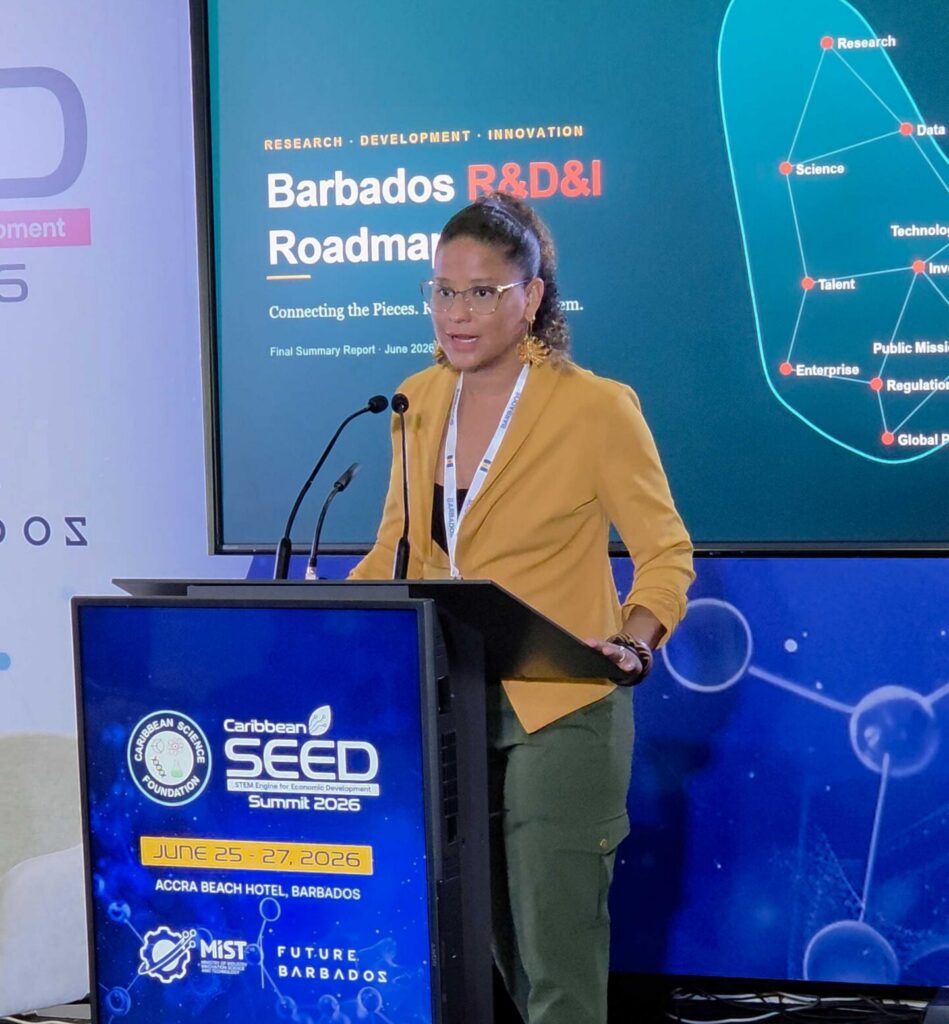
Future Barbados, an independent public policy and research organisation that promotes long‑term economic resilience and sustainable development, has released a draft five‑year plan proposing $65m in targeted investment to shift the island from short‑term crisis responses to longer‑term resilience through science, technology and research and development.
A strategic five‑year investment plan — dubbed the Barbados Research and Development and Innovation (RDI) Roadmap — is valued at US$32.5m ($65m). Commissioned over a year ago with technical assistance from the Inter‑American Development Bank (IDB), the 75‑page blueprint is intended to formalise, finance and accelerate the island’s commercial science and technology activities.
Tamaisha Eytle Harvey, Director of Future Barbados, declared that investing heavily in innovation is no longer a luxury but an absolute necessity for small island developing states (SIDS).
Reflecting on the pace of global advancements, Eytle Harvey noted how everyday hurdles highlight systemic infrastructure gaps. She described her morning journey to the venue, which involved navigating around unmapped municipal service vehicles, dodging road hazards, and managing digital connectivity demands from the back seat.
“Technology is moving faster than ever before. There is a need for advancements in AI, biotechnologies, everything — every part of our lives depends on technology these days,” Eytle Harvey said. “If we don’t give fiscal space, if we don’t give intellectual space to designing the long‑term, more sustainable solutions, we will always be in crisis mode.”
She argued that decades of relying solely on tertiary institutions to handle research has limited national development. She pushed for a more dynamic approach that views innovation as a core economic engine rather than a purely academic pursuit.
“The model that we’ve been using for many decades has put responsibility for this only on one set of people. It was only a university who’s in charge of solving the problems,” she observed. “Well, here we are where all of the problems are our problems. This is a national development entity and engine to be able to spend time, spend effort and resources in a strategic way on solution development. And that means failures, that means experimentation, that means imagination.”
Despite historical underinvestment — where private research spending across regional firms hovers at just 5.4 per cent — Barbados has steadily climbed global indices, currently ranking 58th in frontier technology readiness.
Eytle Harvey highlighted the island’s strong international reputation, robust governance, political stability and highly educated workforce. She also pointed out the rapid emergence of key institutions over the last eight years. Agencies like the Ministry of Innovation, Industry, Science and Technology (MIIST), GovTech Barbados, Barbados Pharmaceutical Inc., and the ROAD (Reclaiming Our Atlantic Destiny) archive digitisation project have all added momentum to this shift.
But significant bottlenecks remain, such as a small domestic market of 300 000 people, severe data fragmentation, capital flight and a lack of connective tissue to move ideas from the lab to the marketplace.
“Currently, we rank very highly — I hope you read my sarcasm strongly — on any investment strategy around R&D (research and development),” Eytle Harvey remarked.
“Having credibility internationally with the development banks, with investors, does make a strength and robustness in our governance systems that makes it easier to build a system like this. But with all of these assets, it’s like, okay, we have the ingredients in the kitchen, but we’re really missing some things to really make this robust.”
She pointed out that critical data remains trapped in static formats. “Data is currently static, hidden in PDF drives and Excel files on different people’s computers. It lives as an individual’s data versus a centralised space.”
To bridge these gaps, the roadmap proposes a targeted funding structure divided across three key pillars over the next five years. The first pillar focuses on direct financial support, earmarking US$14.5 ($29m) for University of the West Indies doctoral programmes, alongside dedicated funding to guide projects through the commercial ‘valley of death’.
Specific research areas include sargassum weed valorisation, public health solutions for non‑communicable diseases (NCDs), and tech cluster matching grants.
The second pillar addresses indirect financial support, allocating US$8m ($16m) to educate businesses on utilising existing R&D and digital transformation tax credits, with new innovation voucher schemes to stimulate private‑sector research.
The final pillar dedicates US$10m ($20m) to infrastructure and coordination, which will fund physical lab upgrades, open‑data architectures, and a single‑entry hub to streamline incoming ideas, as well as an advisory board to ensure data governance and policy accountability.
Eytle Harvey said: “This is really a $100m exercise, but we have to start somewhere and $32.5m looks a little more achievable.
“The only way we’re going to get innovation to happen in the firms and the private sector is to encourage this, not just by educational workshops, but by providing them with the financing and the spaces to do it.”
She added that physical infrastructure must match global expectations. “We can’t be inviting people to Barbados to do R&D, and our labs are from 1965. It’s just a reality. It’s really hard to do the research when your things are stuck on the port for six weeks.”
Regarding data access, she emphasised the economic potential of collaborative platforms. “We need to create this open data infrastructure that is secure, that is safe, that is sovereign, but it’s accessible and can be at one point monetised. Because ten per cent of zero, which is currently where the data is, is zero.”
The RDI Roadmap targets six priority fields poised for high economic returns: pharmaceutical manufacturing, the blue economy, life sciences, renewable energy, digital technologies, and food security. To fund these initiatives, the framework calls for a combined financing model utilising US$13m ($26m) in direct government funding, flexible risk‑mitigation capital from international development partners, and active co‑investment from local and diaspora businesses.
Acknowledging that the roadmap is a living, evolving draft, Eytle Harvey cautioned that regional planning must remain agile given the rapid pace of technological disruption.
“Barbados does not intend to be the best and the greatest at anything. It intends to be the robust space where we can pilot and model for the rest of the world, showing that from small island spaces, things can happen with proper political will, the necessary investments in specific places, and talent.
“It does not make sense in this region at all to plan anything beyond a five‑year cycle because in two years we’re gonna have to reevaluate what this is and readjust it based on what the global situation is. But if we’re not doing multiple things at the same time, we’re not going to get to those results.”
Founded to fill gaps between government, academia and the private sector, Future Barbados conducts policy research, convenes public consultations and pilots programmes that translate ideas into practical projects. The organisation advises on strategic investments, mobilises technical partners and helps channel international funding into local initiatives, with a focus on innovation, governance, and inclusive growth.
(RR)
The post $65m roadmap to jump‑start research, development, innovation appeared first on Barbados Today.