
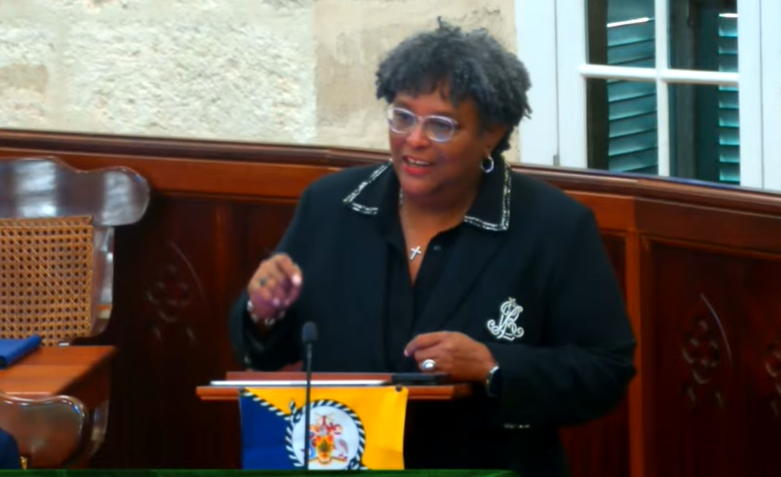
Prime Minister Mia Mottley wasted no time in making good on her post-election vow to stop Members of Parliament from switching party allegiance without triggering a by-election, tabling a constitutional amendment that would force floor-crossing MPs to give up their seats.
The amendment would result in the Constitution of Barbados recognising political parties for the first time. Since independence in 1966, the constitution provided for voters to choose individual MPs who form the government on the basis of commanding a majority in the House of Assembly.
The second reading of the Constitution (Amendment) Bill, marks the first major legislative push of the new parliamentary session. Mottley moved the bill as a “mandate integrity” measure.
The bill, described by the Prime Minister as a “guardrail for democracy”, would automatically vacate the seat of any MP who resigns from, is expelled by, or “crosses the floor” away from the political party under which they were elected.
Suggesting that reality trumped the constitutional convention, Mottley argued that candidates in Barbados do not run as individuals but as representatives of a political party’s philosophy, manifesto, and “social contract” with the people.
“At its core, it says that if the political alignment under which you were elected changes fundamentally, the democratic response is to go back to the voter,” the prime minister said. “This is not a tool of convenience. It is a serious constitutional mechanism.”
Under the constitutional amendment, the process of vacating the seat of a would-be floor crosser would be triggered by a formal notice from the Leader of Government Business or the Leader of Opposition Business to the Speaker.
Mottley was careful to distinguish between political defection and freedom of conscience. She insisted that the constitution as amended would neither silence criticism of the Cabinet or the party, prevent an MP from voting against their party whip on “matters of conscience or religion” or stop an MP from running again in a by-election to seek a fresh mandate as an independent or as a member of a new party.
She stressed that crossing the floor in many democracies was “nothing new”.
Mottley said: “The notion of crossing political, crossing the floor is well known across the world. And for those who say that it needs to be defined, I simply remind them that statutory interpretation very often requires that we give the words their ordinary meaning. If I go to Africa and I say ‘cross the floor’, they know what I’m talking about in Ghana.”
The prime minister ended by saying that Barbados must have systems in place to ensure the rights of voters are protected.
“We need guardrails in institutions. This is all that it seeks to do, but with the requisite checks and balances to ensure that we do not compromise the individual rights of the person. But at the same time, we protect the integrity of the voter who has made the choice, and we protect the institutions as well, upon which the whole platform of political engagement has been based in the post-1937 rebellion of Barbados.”
The post Amendment would give parties constitutional recognition appeared first on Barbados Today.