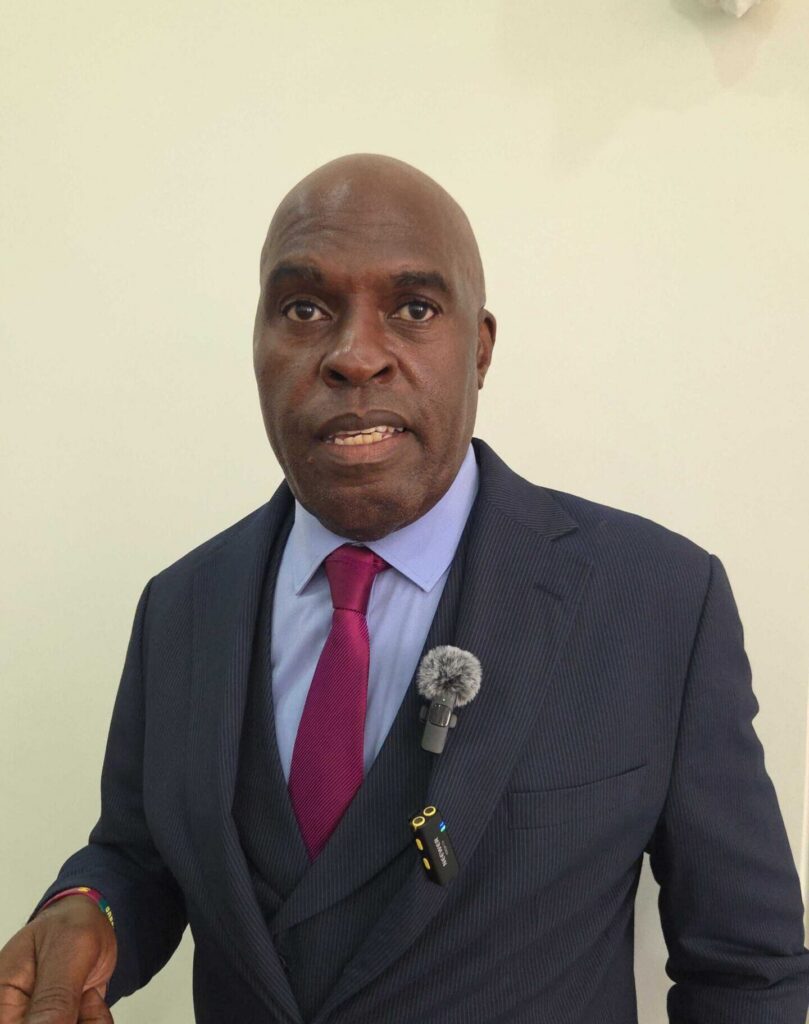

Economist and adviser Marla Dukharan has flagged as “a major vulnerability” the fact that a number of Caribbean countries’ increased foreign reserves are the result of increased external borrowing.
In her recent Caribbean Economic Outlook 2026, she named Barbados among those countries with “foreign reserves that are 100 per cent borrowed”.
She noted that her homeland Trinidad and Tobago had “the only reserve chart in the whole Caribbean that is in secular decline for many, many years”.
Dukharan examined the external position of Caribbean economies, meaning “ the strength of your foreign exchange reserves, the strength of your currencies”.
She saw this as “a major vulnerability across the region, affecting almost every country, and we must take a hard look at our very economic structures to address this problem, where most of us have foreign reserves that are 100 per cent borrowed”.
The economist said this “means they have to be repaid with interest, and that means they are not really [and] truly reserves, and most of us have printed too much money in local currency, so that what our reserves can defend, in terms of defending our currency, is defending our exchange rates, and it puts pressure on those very reserves to defend our currency”.
“And all this speaks to structural problems where we spend on imports more than we can afford to, so we have to borrow to pay for these imports, which is insane,” she added.
In the recent Central Bank of Barbados’ review of the economy in 2025, Governor Dr. The Most Honourable Kevin Greenidge reported that International reserves totalled BDS$3 billion, approximately US$1.5 billion, at the end of December
“A wider current account deficit reduced international reserves and lowered import cover during the year,” he said.
“International reserves decreased to BDS$3 billion at end-December 2025, down BDS$140.9 million from end-December 2024, as higher imports of goods, increased dividend outflows, and a decline in current transfer credits outweighed gains in travel receipts and other inflows. The import cover measured 27.4 weeks at end of 2025, down from 30.1 weeks at end 2024.”
Focusing on Barbados in her analysis, Dukharan said: “Barbados has foreign debt of almost US$3 billion and reserves of about US$1.4 billion, which is about six months of imports. It means that their reserves are more than 100 per cent borrowed.
“And while the exchange rate is two to one, the ratio of the money supply in Barbados, dollars to reserves in US dollars, which ideally should resemble a two to one ratio, like the exchange rate, it’s actually three to one in Barbados.
“By the way, this is not terrible, it used to be much higher. I remember it was something like 12 [to one] some years ago. So doing a lot better in Barbados, so we have seen improvement, but we still have reserves that are more than 100 per cent borrowed.”
On the The Bahamas, she said that country “has a level of foreign debt that’s almost US$6 billion, and it has usable reserves of about US$1.3 billion and this means that reserves are more than 100 per cent borrowed”.
“And while the exchange rate is one to one, one Bahamas dollar to one US dollar, the ratio of the money supply in Bahamian dollars to the level of reserves in US dollars, which should really ideally resemble one-to-one, is actually 7.4 to one,” Dukharan stated.
“And import cover is well below the precautionary three months benchmark at 2.2 months in Bahamas. So Bahamas has some significant external weakness to deal with. Bahamas and Barbados, you will notice that reserve levels are increasing, however, which means we’re borrowing more and putting it in reserves.”
Dukharan said that Guyana, with foreign debt of almost US$3 billion and reserves of US$1.3 billion, while having “quite similar numbers to Barbados”, had other challenges linked to its booming oil economy.
She explained: “While the exchange rate in Guyana is over 200 Guyanese dollars to one US dollar, the ratio of money supply in in Guyana dollars to reserves in US dollars, which should resemble 200 or so to one, it’s actually 657 to one, and they have reserves of less than one month of import cover, which is very low.
“And you might think, hang on, isn’t Guyana the world’s most recent oil exporting nation, and they’re, I guess, facing an oil boom. Yes, all of that is true but . . . everybody is anticipating a boom, so what they do is they import things.
“They build buildings and hotels and apartments, and they buy things to resell, including property, and a lot of what they’re doing and buying, and the economic activity is in anticipation of a boom, in anticipation of asset prices going up so that you can sell later at a higher price.”
She added: “And all of this puts strain on the US dollars available in Guyana, and so it really makes the situation quite delicate for Guyana in terms of foreign currency, less than about a month of import cover.
“It’s quite alarming, but we know they have oil in the ground, we know that they’re exporting the oil, and we know that they have US dollars coming in volumes that Guyana has probably never seen, but they’re also spending it at levels that Guyana has probably never seen.”
Dukharan said Jamaica “has foreign debt of about US$13.6 billion and reserves of US$6.3 billion, meaning that reserves are more than 100 per cent borrowed, but import cover is over eight months and . . . there’s an upward trend of reserves in Jamaica”.
“And while the exchange rate is about 156 Jamaican dollars to one US dollar, the ratio of the money supply in Jamaican dollars to reserves in US dollars, which should ideally resemble a 156 to one ratio, it’s actually about 191 to one,” she reported.
“So not terrible in terms of some of the figures we’ve seen, most notably Guyana, . . ., but it’s something that we need to pay attention to, especially with the vulnerability that Jamaica is experiencing based on natural disasters.”
Trinidad and Tobago was in a different position to other Caribbean countries, with its foreign reserves falling for a number of years, Dukharan pointed out.
She recalled that this challenge “started somewhere around 2013, if my memory serves me correct”.
“Trinidad and Tobago has foreign debt of about US$5.5 billion and reserves roughly the same – US$5.4 billion, so just slightly over 100 per cent borrowed,” she said.
“We have about 6.3 months of import cover, which is very healthy, and while the exchange rate is about $6.80 TT to one, US, and you would expect the ratio of local currency to US dollars in reserve to be around 6.8 to one, like the exchange rate, it’s really about 19 to one, which indicates how much pressure there is on our exchange rate in Trinidad and Tobago, how much pressure is on our reserves [which are] going down steadily.”
The Dominican Republic, with foreign debt of about US$45.5 billion, and reserves of US$14.7 billion, and Suriname, with foreign debt of about US$4 billion and reserves of about US$1.3 billion, were two other countries she said had foreign reserves are more than 100 per cent borrowed.
Dukharan said that the Caribbean overall was “really in a position where we’re trying to hold on to reserves in US dollars”.
“We’re trying to save us dollars because this is what we need when there is a crisis. We need it every day for imports, but we need it more so when there’s a crisis, but we’re borrowing a lot,” she observed.
“And so the scenario that this whole situation is of not just geopolitics and uncertainty, but also geo economics and also the climate crisis is creating a kind of vulnerability that where I think it’s becoming more acute with respect to the amount of reserves that’s borrowed that we have to pay back with interest.”
The post Foreign reserves ‘based on borrowing’ appeared first on nationnews.com.