Caribbean governments and training institutions are being pressed to deepen collaboration on skills development, as regional officials warned that the future competitiveness of the region depends on how well it adapts to rapid global and technological change.
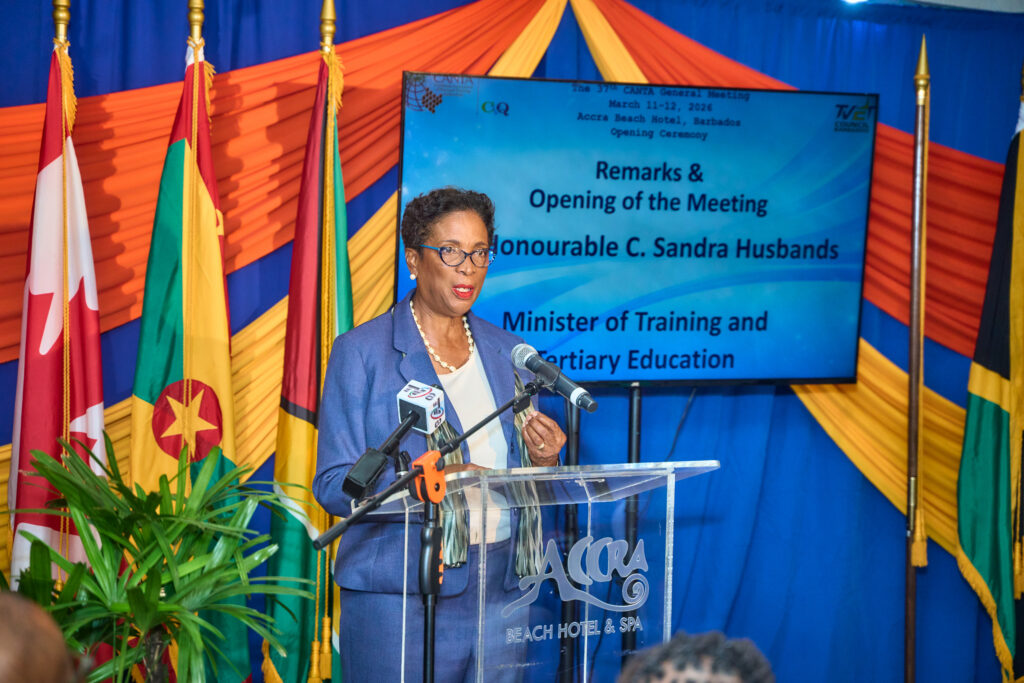
The call came during the opening ceremony of the 37th general meeting of the Caribbean Association of National Training Authorities (CANTA) at the Accra Beach Hotel and Resort, where regional Technical and Vocational Education and Training (TVET) leaders gathered to discuss strategies for strengthening workforce development across the Caribbean.
The theme for this year’s meeting is “Collaboration Through TVET: Empowering the Caribbean Workforce, Strengthening Our Future”.
Minister of Training and Tertiary Education Sandra Husbands challenged regional stakeholders to rethink how the Caribbean prepares its people for emerging economic realities.
“This year’s meeting is convened at a time when the Caribbean is being called upon to think and act more strategically regarding its people, skills and collective resilience,” Husbands said.
She noted that the region is currently navigating major transitions, including economic shifts, rapid technological change, labour mobility and climate‑related pressures.
“In this context, working together is no longer optional, it is absolutely essential,” she stressed.
Husbands pointed out that while regional leaders within CARICOM have already agreed on many of the policies needed to strengthen regional development, the challenge now lies in implementing those decisions.
“The beauty of CARICOM is that the heads of government already agree about what it is we need to do and how it is we need to move,” she said. “What is critical is that the CARICOM organs now give life to those decisions.”
The minister emphasised that the Caribbean’s greatest asset is its people and that countries must focus on reskilling and upskilling their populations to remain globally competitive.
“Our region is not wealthy but our region has people – well educated, intelligent – and we need to leverage those resources in order to help us move our countries forward,” she said.
Husbands added that with countries worldwide restructuring how they train their populations, the Caribbean now has an opportunity to reposition itself.
“Given the fact that the entire world is now repositioning in terms of training their population for a new reality, we now have the opportunity to reset what we are doing and move to the front of the pack,” she said.
She urged delegates attending the meeting to move beyond discussion and produce tangible outcomes that strengthen regional cooperation.
“When you walk away, it is important that we walk away with concrete plans and initiatives and ways of working together,” Husbands said. “Not every island running to do their own implementation, but how can we leverage our togetherness to come up with joint implementation plans so that our resources spread further and we achieve more.”
Chair of CANTA and CEO of the St Kitts and Nevis TVET Council, Dr Kertney Thompson, also underscored the importance of regional cooperation in addressing shared global challenges.
He said the significance of CANTA’s work is becoming increasingly clear as the world undergoes major geopolitical and economic shifts.
“The world today is experiencing profound shifts. Supply chains are being reconfigured, technological changes are accelerating at an unprecedented pace, and climate change continues to threaten the sustainability of our region,” Thompson said.
Pointing to the devastating impacts of recent hurricanes across the Caribbean, he warned that the region must remain prepared for the growing effects of climate change.
“The theme of this meeting reminds us that collaboration is not optional. It is absolutely essential,” he added.
Thompson emphasised that strengthening the Caribbean workforce will require partnerships across governments, training institutions, industry and regional organisations.
“Empowering our workforce requires partnership… It requires us to break silos and recognise that the challenges we face, such as skill gaps, youth unemployment and technological disruption, are shared challenges that demand a shared and collective effort to find solutions,” he said.
The post ‘Unite on skills training’ to meet global challenges appeared first on Barbados Today.