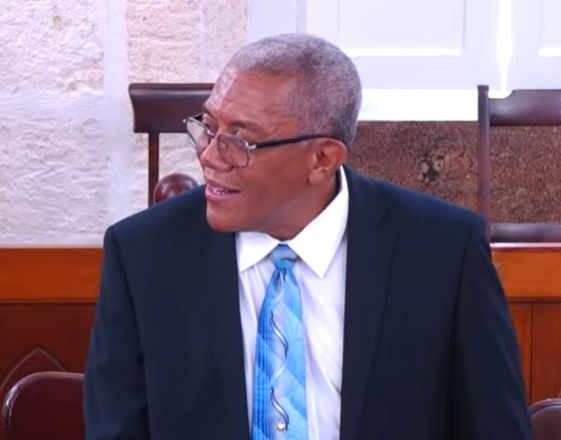
Independent Senator Andrew Niles has urged the government to overhaul the way it prepares and manages the national budget, warning that persistent gaps between requests and actual spending are exposing deep flaws in public finance management.
In the wake of revelations last week that the final bill for CARIFESTA XV had ballooned by nearly 800 per cent to $31.7m from an original request for $4m in the previous financial year, Senator Niles introduced the concepts of “the acts” (the requested budget) and “the grant” (the final authorised amount) as the Appropriations Bill for the new fiscal year came before the Senate on Monday.
He highlighted a persistent and often severe “gap” that he argues has moved beyond mere fiscal maths to impact the “humane” side of public service.
He noted that while the initial budget for the period was set at $5.1bn, it has since been revised upward to $5.89bn, representing a gap of approximately $710m. While supplemental resolutions accounted for $562m of that total, the remaining $148m reflected technical revisions such as depreciation and accrual adjustments.
To digest the 800-page budget document, Senator Niles revealed he utilised artificial intelligence, which summarised the data in under six minutes. This analysis identified 93 line items across 17 ministries that required significant adjustments.
The trained engineer categorised the budget shortfalls into five distinct structural issues.
First is deliberate compression, where known costs are understated to meet fiscal targets. Second are structural deficits in institutions such as the Transport Board, where permanent costs inherently exceed revenue. Third are emergency shocks, such as Hurricane Beryl, which incurred a $17.5m cost. Fourth are informal gaps caused by volatile exchange rates that inflate the cost of overseas missions. Finally, he cited governance failure, where breakdowns in oversight leave the state exposed.
The senator was particularly vocal about the Queen Elizabeth Hospital (QEH), describing it as a “vehicle within this country that is so large… that really dictates the pace of this country”, describing ministries as businesses.
“When you take those salaries out of the equation, and you ask the QEH to run, it doesn’t work,” Senator Niles asserted. “I always ask myself the question, let me take personal monuments out of the conversation. And when you take personal monuments out of the conversation of every single ministry, you get to what I call the ordinary playing field. It becomes exceptionally difficult to run the business. It is absolutely difficult to run the business.”
Looking towards the future, Senator Niles expressed concern over a projected dip in revenue following a temporary windfall. “When revenue falls to 3.8bn as projected, the compression, I am sure, will return,” he warned.
“The compression pressure returns, the gap cycle restarts, and we will be back to, I would like to use the term, the good old days, but we will revert to a scenario whereby we will be looking at the situation as we would have looked at it in recent years.”
The senator concluded by calling for a shift in how the government handles these financial shortfalls. “The supplementary, as you know, is an axe to approve an expenditure that has already been committed, or has already been spent,” he said.
“We need to really be in a position, sir, at the end of the day, when we look at estimates, to find ways and means to actually improve the mechanisms around the estimates so that the conversation can be much more palatable, can be much more of an understanding, can be much more collaborative.”
(RR)
The post Independent senator urges budget reform to fix widening fiscal gaps appeared first on Barbados Today.