
Police have begun a pilot programme of enhanced nightly patrols in key farming districts across southern Barbados, stepping up efforts to curb a surge in crop theft that farmers and officials warn is threatening the island’s agriculture.
Acting Superintendent Anthony Warner, Deputy Divisional Commander for the Southern Division, said the initiative will see officers deployed in mapped zones across Christ Church, St George, St John and St Philip, targeting what he described as Barbados’ farm belt.
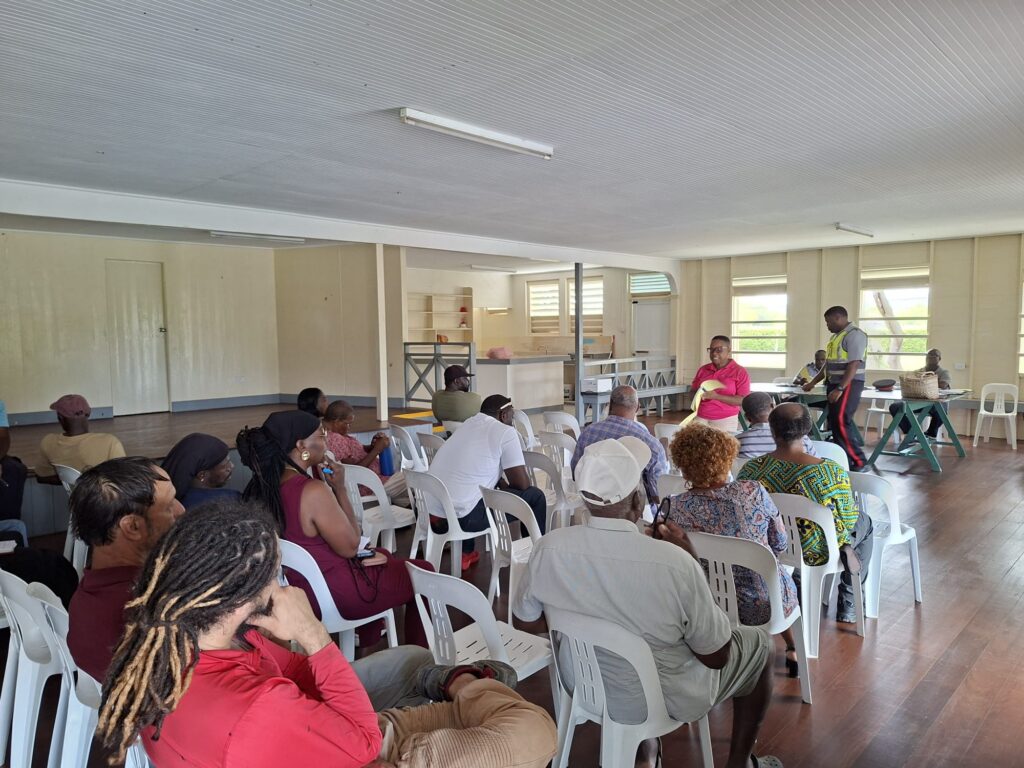
“The meeting was to discuss some of the challenges that they are having in terms of crop thefts and introduce to the farmers a pilot programme that we are seeking to introduce,” Warner said following a session with farmers at King George V Memorial in St Philip on Tuesday.
“Part of that programme is to have the area, the entire Southern Division, particularly the agriculture belt, mapped out in zones where officers will be patrolling.”
He added: “We have a patrol team, and they will be patrolling in those zones to address the challenges that some of the farmers are having.”
The initiative, which is already in its early stages, is aimed at strengthening surveillance and tightening monitoring systems around agricultural production and distribution.
“What we are seeking to achieve… is to strengthen our surveillance and the farm coverage area, and to introduce a structured harvest and notification procedure, established standardised produce identification systems,” Warner said.
Police are also seeking to disrupt what they described as an illegal resale market for stolen produce, placing increased responsibility on both farmers and buyers under existing legislation.
The enforcement push is backed by the Protection of Agricultural Products Act, which requires anyone in possession of commercial quantities of produce to provide proof of ownership, such as a receipt or delivery note, or face prosecution.
“If we encounter a person who has… the agricultural produce in their possession, and they cannot produce… the certificate or the receipt showing that they’ve made the purchase and they take us back to the farmer, that farmer is liable to be charged also along with the purchaser for that product,” the acting superintendent warned.
Farmers were further urged to adopt preventative measures, including installing surveillance cameras and motion detectors, and to use official receipt books issued by the Barbados Agricultural Development and Marketing Corporation (BADMC) to help establish proof of legitimate transactions.
Warner said the success of the pilot will depend heavily on stronger collaboration between law enforcement and stakeholders.
“Most importantly, coming out of this project, we are also seeking to improve the relationship, communication, and the collaboration… to see how much information we can get, how best we can police and service this section of our community, the farmers that we rely on so much for our food security.”
The pilot comes at a time when concerns about praedial larceny have intensified, with farmers and industry officials warning that the problem has evolved beyond small-scale theft into organised criminal activity.
At a recent farmers’ forum, stakeholders described theft as increasingly coordinated, involving the use of vehicles, lookouts and structured resale networks. Some farmers have warned that repeated losses are pushing them to the brink of closing operations.
One farmer said the situation had become “the final straw” after years of dealing with drought, pests and other pressures.
Officials have also cautioned that the continued loss of crops and livestock could have wider implications for national food security if left unchecked.
Recently, in a parliamentary debate, Attorney General Wilfred Abrahams spoke to the seriousness of the issue, warning that organised farm theft poses a growing threat to the sector and requires a coordinated response.
Warner said the current patrol initiative has already shown some early signs of impact, noting: “because we’ve not had many reports, if any, within the past two or three weeks that the project has started.”
But he stressed that the pilot will be continuously assessed and refined.
“What we are hoping for is further buy-in… that we can improve on the pilot projects to see which parts are working, which parts we can improve on, and which parts probably we’ve got to take out and come up with new initiatives for it.”
If successful, the programme is expected to be expanded to other divisions across the island.
The post Police roll out pilot night patrols to combat farm theft in South appeared first on Barbados Today.