Minister of Finance Ryan Straughn has unveiled what he calls a blueprint for a “New Barbados” — a decade‑long strategy to double the national economy through digital transformation, low‑tax growth, and a major regeneration of Bridgetown designed to benefit local communities as much as investors.
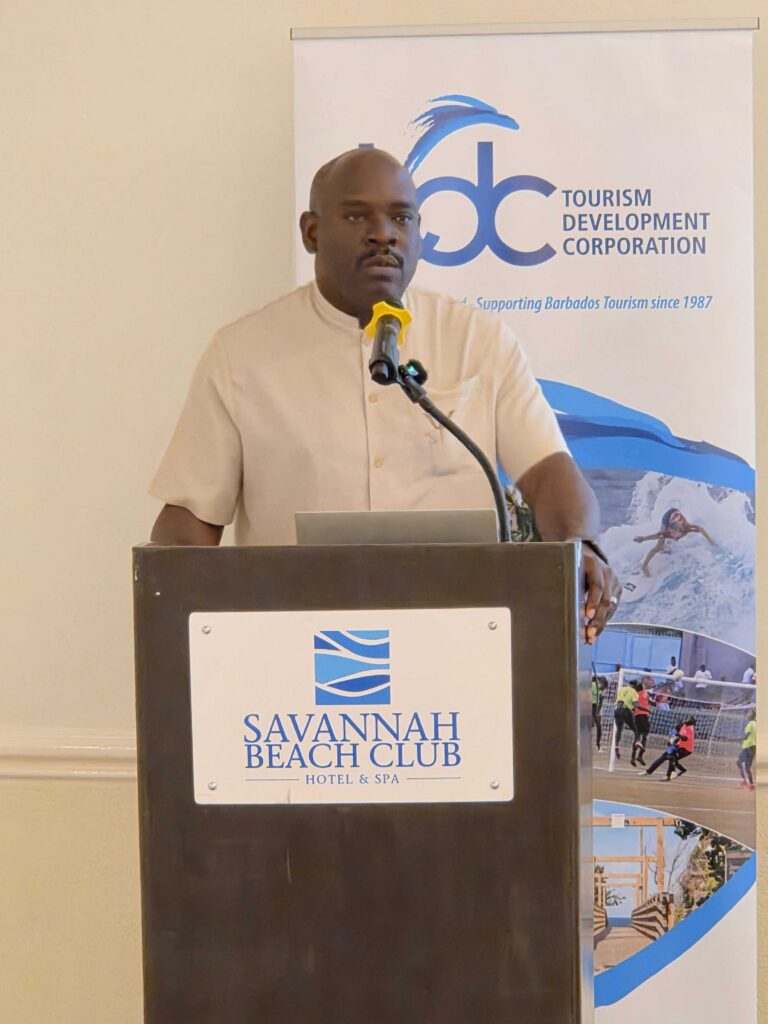
Speaking to the Tourism Development Corporation (TDC) annual general meeting, Straughn emphasised that the nation is in the midst of a transformative moment that demands both speed and confidence in execution.
He signalled a major shift in how the country manages its primary industry, noting that the government is committed to diversifying within the tourism sector to build long‑term resilience and strengthen the linkages between culture, manufacturing and agriculture.
The finance minister was particularly candid regarding the future of Bridgetown, predicting that the capital will take on a completely different character within the next three to five years. This rebirth is expected to be driven by a significant urban regeneration programme designed to ensure that local residents benefit directly from major new hotel developments and commercial investments.
“Bridgetown is going to be a very different city,” the minister said. “We are embarking on a significant urban regeneration exercise such that as major investment coming into the area, people also would benefit from some of that investment.”
He acknowledged that while the country is now witnessing the level of investment that should have occurred two decades ago, the current momentum is crucial for filling the spaces where large‑scale development is planned. This includes a strategic focus on the “planning gains” that these investments bring, ensuring that social returns — such as improved public spaces and community enfranchisement — are realised alongside private profits.
Beyond physical infrastructure, the minister highlighted a rigorous push towards digital sovereignty and administrative efficiency. A new “Smart Finance” platform is set to launch in the coming financial year, aimed at digitising the application process for concessions and removing routine administrative bottlenecks that currently hinder the pace of business.
Straughn noted that the ultimate goal is to eliminate the need for citizens to queue for services, emphasising that time is a valuable commodity that should be spent on high‑value activities rather than bureaucracy.
“I literally want our Barbadians not to have to line up anywhere to pay for anything,” he explained. “Because time is money, and we want people to spend their time doing things that are of value to them rather than routine things.”
He added that if this ethos is adopted across the entire economy, the nation will see small businesses transition into medium enterprises, and medium‑sized firms grow to a regional scale.
Addressing the broader economic landscape, the minister reaffirmed the government’s commitment to a low direct‑tax posture to maintain investor confidence and drive growth. He referred to the “love‑hate relationship” some may have with the tourism sector, reminding stakeholders that “tourism is our business” and must take the lead in delivering economic stability.
To maximise this, he has charged the Barbados Tourism Marketing Inc (BTMI) with a clear mandate to eliminate the traditional “rough” period between April and November. He estimated that achieving 70–80% capacity utilisation during those months using existing infrastructure would have a significant positive impact on the overall economy.
This strategy includes targeting new markets in Latin America, Africa and the Middle East to insulate the island from traditional seasonal dips and geopolitical shocks. “We must insulate the economy from these geopolitical shocks in the shortest possible time,” Straughn insisted.
The minister also spoke to the demographic challenges facing the island, mentioning a new immigration bill intended to attract global talent to complement the local workforce. By using technology to deliver services more efficiently, he believes Barbados can “re‑engineer” its systems to punch above its weight on the global stage.
“We have to almost create a virtual Barbados whereby we have re‑engineered our system such that it gives us the presence as if we are a billion people,” he said. This involves not only attracting new skills but also an aggressive re‑skilling of the existing population to ensure that every Barbadian can participate in the emerging digital and high‑service economy.
Straughn concluded by challenging stakeholders to work hand‑in‑hand with the government, asserting that with the right partnership and focus on standards, the country has the potential to double the size of its economy within the next decade.
He stressed that the government is focused on completing “fiscal repairs” to allow for total concentration on this national vision. “I am confident that we should be able to double the size of this economy within ten years,” he said, “and doubling the size of the economy without necessarily feeling as if the systems are under pressure requires sectors like tourism leading in that respect.”
He gave his assurance that the government will continue to press forward on climate and energy resilience, ensuring that Barbados remains not just a beautiful destination but a stable and premium jurisdiction for global investment.
The post Finance minister sets out “New Barbados” plan for digital economy, urban rebirth appeared first on Barbados Today.