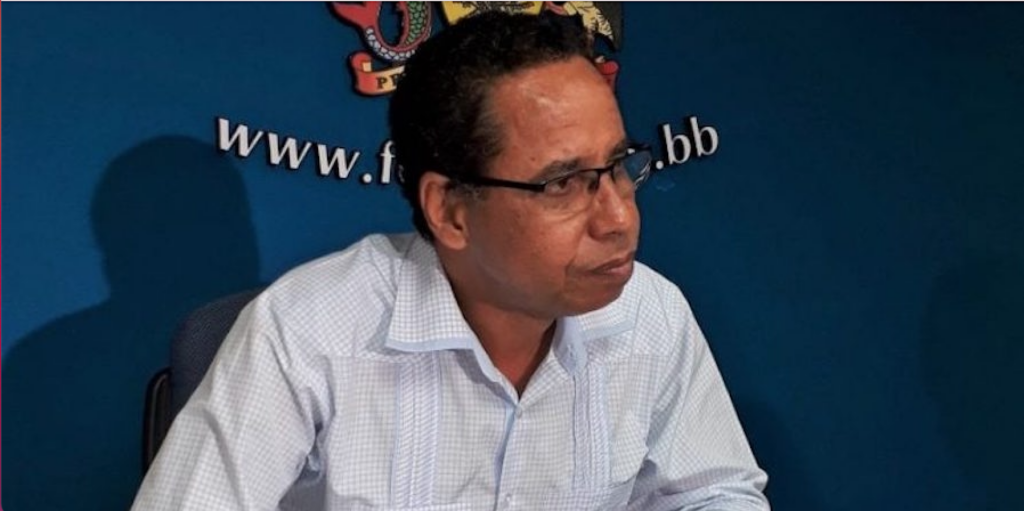
Ambassador to CARICOM David Comissiong has hailed a United Nations resolution describing the transatlantic slave trade as a “grievous crime against humanity” as a landmark victory for the global quest for reparatory justice, saying it cements the Caribbean’s case for reparations on firm legal and historical ground.
The resolution, passed by 123 member nations on Wednesday, calls for the return of stolen cultural artefacts, the establishment of a global reparations fund, and increased public education through agencies such as UNESCO.
The United States joined with Israel and Argentina to vote against the resolution while 52 other countries, including all of Europe’s former colonial powers that captured and enslaved millions of Africans, abstained.
In an exclusive interview with Barbados TODAY, Amb Comissiong emphasised that while the journey began in earnest at the 2001 World Conference Against Racism in Durban, South Africa, this latest development carries more weight.
He said: “What made yesterday’s resolution perhaps even more significant than the 2001 Durban Declaration… is that those slavery and reparations notions were part of a very wide and comprehensive declaration, whereas yesterday the United Nations General Assembly focused on this specific issue.”
He described the text as “very compelling”, stating that it “lays out in detail the legal and historical basis for designating racialised chattel slavery as the gravest crime against humanity in the history of the world”.
Ambassador Comissiong acknowledged that he was “disappointed but not surprised” that the vote was marked by a coordinated wave of abstentions from 27 European Union nations, including former colonial powers France, Spain and the United Kingdom.
When asked if this “wall of silence” suggested a need for a new strategy, he said: “I’m disappointed that these European governments seemingly find it unable to muster up and to rise up to the moral conscience and the moral clarity and the sense of responsibility that is required of them.”
He dismissed the long-standing European legal defence—that slavery was legal at the time it was practised—as a “totally bogus” and “morally bankrupt”.
But Ambassador Comissiong pointed out that while governments remain the “stubborn holdouts”, progress is being made with European civil society, including universities, banks and the Church of England.
He specifically highlighted that the “government is the institutional link between the present and the past”, noting that it was the state that organised and profited from the system.
“The government has access to the kind of resources and development programmes that are required to do justice to our reparations demands,” he added.
A central theme of the ambassador’s response was the burgeoning alliance between the African Union (AU) and CARICOM. The resolution was championed by Ghana, with the backing of both regional bodies, signalling a shift towards a more “sophisticated” and unified global front.
“What Ghana did… really lays a very good foundation for the Africa-Caribbean partnership in taking forward our reparations campaign to a successful conclusion that will be a major substantial reparations settlement,” Comissiong explained.
He revealed that he has been invited to join an AU committee of legal experts tasked with exploring litigation and international law strategies.
Despite the diplomatic friction, Ambassador Comissiong stressed that Barbados does not intend to dismantle current trade or bilateral agreements with nations such as the UK or France. Instead, the strategy is one of persistent confrontation and “national embarrassment” for those on the wrong side of history.
“We are not going to, in any way, dismantle or subvert our current trade and economic relations,” Ambassador Comissiong said. “But by the same token, we are going to continue to confront them with this reparations claim. It is ultimately going to become more and more untenable.”
The ambassador pointed to the upcoming Commonwealth Heads of Government Meeting (CHOGM) in Antigua and Barbuda in November as the next major battlefield. He noted that even King Charles III has previously acknowledged that reparations is “an idea whose time has come”.
For Ambassador Comissiong, the message to Europe is clear: the momentum is irreversible. “Power concedes nothing without a demand and a struggle,” he said, invoking the words of Frederick Douglass. “We are confident that ultimately we will prevail.”
ricardoroberts@barbadostoday.bb
The post UN slavery resolution hailed as reparations campaign watershed appeared first on Barbados Today.