Following almost a decade of being shut out of Parliament and suffering three consecutive electoral defeats, the Democratic Labour Party (DLP) is taking its first tentative steps toward a massive internal overhaul, political observers have said.
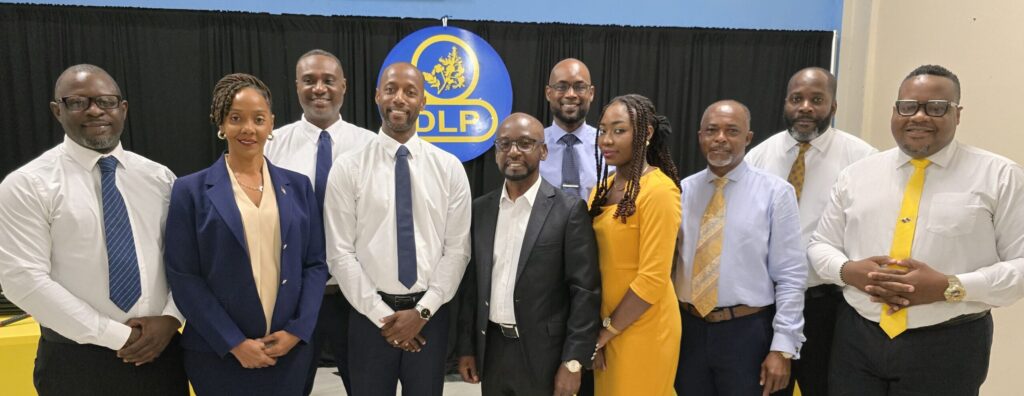
The appointment of former minister Stephen Lashley as interim president, alongside a refreshed “shadow cabinet” led by Senator Ryan Walters, has sparked a wave of cautious optimism — and a fair share of scepticism — from the nation’s leading political commentators.
The consensus among the experts was that the DLP is in survival mode. While the party’s new structure provides a temporary floor, they suggested that its climb back to national relevance will require more than just a reshuffle of names but a fundamental restoration of trust with voters.
For the DLP, the immediate priority appears to be listening to the electorate. Dr Kristina Hinds, a prominent political scientist, suggested that while the move is overdue, it represents a “meaningful step in the right direction.”
She noted that the party now has a window of time to rebuild its fractured base before the next general election.
“They are hopeful and positive signs,” Dr Hinds observed, though she cautioned that the party is not yet at a point where it can realistically challenge the Barbados Labour Party (BLP) juggernaut.
“They need to rebuild internally… as well as rebuild a level of credibility in Barbados so that they can garner sufficient support within three to five years.”
The choice of Stephen Lashley to steer the ship until the party’s annual conference in August is being viewed as a strategic play for stability.
Long-time political analyst Dr George Belle described Lashley as a “stabilising and sober presence” who is well-equipped to bridge the gap following the resignation of Ralph Thorne. According to Dr Belle, Lashley’s primary mandate is not necessarily to reinvent the party’s wheel, but to ensure it does not spin off the tracks entirely.
“What he’s required to do is not let it deteriorate any further,” Dr Belle explained. “He has to maintain continuity from the defeat to the next annual conference, and then we will see who emerges at that point to give a vision for the rebuilding of the party.”
But the “vision” of the party remains a point of contention for Dr Belle, who was particularly dismissive of the “Barbados First” nationalist slogan used in recent campaigning, labeling it “rubbish” and “shallow”.
He argued that the DLP must instead return to its social democratic roots and modernise its philosophical base.
Political analyst Devaron Bruce offered a more nuanced view of Lashley’s return, describing him as “one of the least offensive members” of the era often referred to by DLP critics as the “lost decade”.
Bruce highlighted Lashley’s ability to balance relatability with sophistication in his public messaging, a trait the DLP desperately needs. Yet, Bruce warned that a change in messenger is insufficient without a change in the message itself.
“The party has to think about what it’s saying as opposed to who is saying it,” Bruce said. He urged the party to use its “listening campaign” for genuine introspection rather than as a public relations exercise.
“I think it is very important that after three electoral defeats, the DLP needs to humble itself… they don’t know what they’re doing, long story short, and I would hope that this time around, this listening is productive.”
The composition of the new shadow cabinet has also raised eyebrows, notably for its lack of “old guard” faces. Pollster and head of the Caribbean Development Research Services (CADRES) Peter Wickham expressed satisfaction with the general direction, noting the absence of veterans Richard Sealy and David Estwick.
To Wickham, this signals a clear determination to find a different path with “new young Turks”. While some criticised a “recognition gap” with these newer figures, Wickham argued that the party has no choice but to build new political capital from scratch.
”My feeling is that the blended approach has exhausted itself, and now they know they have to start with the young Turks,” Wickham said.
He emphasised that the shadow cabinet’s primary role right now isn’t just to criticise the government, but to introduce themselves to a population that has thrice rejected the party’s previous iterations. Wickham suggested that the DLP’s past leaders often “jumped the gun” by moving straight into criticism of Prime Minister Mia Mottley before fixing their own house.
“The shadow cabinet is fine, but it’s not going to be a game-changer for most people because most people are more anxious to see that the party is ready and can form a government,” Wickham added.
As Senator Ryan Walters takes the helm of the shadow cabinet, analysts see him as the most logical “face” of the party’s political vanguard. His ability to bridge the gap between the party executive and its minimal parliamentary presence will be tested in the coming months.
The post New DLP leadership faces ‘long road’ to credibility, analysts say appeared first on Barbados Today.