
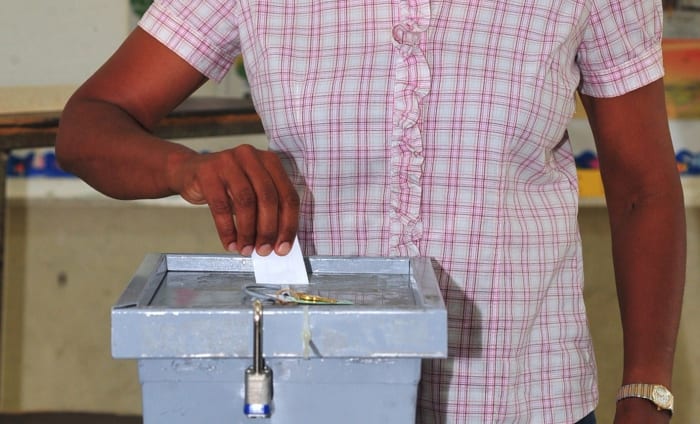
More than a quarter of a million Barbadians were registered to vote on February 11, yet barely four in ten cast a ballot — but even that figure may be misleading, and may be closer to just over half, according to a leading political scientist.
As the Electoral and Boundaries Commission (EBC) released the official results of the general election on Thursday, pollster Peter Wickham assessed the voter turnout as a negligible decrease.
According to the official figures, 273 947 Barbadians were registered to cast their ballots, in a population estimated by World Population Review at 282 634.
The total number of people who voted was 115 619.
The data, which shows a 42.20 per cent turnout, is not that much different from the number of voters who cast their ballots during the 2022 poll, according to Wickham.
Wickham told Barbados TODAY on Thursday: “They are estimating the voter turnout at about 42 per cent, essentially suggesting that about the same number of people voted. It’s not high. The other factor that you have to take into consideration is the extent to which voter turnout appears to over-estimate… is based on an over-estimation of the number of eligible people. When doing an analysis, I worked out about 50 000 who were either dead and not available to vote that were still on the list.”
He added: “This means that, by my estimation, the voter turnout was closer to 55 per cent… which is still not great; but I think it’s a more reasonable estimation as to what the likely outcome would have been, if those names were not on the list.”
The pollster also noted that the “insignificant” decrease in voter turnout is slightly higher among the men. “But overall, it’s about the same as the last election. I think it’s about 02.02 per cent, which is really nothing,” Wickham explained.
He also said there were some important political outcomes reflected in the official numbers, which showed an “insignificant” increase in the level of party support for both major political parties.
“Essentially,” Wickham observed, “this election was one that was flat in terms of changes in developments, because there were about the same number of people voting, pretty much in the same way. And then, of course, you had the fact that, probably the best performance for the Democratic Labour Party would have been in St Michael North West, which is where [Senator] Ryan Walters ran. That was the best performance, but still it wasn’t enough to carry them over the line.”
The data continues to perpetuate a contentious issue during discussions leading up to the February poll — the number of people registered to vote.
What to Know: Barbados at the Polls — 1966–2026
Voter turnout at every general election since independence
Note on figures: All turnout percentages are calculated against the EBC’s registered voters’ roll. Analysts including Peter Wickham and Kevon Edey have consistently argued that roll is inflated — at 273 947 for a country of roughly 282 000 people — and therefore understates actual civic participation. The 2026 figure has been certified by the EBC.
1966 · November 3 · Turnout: 79.7%
Registered: 99 988 | Voted: 79 691 | Winner: DLP (Errol Barrow) — 14 seats; BLP 8; BNP 2
The last election before independence, still using two-member constituencies in which each voter cast two ballots. Errol Barrow’s DLP won a second term as Barbados prepared to become a sovereign nation on 30 November. High turnout reflected the historic moment.
1971 · September 9 · Turnout: 81.6% (all-time record)
Registered: 115 189 | Voted: 94 019 | Winner: DLP (Barrow) — 18 seats; BLP 6
The first election under single-member constituencies. Barrow’s government, riding popular enthusiasm for its post-independence social programmes, won decisively. Turnout has never been higher.
1976 · September 2 · Turnout: 74.1%
Registered: 134 241 | Voted: 99 463 | Winner: BLP (Tom Adams) — 17 seats; DLP 7
The BLP returned to power after 15 years in opposition, swinging nearly ten percentage points away from the DLP. Tom Adams became Prime Minister, beginning a decade of BLP dominance.
1981 · June 18 · Turnout: 71.6%
Registered: 167 029 | Voted: 119 566 | Winner: BLP (Adams) — 17 seats; DLP 7
The first post-independence administration to win a second consecutive term. The margin was unchanged but turnout continued a gradual slide from 1971’s peak. The voters’ roll grew by 32 000 in five years, raising early concerns about list accuracy.
1986 · May 28 · Turnout: 76.7%
Registered: 176 739 | Voted: 135 562 | Winner: DLP (Barrow) — 24 seats; BLP 3
One of the most dramatic elections in Barbadian history. Prime Minister Tom Adams had died in office in 1985; his successor, Bernard St. John, was swept away in a DLP landslide. Barrow returned from opposition to win 24 of 27 seats — the DLP’s all-time high of 59.5 per cent of the vote. A motivated electorate pushed turnout back up nearly five points. Barrow died in office the following year, succeeded by Erskine Sandiford. The House expanded from 24 to 27 seats.
1991 · January 22 · Turnout: 63.7%
Registered: 191 000 | Voted: 121 696 | Winner: DLP (Erskine Sandiford) — 18 seats; BLP 10; NDP 0
The sharpest single-election turnout drop on record: −13 points from 1986. Four DLP rebels had broken away in 1989 to form the National Democratic Party under former Finance Minister Richard Haynes; Sandiford called an early election for a mandate. The NDP polled 6.8 per cent but won no seats. Sandiford secured a full term but his 8 per cent public-sector pay cut triggered mass protests, setting the stage for the first parliamentary no-confidence vote in Caribbean history. The House expanded to 28 seats.
1994 · September 6 · Turnout: 60.9%
Registered: 206 642 | Voted: 125 822 | Winner: BLP (Owen Arthur) — 19 seats; DLP 8; NDP 1
Called after Sandiford became the first Caribbean prime minister removed by a parliamentary no-confidence vote in the modern era — brought down when nine BLP members joined four DLP rebels. David Thompson briefly held the office before the election was required. Owen Arthur’s BLP won comfortably. The NDP won its only seat in its history.
1999 · January 20 · Turnout: 63.4%
Registered: 204 307 | Voted: 129 450 | Winner: BLP (Arthur) — 26 seats; DLP 2
Arthur’s BLP won the most decisive victory to that point — 26 of 28 seats, 64.9 per cent of the vote — as strong economic management rewarded the government. The DLP was left with two seats and David Thompson resigned the party leadership. The NDP was eliminated.
2003 · May 21 · Turnout: 56.9%
Registered: 218 811 | Voted: 124 463 | Winner: BLP (Arthur) — 23 seats; DLP 7
Arthur became Barbados’ first three-term prime minister, but turnout fell to the lowest point since universal adult suffrage was introduced in 1951. The House expanded to 30 seats, where it has remained.
2008 · January 15 · Turnout: 63.5%
Registered: 235 510 | Voted: 149 633 | Winner: DLP (David Thompson) — 20 seats; BLP 10
After 14 years in opposition, the DLP under David Thompson ended the BLP’s three-term run. Turnout recovered strongly — up 6.6 points — as an energised DLP base came out in force. The two parties were separated by fewer than 8 000 votes nationally. Owen Arthur had called the election early; the gamble failed. Thompson died in office in 2010, succeeded by Freundel Stuart.
2013 · February 21 · Turnout: 62.0%
Registered: 249 024 | Voted: 154 443 | Winner: DLP (Freundel Stuart) — 16 seats; BLP 14
The closest result by seat distribution since the early post-independence era. Stuart won by the slimmest margin as Barbados began to feel the global financial crisis. Mia Mottley led the BLP for the first time. The DLP’s narrow re-election set the stage for an economic deterioration that would prove catastrophic five years later.
2018 · May 24 · Turnout: 59.6%
Registered: 258 901 | Voted: 154 193 | Winner: BLP (Mia Mottley) — 30 seats; DLP 0
The most extraordinary result in Barbadian electoral history. Mottley’s BLP swept all 30 seats — the first clean sweep since universal suffrage — and Mottley became Barbados’ first female prime minister. The DLP, having presided over IMF-supervised austerity, was reduced to zero seats for the first time in party history. Yet turnout fell to a new low of 59.6 per cent: the most decisive mandate in history achieved on the least engagement — a paradox explained by the mass abstention of DLP supporters who simply stayed home.
2022 · January 19 · Turnout: 43.0%
Registered: 266 339 | Voted: 114 447 | Winner: BLP (Mottley) — 30 seats; DLP 0
A snap election called within weeks of Barbados becoming a republic (30 November 2021). The BLP swept all 30 seats for the second time — unprecedented in the Commonwealth. But turnout crashed 16.6 points to 43 per cent, the worst on record at the time, as DLP-aligned voters again abstained en masse. The BLP received fewer votes than in 2018. A registered roll of 266 000-plus in a country of 282 000 drew mounting criticism.
2026 · February 11 · Turnout: 42.2% (record low)
Registered: 273 947 | Voted: 115 619 | Winner: BLP (Mottley) — 30 seats; DLP 0
A third successive 30–0 sweep — the first such hat-trick in Commonwealth electoral history. Called three years early, the snap election further depressed participation; fewer than 116 000 Barbadians voted. DLP leader Ralph Thorne lost his own seat in St. John. The BLP polled roughly 71 000 votes — fewer than in 2022. The Congress of Trade Unions has demanded a national census after voters reported finding their names absent from the roll.
Turnout at a glance
1966 — 79.7% — DLP
1971 — 81.6% — DLP (record high)
1976 — 74.1% — BLP
1981 — 71.6% — BLP
1986 — 76.7% — DLP
1991 — 63.7% — DLP
1994 — 60.9% — BLP
1999 — 63.4% — BLP
2003 — 56.9% — BLP
2008 — 63.5% — DLP
2013 — 62.0% — DLP
2018 — 59.6% — BLP
2022 — 43.0% — BLP
2026 — 42.2% — BLP (record low)
Sources: EBC official election summaries; Parliament of Barbados; Caribbean Elections; Nohlen; IFES; IPU Parline.
The post More may have voted in February than official turnout figure suggests – pollster appeared first on Barbados Today.