

Last week, the Electoral and Boundaries Commission (EBC) released the results of the 2026 election, which was the second called by Prime Minister Mia Mottley and the third in which she was victorious. This electoral event signals the commencement of the Barbados Labour Party’s (BLP) second three-term sojourn since Independence, which is a historical achievement worthy of note, especially as the Democratic Labour Party (DLP) has only once achieved this feat (straddling the pre- and post-independence periods).
There are other obvious regional historical markers, and one such is the ability to secure all available seats, which few leaders have accomplished once, far less twice or three times. In this regard, Dr Keith Mitchell would have led his NNP to three clean sweeps, but these were not successive; therefore, Mottley’s would represent a regional first.
It is also important to note that across the region, most political parties that become a first-term government lose seats and support in their second and third terms; as such there is a relatively short list of prime ministers who have increased their support while in office. Previously, Owen Arthur would have done this in 1999, Roosevelt Skerritt (Dominica) in 2005 and 2009, along with Gaston Browne (Antigua) in 2014. Such an achievement is both challenging and significant, as it reflects a rare public endorsement of the leader’s tenure and places Mottley among a highly select group of Caribbean leaders.
Voter Turnout and Participation
Historic markers aside, attention turns to voter participation, which has rightfully generated considerable interest. The standard tool for assessing voter participation is the EBC’s voter turnout statistic, which is presented here alongside that of the 2022 election and would at face value suggest that this election recorded a historic low of 42 per cent participation. Comparatively, the 2026 turnout represents a -1.8 per cent decline over the 2022 level, which is, strictly speaking, statistically insignificant but does demonstrate that less people voted. In real terms 1 146 more people voted in 2026; however, there were 7 608 more registered than in 2022, which explains the statistical reduction.
The EBC’s approach continues to be problematic and has been raising concerns across the region, where the lists would seem to be bloated, as these include the names of people who are not available to vote for any of several reasons but are nonetheless presented as potential voters. This scenario creates an illusion implying that voter turnout is lower than it really is. In this regard, the 2025 St James North by-election was a useful case study where 2 068 persons were identified as potential voters, although they were unavailable to vote, representing 20 per cent of persons listed. Additionally, at the national level, population estimates of persons over 18 suggest that there are 223 312 eligible voters instead of the 273 947 listed, which is a significant difference of 50 000 odd voters. Certainly, if this lower number were the basis of the calculation, the turnout would have been 51 per cent, which is roughly half of eligible voters.
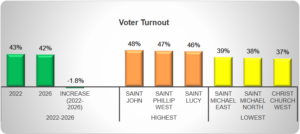
Notwithstanding concerns with the EBC estimates, the comparative turnout figures (between constituencies) are illustrative of greater and lesser levels of participation and provide clues regarding the reasons why Barbadians are motivated to participate. The three constituencies with the highest turnout were among the most heavily contested, suggesting that candidates in these places were able to motivate higher levels of participation. Conversely, the scenarios in the constituencies with the lowest turnout appear to reflect a relative level of indifference that could relate to the fact that the contests there were less exciting.
A post-election survey conducted by CADRES in the wake of the 2025 St James North election suggested that motivation to vote can be heavily impacted by the assumption that the outcome is a foregone conclusion, which is perhaps the assumption that separates the highest and lowest turnout constituencies in Barbados.
Party Support and Swing
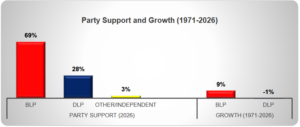
The other important consideration coming out of the 2026 election is the comparative performance of the two parties in terms of seats and votes. The diagrammatic presentation of party support demonstrates that the BLP received three times as much support as the DLP, while the cumulative support of the other parties and independent candidates was 3 per cent. The more curious observation, however, is related to the growth of support for both parties since 1971, which was the first year of single-member constituencies. This growth is calculated based on the average increase in support between elections over this time and is also presented diagrammatically. The BLP has grown by 9 per cent, while the DLP has contracted by -1 per cent, which translates to an average vote haul of 68 670 BLP versus 53 879 DLP on each electoral excursion. In 2026, the BLP gained 79 321 votes, which was above average, while the DLP’s 32 059 was below average, and this immediately speaks to the issue of voter apathy, which is not well understood in Barbados. Clearly, the matter is not one of generalised apathy, but more specifically the apparent inability of one party to motivate its voters to turn out.
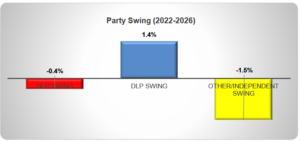
The fact that the BLP had been able to repeatedly capture all seats in 2018, 2022 and 2026 suggests that the more interesting consideration would be the extent to which either party has improved which is reflected in the electoral swing, presented here diagrammatically. It can be seen that the BLP’s swing was -0.4 per cent, which was effectively a decrease in support, while the DLP increased its national support with a swing of 1.4 per cent. In numerical terms, the BLP added 522 votes, while the DLP added 1 786, both of which were statistically insignificant quantities. Although the DLP might be tempted to celebrate these improvements, it is important to note that a party which gains more than 60 per cent support in this region, is not expected to grow further, while a party which gains less than 30 per cent should normally grow at a rate that is well beyond statistically insignificant levels.
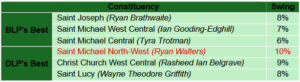
The swing or improvement between elections can also be examined at the level of the constituency where it becomes more interesting as these changes were, in some instances, statistically significant. This analysis has isolated the BLP and DLP’s top three performing constituencies, and in these instances, the candidates here outperformed their respective parties. These performances are all commendable regardless of whether or not the candidates won their election, as these represent individual efforts, and as often happens, the best-performing candidate overall did not win his seat. Ryan Walters’ 10 per cent swing represents the single largest improvement of any candidate in the 2026 election, while newcomer Ryan Brathwaite represented the BLP’s most significant improvement over 2022, gaining 8 per cent while the BLP lost -0.4 per cent (nationally).
Another significant observation with respect to this election is the fact that all BLP candidates secured their seats with a majority of votes as distinct from a plurality, which reflects the fact that in no instance did the third party or independent candidate “cost” the DLP any seat. This is important, as the impact of the other party and independent candidates is often viewed in terms of the potential spoiler effect, and this was not the case in this instance. It can therefore be said that there was little significant impact from this political cohort at the national or local levels.
Peter W Wickham (peter.w.wickham@gmail.com) is a political consultant and a director of Caribbean Development Research Services (CADRES).
The post Of seats, swings and voter turnout appeared first on Barbados Today.