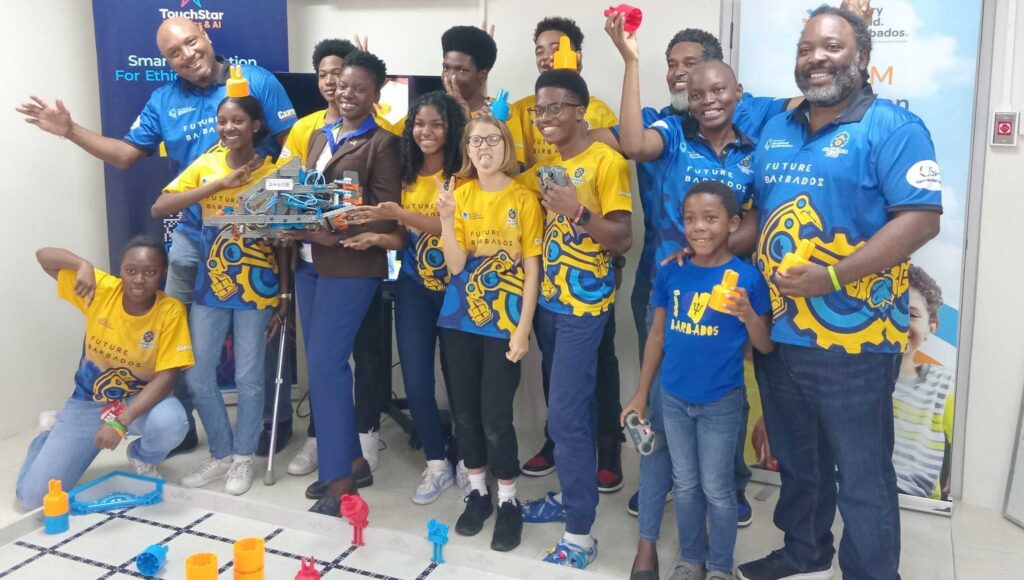
A team of secondary school students from across Barbados will represent the island at the VEX Robotics World Championships in the midwestern American city of St Louis, Missouri, later this month, after spending five months designing and building two competition robots from scratch.
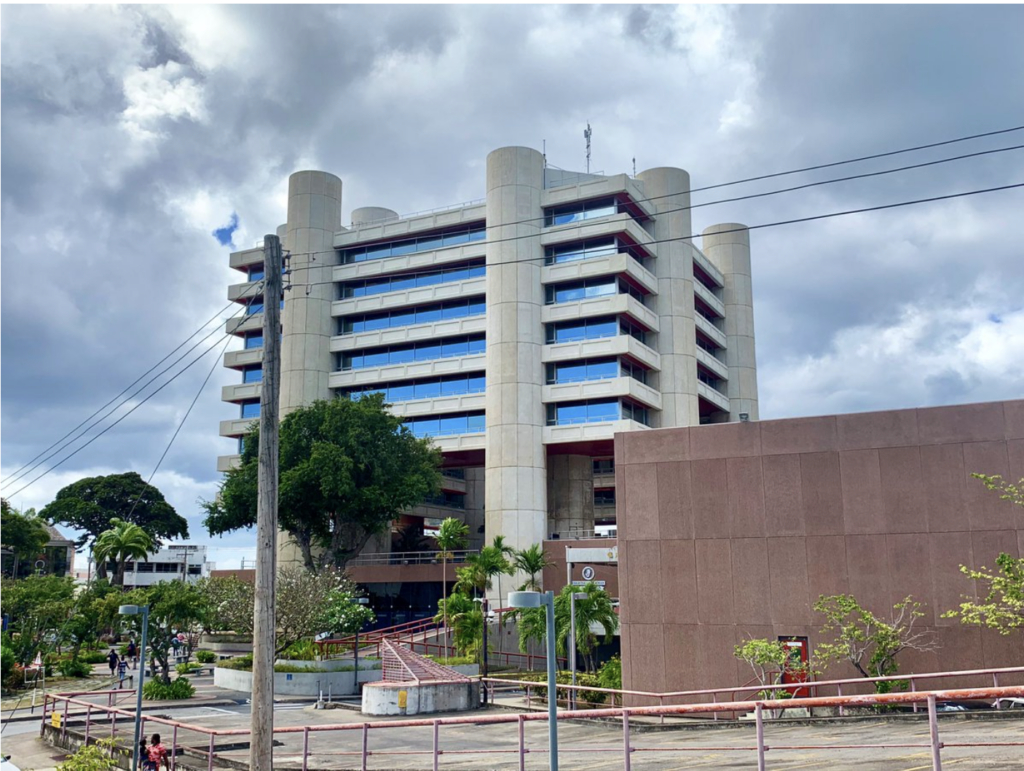
The Gears and Bots 246 Robotics Club, composed of students from The St Michael School, Harrison College, Queen’s College, Alleyne School and the Foundation School, showcased the fruit of five months of intensive labour. Standing before educators, sponsors and officials at the Strategic Innovation Unit (SIU) , the students demonstrated the capabilities of their custom-built robots, “Flying Fish” and “Broken Trident”.
For the team’s mentors, the journey has been an emotional one, driven by a desire to see Barbados transition from a consumer of technology to a creator of it.
“This is about the blue, yellow, and black,” said coding and robotics teacher Shawn Hoyte, one of the lead mentors. “I told the students this is not beyond us. We cannot continue to rely on other countries to import technologies and come up with ideas for us. These should be indigenous ideas developed by these young people. They are not just at the vanguard; they are at the tip of the spear.”
The students have been operating on a gruelling schedule, often working from 9 a.m., until 8 p.m., including weekends, to refine their machines. Unlike many international competitors who spend an entire year preparing, the Barbadian contingent has achieved its current technical proficiency in just five months.
Twelve-year-old Paula Bridgeman, a driver and builder for the team, explained the intricacies of their first robot, “Flying Fish”, which competes in a game involving the strategic stacking of coloured pins.
“The autonomous section is where the robot makes decisions by itself and completes tasks without human intervention,” Bridgeman explained. “Each connected pin is one point, but if you mix the colours, you get five bonus points.”
The technical complexity of the projects was further detailed by 15-year-old Tykairi Sargeant of Harrison College, who noted that the team had to learn advanced concepts such as pneumatics and gear ratios from scratch.
“Those gears are not there for style,” Sargeant noted. “They are there to speed up the robot or slow it down depending on the amount of teeth the gear has. We went through many iterations because of stability issues, but after a lot of research and trial and error, we found out how to do it.”
Joshua Jupiter, 15, from The St Michael School, elaborated on the sophisticated PID (Proportional Integral Derivative) code used to ensure the robot corrects its own course during the autonomous phase. The team’s second robot, “Broken Trident”, utilises a unique “S-type” intake system designed to collect and score balls with high efficiency.
The initiative has received high-level praise from the Ministry of Education Transformation, with Chief Education Officer Dr Ramona Archer-Bradshaw in attendance to witness the demonstration. The project was made possible through the support of sponsors and the collaborative efforts of teachers who volunteered their time as professional mentors.
The Gears and Bots 246 team remains focused on its goal of becoming world champions, viewing the competition as a “history-making” moment for Barbadian education and technology.
“These students should be celebrated because this is something that has never been done,” Hoyte added. “I like challenges, and while I’ve had mine, they pale in comparison to the pride of representing Barbados.”
Dr Archer-Bradshaw reflected on the long journey that began in 2013. At the time, she was a science tutor at Erdiston Teachers’ Training College with a dream of integrating technology into the local curriculum.
“I must say, I’m very emotional because this journey of coding and robotics didn’t start yesterday; it didn’t start last year,” Dr Archer-Bradshaw shared. “It started about 2013 when there was a science tutor who thought that coding and robotics was something that could be introduced into our schools to help our children learn how to think critically.”
The chief education officer detailed how the initiative grew from a partnership with the Caribbean Science Foundation and Barbadian scientist Cardinal Ward.
After undergoing personal training in drive trains and block coding, Dr Archer-Bradshaw spearheaded a movement to train teachers across the island. That effort has now resulted in more than 300 educators being certified in various VEX platforms.
While the competition in St Louis represents the “highest level” of the sport, Dr Archer-Bradshaw emphasised that the programme’s true value lies in character development and cognitive skills rather than just technical prowess.
“Some will look at this and say, well, it’s just coding and robotics,” she noted. “But this coding and robotics is a vehicle that is being used to teach you how to critically think, how to problem solve, how to make mistakes and laugh at yourself and say, ‘Oh my goodness, I should do this a different way.’ It teaches you how to communicate with one another, how to collaborate, and how to be resilient.”
The programme saw a significant push in 2022 when, with the support of the Ministry of Education and education reform leads such as Dr Denny, coding was introduced into nursery, primary and secondary schools. This expansion led to the appointment of a dedicated education officer to ensure the programme’s sustainability.
Recalling a conversation from the previous year with Education Officer (ag) for Coding and Robotics Kenneth Turton, Dr Archer-Bradshaw explained that she challenged the team to ensure their international participation was not a one-time event.
“I remember when Kenneth came to me last year and said: ‘Chief, we want to take a team overseas to the VEX worlds,’ and I said to him, ‘Kenneth, I’m not just taking you on a trip. You have to go and come back and tell me how we’re going to have a team go over again the next year.’”
That challenge was met, and the Barbadian team is now prepared to depart at the end of April 2026. Dr Archer-Bradshaw credited the success of the initiative to the “dedicated teachers” who work beyond their regular duties to provide these life-changing experiences for the youth.
“I’m so happy that the vision and the dream of coding and robotics in schools has come to pass,” she concluded, to a round of applause for the departing students.
Team heading to the VEX Robotics World Championships
VEX IQ Team
Virineia Iakubbo 1st form Harrison College
Joshua Jupiter 3rd form St Michael School
Paula Bridgeman 2nd form Queen’s College
Tykairi Sargeant 4th form Harrison’s College
VEX V5 Team
J’nai Thomas 5th form Christ Church Foundation
Nathan Whittaker 4th form Alleyne School
Ashley Chase 5th form St Michael School
Tyler Marshall-Brancker 5th form Christ Church Foundation
(RR)
The post Students prepare for Robotics World Championships in US appeared first on Barbados Today.