The Central Bank of Barbados is helping to unlock financing for small businesses by reducing the risks faced by commercial banks through the Enhanced Credit Guarantee Fund (ECGF).
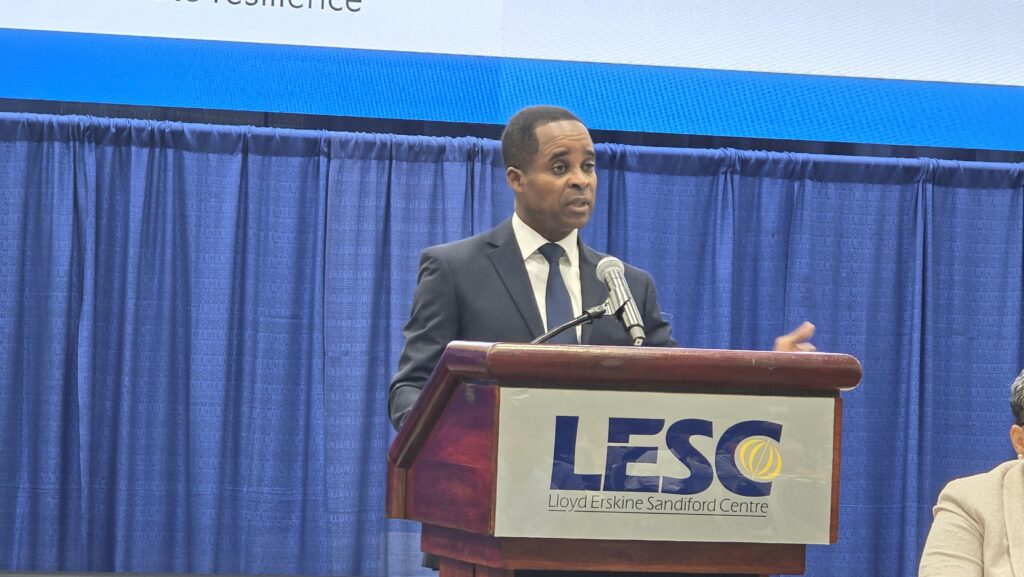
The announcement was made on Wednesday by Director of Foreign Exchange and Fund Management at the Central Bank, Darrin Downes at the State of the Sector conference at the Lloyd Erskine Sandiford Centre.
Funding accessed through the ECGF can be used for productive business activities, including the purchase of equipment, buildings, infrastructure and technology.
He explained that the fund operates as a partial credit guarantee scheme, with the Central Bank acting as the executing agency.
“Tasked with administering and managing the fund, the fund essentially shares the lending risk of financial institutions. The key issue that the Enhanced Credit Guarantee Fund addresses is the persistent structural financing constraint faced by many micro, small and medium enterprises (MSMEs) due to insufficient collateral,” Downes said.
The ECGF was introduced against the backdrop of findings from a recent study led by UWI management expert Professor Dwayne Devonish, which highlighted that many MSMEs were struggling to access financing because they lack traditional assets required by banks.
As a result, he said the ECGF created a shift in the credit landscape from risk aversion to risk sharing.
Downes explained that while the Central Bank manages the fund, businesses must still apply for loans through their financial institutions.
“I know there are some persons who believe that it is the Central Bank who lends money, who assesses your project, but we leave that part of the process to the banks. You’re a customer of the bank, the bank understands the nature of your business and you can have that discussion about whether you qualify,” he said.
Downes outlined that to qualify, businesses must be formally established, revealing that the eligibility criteria for MSMEs mandates that a business must be an incorporated entity, having all the necessary licenses and permits to operate legally in Barbados.
“I believe that of the over 90 per cent (of MSMEs) that are micro, 45 per cent are incorporated. Those incorporated entities can access the funds through their financial institution.
“One of the other eligibility criteria is that the company must have no more than $20 million in assets in annual revenue given the figures that we have seen. It represents the upper limit on the firms who would benefit from the fund and no more than 200 employees,” Downes said.
Downes explained that the application process will be handled digitally.
“All applications are submitted electronically to the Central Bank via an online workflow system that we affectionately call CBD flows. So, the bank, armed with the information that’s required, logs into the portal and they just answer these questions and include the information. We receive a notification as soon as the application is received, we assess that application and within seven business days the bank has a decision,” he said.
Loans under the programme start as low as $20,000, with total support per business capped at $6 million, while individual guarantees are limited to $2 million.
“The guarantees that are issued are up to 80 per cent of the outstanding loan balance. The maximum guaranteed amount is $2 million on any given loan, the tenure for the guarantee is 10 years, and there’s a guaranteed fee of 0.7 per cent paid on the outstanding loan balance which is paid by the financial institutions,” Downes said, while explaining that the programme only applied to new loans.
He added that businesses must remain in good standing, as loans that fall into arrears carry consequences.
“Because if a claim is paid on a non-performing loan, which means you’re not able to work it out with your banker, that particular entity unfortunately cannot access the fund again. It sounds harsh, I know, but again, it’s in the interest of ensuring the sustainability of the fund,” Downes said.
Downes also explained what happens in the event of default.
“We will pay 100 per cent. If the loan went in arrears at 900 million, we will pay the 800 million that we guarantee. The bank would then be responsible for recovering the extra.
“If your loan goes into default and your institution has to make a claim for payment of the guarantee, the institution is responsible for seeking to recover in accordance with the institution’s recovery process in the same way that you would have given a loan to a customer and you’re seeking to recover,” he said.
(LG)
The post Central Bank breaking collateral barrier for MSMEs appeared first on Barbados Today.