
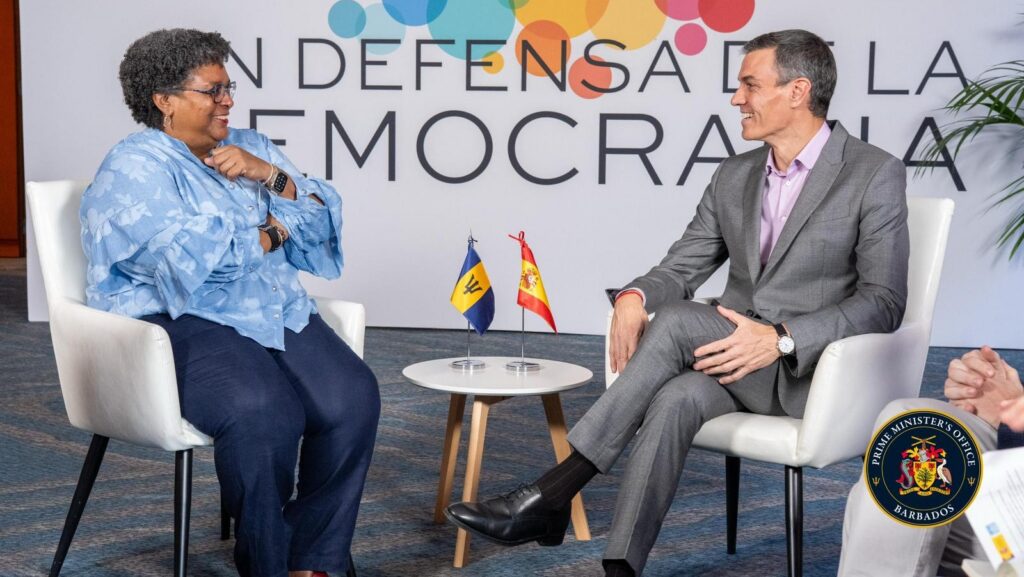
Prime Minister Mia Mottley joined fellow leaders in Barcelona for the IV Meeting in Defence of Democracy, which concluded with a declaration reaffirming commitment to democracy, human rights and the rules-based international order.
The declaration also called for a targeted and implementation-focused agenda on multilateral reform, information integrity, democratic digital governance and inclusive development.
Against a backdrop of deepening conflict, inequality, polarisation and disinformation, Prime Minister Mottley used the platform to place Barbados firmly among those countries insisting that democracy must be defended not only in word but also in deeds.
Her intervention centred on three interconnected concerns: the need for the maintenance of a rules-based international order, the dangers of extremism fuelled by inequality, discrimination and hatred, and the urgent necessity of protecting the virtue of truth itself in an age of disinformation.
“For small states like Barbados, a rules-based order is essential to our ability to exist and succeed.”
She warned too that inequality, when left unchecked, threatens the very foundations of democratic governance.
“When democracy does not deliver for people, and when inequality becomes extreme, it erodes faith in the system itself and creates space for extremism.”
The positions advanced by the Prime Minister found meaningful expression in the Barcelona outcome.
The declaration reaffirmed that respect for international law and multilateral cooperation remain the most effective foundations for peace, sustainable development and human dignity and committed participating leaders to a renewed, more effective, inclusive and representative multilateralism, including reform of the United Nations and, in particular, the Security Council.
Of particular significance to Barbados, it also recognised the urgent need for a reformed and inclusive multilateral system that addresses the needs of countries in special situations, including Small Island Developing States, while supporting a global financing for development framework that can better respond to citizens’ expectations.
A central thread of the Prime Minister’s contribution was the defence of what she described as informational sovereignty.
“Without facts there is no truth, without truth there is no trust, and without trust there is no shared reality.”
She argued that this is why democracies must defend the public’s right to know. That emphasis was reflected in the outcome declaration, which committed participating countries to strengthen international cooperation on transparency, accountability and democratic governance in the digital sphere; launched a Digital Democracy Roundtable, and called for support for algorithmic transparency, information integrity, pluralistic media, the sustainability of journalism and digital sovereignty.
Prime Minister Mottley further urged leaders to move beyond generic declarations and instead identify common purpose rooted in common values.
“If we are serious about the Sustainable Development Goals, we have to be serious about allowing countries to access the means to achieve them. The reform of the international financial system is central to that effort.”
She also argued that “we need a more comprehensive, fairer and more democratic system”, one capable of ensuring that people have access to the basics, including food and water, and of answering the hard question of who benefits when crises drive up costs and push vulnerable countries further to the margins.
In that regard, the Barcelona outcome acknowledged that persistent inequality creates fertile ground for extremism and democratic backsliding, reaffirmed the importance of a fair and progressive tax system, and recognised that climate change is exacerbating inequality.
Importantly, the Barcelona meeting marked what the declaration described as a decisive step from shared concern to implementation. The initiative will reconvene in New York in September during the United Nations General Assembly.
On the margins of the initiative, Prime Minister Mottley held bilateral discussions with Prime Minister Pedro Sanchez of Spain on a practical agenda of cooperation with direct relevance to Barbados and other small states.
Those discussions covered migration policy, climate resilience, renewable energy, methane action, data and digital governance, international competitiveness, strategic autonomy and the removal of barriers that continue to place small states at an economic disadvantage.
Among the issues explored were Barbados’ interest in learning from Spain’s migration policy experience through a possible technical study visit; the importance of climate resilience as a first line of national defence; the transition to renewable energy while maintaining resilience in a hurricane-prone small island state; the case for stronger methane standards; the governance of data centres and green energy; and the strategic importance of digital and communications sovereignty.
The two sides also discussed concerns related to international listings and the tangible disadvantages these continue to impose on countries such as Barbados.
Prime Minister Mottley also raised the matter of Barbados being finally removed from a blacklist of financial jurisdictions which Spain maintains even though Barbados has met all Organisation for Economic Co-operation and Development (OECD) requirements, to which Prime Minister Sanchez assured that the process to have their list updated and have Barbados removed would be undertaken.
The post Mottley calls for democratic renewal, truth and fairness in Spain appeared first on Barbados Today.