
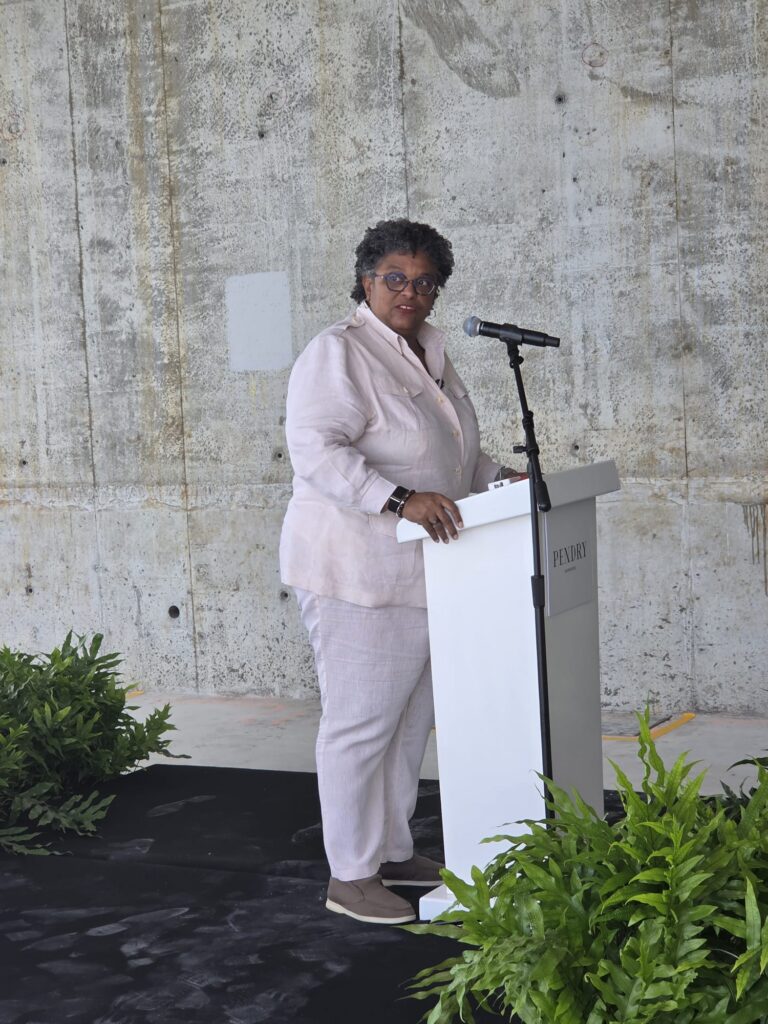
A second desalination plant for northern Barbados, public shareholdings in the new facility, and an August deadline to end the “brown water” plaguing households in St Lucy and St Peter were at the heart of a water-security package unveiled by Prime Minister Mia Mottley on Tuesday, as she cast reliable supply as a frontline defence against drought and a prerequisite for the island’s “Tourism 3.0” ambitions.
In a speech to developers and other officials at a ceremony at the upscale Pendry Hotel Residences in St Peter, the prime minister framed these utility upgrades as a mechanical necessity for national development, ensuring that the island’s infrastructure keeps pace with its evolving tourism and residential needs.
The centrepiece of the announcement was a new desalination facility in St Lucy dedicated to the northern parishes.
Recognising the region’s rapid growth and the inherent challenges of being one of the world’s most water-stressed nations, the prime minister said that the government is “committed to building a second desalination plant for the north to ensure that Bajans and those who visit have the opportunity to have a ready supply of water without worry”.
She noted that this facility will ensure the supply is “of a quality that we are working hard to ensure is fully acceptable for all”.
Mottley revealed that the plant would not be a strictly state-run entity: “The government has already committed that not only will the Barbados Water Authority be a major shareholder, but it will be opened up to public ownership across the island.”
She added: “Those who pay water rates should be entitled to be able to own and earn from water as well.”
Beyond the long-term goal of desalination, the prime minister addressed the immediate “growing pains” experienced by residents in St Lucy and St Peter.
The administration has spent the last year aggressively replacing ageing water mains that have long contributed to service disruptions and inefficiency, she said.
“Thirteen months ago, people said we were mad and that there was no way we were going to be able to replace all the mains in the parish of Saint Lucy,” Mottley recalled. “We are almost there … by the end of May, we should have finished all of them.”
Addressing the persistent issue of “brown water” that has affected households in the north, the prime minister provided a specific timeline for technical interventions at Alleynedale, St Peter. She explained that while global supply chain logistics had caused a slight delay, the solution was imminent.
“I’m told that the equipment for the filtration systems will be on island within a few weeks and installed such that by August … all of those systems will be in place,” she said. She noted with a touch of wit that improvements were already visible, remarking that the water colour in many homes was now “even lighter than my suit”.
Mottley emphasised that these upgrades are not merely about convenience but are a survival strategy in the face of the global climate crisis. She reminded the audience that for Barbados, the climate threat often manifests as “drought more than a hurricane”, making water management a pillar of national security.
“We do not live in a world that disregards the fact that Barbados is a scarce water country, one of the 15 most scarce water countries,” she said. Consequently, she insisted that “all the new tourism product is appropriately greened and appropriately digital to make sure that the efficiencies which are necessary for us in tourism can be gained.”
The prime minister asserted that this infrastructure “restructuring” is essential for sustaining the Barbadian quality of life and tourism, newly rebranded as “Tourism 3.0”. By combining the maturity of a 60-year-old independent nation with the “energy of a five-year-old republic”, she argued that Barbados is uniquely positioned to command global respect.
“No one owes us a living,” she said, “and that is why we are determined to command the respect that will ensure we can sustain our quality of life and use this as an anchor to the linkages which are necessary.”
With the filtration systems set for August and the desalination plant on the horizon, residents of the north can look forward to a stabilised utility grid, the prime minister vowed.
The goal was to “ensure that the experience was not one that divided the country but one that united the country,” she said, starting with the most basic necessity: clean, reliable water.
(RR)
The post PM unveils desalination plant, mains overhaul for northern water supply appeared first on Barbados Today.