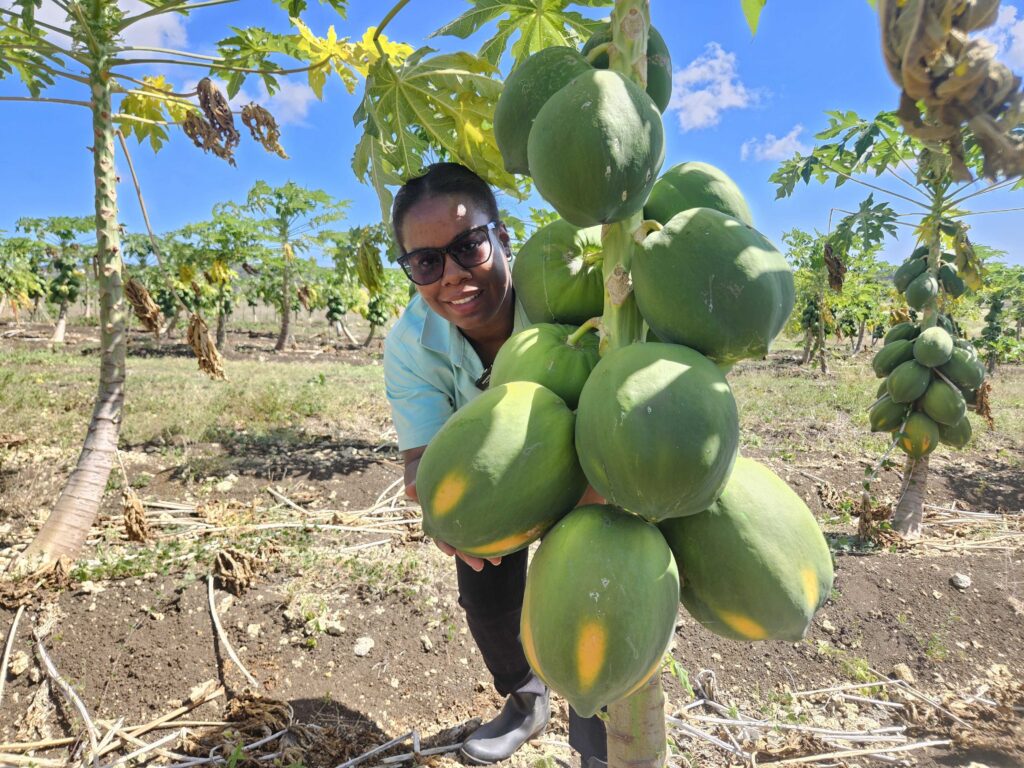
A pilot project testing disease-resistant varieties of papaya — commonly known here as papaw — is beginning to revive Barbados’ struggling industry, offering early signs that growers may reduce reliance on imports after years of decline caused by crippling bunchy top disease.
The initiative, led by the Caribbean Agricultural Research and Development Institute (CARDI) in collaboration with Valley Island Farm in St George, comes after years of decline linked to bunchy top, which affects the growth of the plant, and causes severe stunting and distorted leaves, effectively halting fruit production at an early stage.
The project focuses on identifying more resilient varieties while improving cultivation practices, Valley Farm manager Ron Hope told Barbados TODAY.
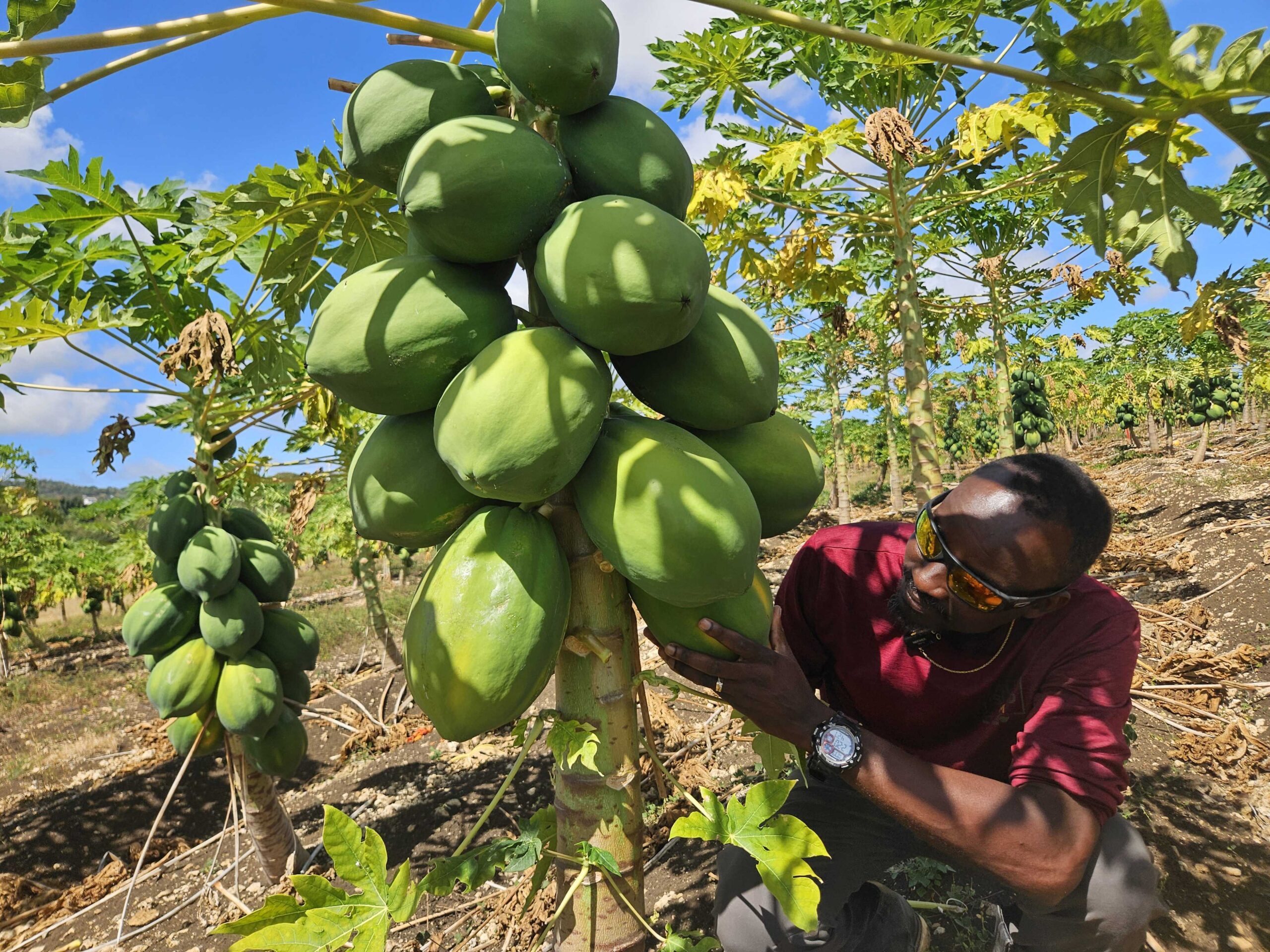
Valley Island Farm manager Ron Hope inspecting a paw paw plant. (SZB)
“To revitalise the industry, we’ve started with basically a varietal trial,” Hope said. “I have six different varieties that we have planted, looking to see which one will produce better… but also who will show more resistance to bunchy top, as bunchy top really is the main problem that you get.”
He explained that the disease remains the primary constraint on production: “Bunchy top is what kind of kills out the plant at a very early stage and basically stops your production.”
The trial spans seven plots across roughly four acres, with approximately 300 plants per plot, allowing for side-by-side comparison of varieties under identical conditions.
“Red Lady seems to be doing the best,” he said, pointing to its stronger seedlings, faster growth and structural resilience.
“[Red Lady variety] was a lot stronger than the others… it grew a bit faster than the others. Also the branching and the sturdiness of the trunk is very, very important.”
The variety also demonstrated better fruit quality and reduced disease impact compared with others, he added.
While the trial initially focused on research, Hope said it has already transitioned into commercial production.
“Right now we are harvesting,” he said. “I started harvesting two weeks ago… started with a thousand pounds. Now I’m up to like three thousand pounds a week.”
Produce is being sold primarily through wholesalers and direct farm sales. “I’m wholesaling at $2.50 a pound,” he said, adding that buyers include supermarkets and vendors purchasing in bulk.
Despite the encouraging yields, challenges remain, particularly water availability during the dry season.
“A major challenge here, now in the dry season, would be water. Papayas love water and this seems to be what’s slowing down my production at this point,” Hope said, adding that he was unable to pump water to the field currently.
He also highlighted the need for better consumer education on ripening and usage, noting that improper handling contributes to waste.
“I don’t think people understand papayas,” he said. “I have people waiting until they get fully yellow and once they get fully yellow, they spoil… you can start consuming them from the time they start to turn a bright yellow streak.”
Hope was confident in the crop’s viability despite the disease pressure. “Bunchy top doesn’t scare me. That’s why I still plant papayas,” he said. “Once you can harvest for 18 weeks, you would have done your business. You’ll be profitable.”
Christina Pooler, Barbados representative at CARDI and the natural resource management specialist at the Barbados unit, said the project forms part of a broader effort to address the disease at a national level.
She noted that bunchy top disease has affected production island-wide, prompting a coordinated response through the papaya stakeholders platform.
“We know that it’s been a prevalent disease that has been affecting papaya production island wide, so we’ve used this as an opportunity… to see what best agronomic practises we can use to minimise the effect of the disease.”
The trial includes monitoring plant performance, testing treatments and managing the pest responsible for spreading the disease.
She added that findings from the project will be shared with farmers to guide improved production methods.
“We hope to share the results from this particular trial with farmers to help inform them of better practices.”
The post Papaw trial shows early promise in crop disease fight appeared first on Barbados Today.