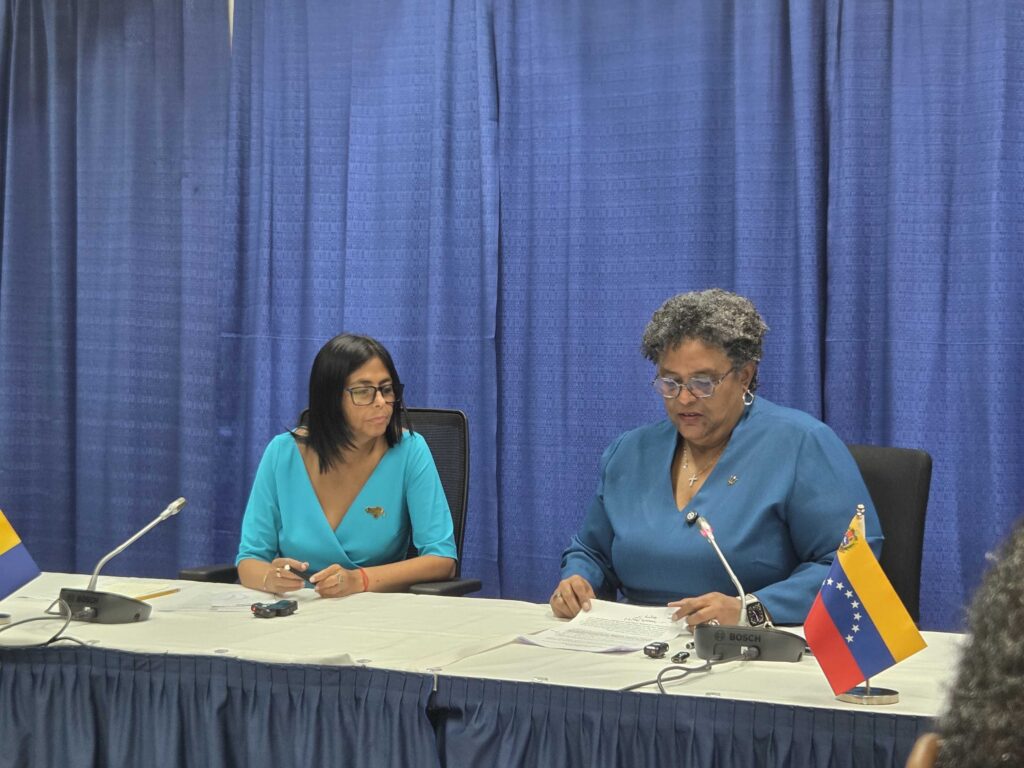
Barbados and Venezuela on Monday announced an ambitious strategic partnership spanning food production, energy investment and language integration, as Bridgetown hosted the first high-level visit by Caracas’ new leadership since the removal of president Nicolás Maduro.
Prime Minister Mia Mottley and Venezuelan Acting President Delcy Rodríguez have signalled a transformative era of cooperation between their nations, issuing a joint media statement following a day of high-level bilateral talks at the Lloyd Erskine Sandiford Centre.
The leaders emphasised that the geographical proximity of the two nations — separated by just an hour’s flight — must finally be matched by deep economic and social ties.
Mottley framed the collaboration as a necessary shield against the global pressures of inflation and fractured supply chains.
“Given our last visit to Caracas, we do not start from the bottom, but we already have a foundation from which to build,” she said. “But it becomes all the more important that we cooperate now at a time when inflation and supply chain logistics are confronting all of our countries. Venezuela has done remarkably well in food sovereignty and is in a position to assist many of us in the region with respect to access to affordable food.”
A key agreement would allow Barbadian farmers and the government to produce food directly on Venezuelan soil. This initiative aims to stabilise food prices in Barbados while leveraging the island’s logistics to create an export hub for the wider Caribbean and beyond.
“We believe that there are significant more opportunities, especially given the fact that Venezuela is capable of producing a wide range of food because of its broad climatic conditions,” Mottley explained. “We are committed to ensuring that the planes and ships that come here do not go back with their holds empty, but in fact can go back with produce that can benefit our farmers and our manufacturers.”
The prime minister also highlighted a linguistic shift for the island, setting a target for Spanish to become Barbados’ second official language — reaffirming a policy set nearly 50 years ago but never fully implemented. By 2030, all Barbadian children under 18 should be exposed to Spanish, facilitating seamless trade and travel within the hemisphere, she declared.
“Simply put, we believe we can complement each other in this regard,” Prime Minister Mottley said. “We must not let history or language prevent us from being able to find the best possible cooperation for our two countries and our two peoples. If we get this correct, it makes it easier for us to see real progress on the next platform, which is tourism and connectivity.”
Energy drive
Turning to energy, Mottley acknowledged Venezuela’s historical role as a stabiliser in the region, citing the San Jose Agreement and the PetroCaribe agreement. She expressed a desire for the Barbados National Energy Company to explore joint investments in Venezuelan oil and gas fields to ensure long-term energy security.
“The price of energy is what concerns everyone across the world today,” the prime mnister said. “We welcome the opportunity for this cooperation to see how best we can invest to the benefit of both countries at this very, very difficult time of energy insecurity. But we want our cooperation to extend also beyond fossil fuels to also renewable energy.”
‘New birth’ of ties
Acting President Delcy Rodríguez, who leads the Bolivarian Republic’s administration since US forces invaded Caracas in early January and removed Maduro to face US criminal charges, echoed the sentiment of a “new birth” in diplomatic relations, officially marking April 27 as the start of a reinvigorated economic and trade alliance.
“I have always told the prime minister she is very loved by her people, and she exercises her leadership for the well-being of her people,” Rodríguez said.
Deal on food, tourism links
“We have finished this visit with great joy after advancing on many important topics. The first topic we touched on was on the production of food — that Barbados should come to Venezuela to produce food on Venezuelan soil. That would allow for the supply of food to Barbados, but also allow Barbados to become a hub where we can export foods for the rest of the world.”
Rodríguez further detailed plans to bolster maritime and air links, suggesting that increased flight frequencies between Caracas and Bridgetown would open new tourism markets for both nations. She extended an invitation for Barbadian professionals to assist in training Venezuelan tourism operators, while offering Venezuelan expertise to help Barbados expand its energy production.
“We have also invited Barbados to come and invest in oil fields and exploration in Venezuela,” Rodríguez said. “We want to join strength to increase the production of hydrocarbons to guarantee the supply and safety for energy to the people of Barbados in the future. We also discussed the complementarity for renewable energies, such as manufacturing solar panels together.”
On the educational front, Rodríguez pledged to expand the Venezuelan Institute for Cultural Cooperation in Barbados, utilising new technology to bridge the gap between Venezuelan teachers and Barbadian students.
“The prime minister has expressed her intention of having the people of Barbados acquire a second official language, and that would be Spanish,” Rodríguez said. “We have decided to amplify the capacities of our institute here to include technology which will allow for teachers of Venezuela to provide more training for the people of Barbados.”
Rodríguez presides over an uneasy political transition at home amid intense debate about Washington’s role and the country’s democratic future. In a series of coordinated attacks, US special forces seized Maduro and flew him to New York to face drug-trafficking and corruption charges, a move critics have condemned as a violation of international law and Venezuelan sovereignty.
Now held at the Metropolitan Detention Center in Brooklyn alongside his wife, Cilia Flores, Maduro has pleaded not guilty and told a Manhattan federal court he is a “prisoner of war” who was “kidnapped” by the US.
The bilateral talks concluded with an exchange of gifts, including an indigenous-crafted beach bag and a piece of Barbadian art, symbolising the cultural ties the leaders hope to solidify.
“I invite you and your delegation to treat Barbados as home,” Mottley said. “We want our relationship to benefit ordinary people so that they can get the best that both countries have to offer.”
The post New deal includes farming, energy, Spanish as second language appeared first on Barbados Today.