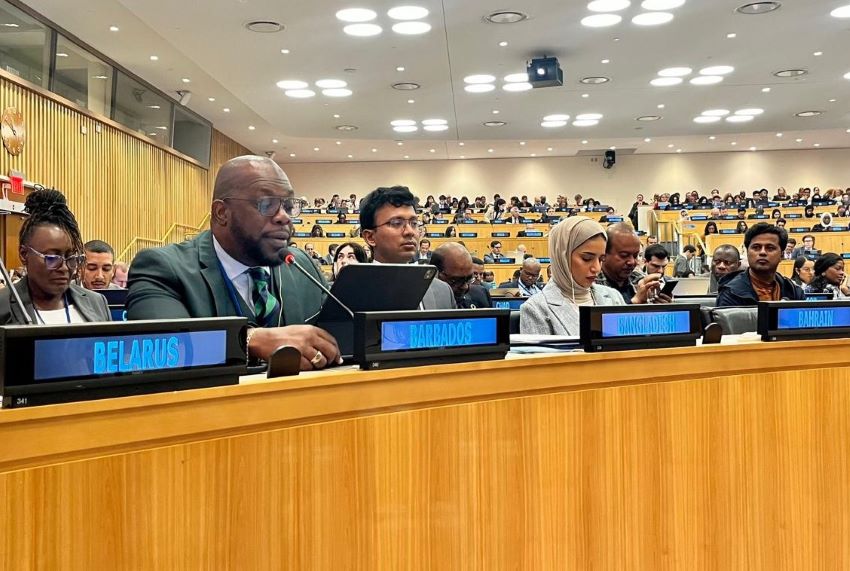
Days after defending controversial immigration reforms in Parliament, the government has taken its case to the international stage, telling the United Nations that migration is essential to Barbados’ economic survival as it confronts a shrinking workforce, an ageing population and intensifying climate pressures.
Minister of Home Affairs Gregory Nicholls told the Second International Migration Review Forum in New York that migration must be treated as a development strategy for small island states facing labour shortages, ageing populations and climate pressures.
The forum is the UN’s main global meeting where governments and other interest groups assess how well they are implementing the Global Compact for Safe Orderly and Regular Migration, share progress and challenges, and agree on future commitments to make migration safer and better managed.
“Migration, managed well, is not a burden. It is an engine for creativity, innovation and growth,” Nicholls told the meeting.
His remarks closely follow the debate in the House of Assembly last week over proposed changes to Barbados’ immigration and citizenship laws, which the government said were needed to address population decline, outward migration and increasing pressure on the labour force.
During that debate, Nicholls noted that Barbados’ shrinking and ageing population threatens economic growth, pension sustainability and the country’s competitiveness.
Expanding that argument at the UN, he told delegates that for small island developing states, migration and climate change are deeply connected.
“For small island developing states, climate change and migration are not parallel agendas – they are the same agenda,” he said.
Nicholls also used the international forum to highlight Barbados’ push towards greater regional integration through the full free movement arrangement launched last October between Barbados, Belize, Dominica and St Vincent and the Grenadines.
The agreement allows nationals from those countries to live and work indefinitely across participating states while guaranteeing access to healthcare and education for their children.
“This is not generosity. It is obligation built on political will, regional solidarity and human rights,” the interior minister said.
Barbados is also in the process of developing a National Migration Policy guided by CARICOM frameworks and the UN Global Compact for Safe, Orderly and Regular Migration.
According to Nicholls, the policy is expected to modernise migration pathways, strengthen border systems and support economic growth.
The direction mirrors several proposals currently before Parliament in the Immigration Bill, including expanded residency categories, broader eligibility for permanent residency and a merit-based immigration system designed to attract skilled workers, investment and retirees with financial means.
The government has argued that the reforms are necessary to help offset demographic decline and improve Barbados’ competitiveness in attracting human capital and business investment.
Nicholls also renewed calls for climate finance reform through the Bridgetown Initiative, warning that climate-related displacement is already affecting vulnerable island states by placing pressure on borders, food security and national stability.
“Migration should be seen as an option, and not a mere act of survival,” he said.
The minister further noted efforts to strengthen ties with the Barbadian diaspora in the United Kingdom, Canada and the United States through investment opportunities, skills transfer and return migration initiatives.
Barbados was participating in the forum not only to speak, but to strengthen partnerships that support “safe, orderly and dignified migration”, Nicholls declared.
(BT)
The post Govt defends migration policy at UN forum appeared first on Barbados Today.