A UWI Cave Hill scientist has discovered three new species of microorganisms in decomposing sargassum, a breakthrough that could turn a persistent coastal problem into a foundation for a homegrown biotechnology industry, Barbados TODAY has learned.
What has long been considered a coastal nuisance and a menace to tourism is now being seen as a scientific goldmine, as Dr Bidyut Mohapatra has identified and named the new microbes after his homeland.
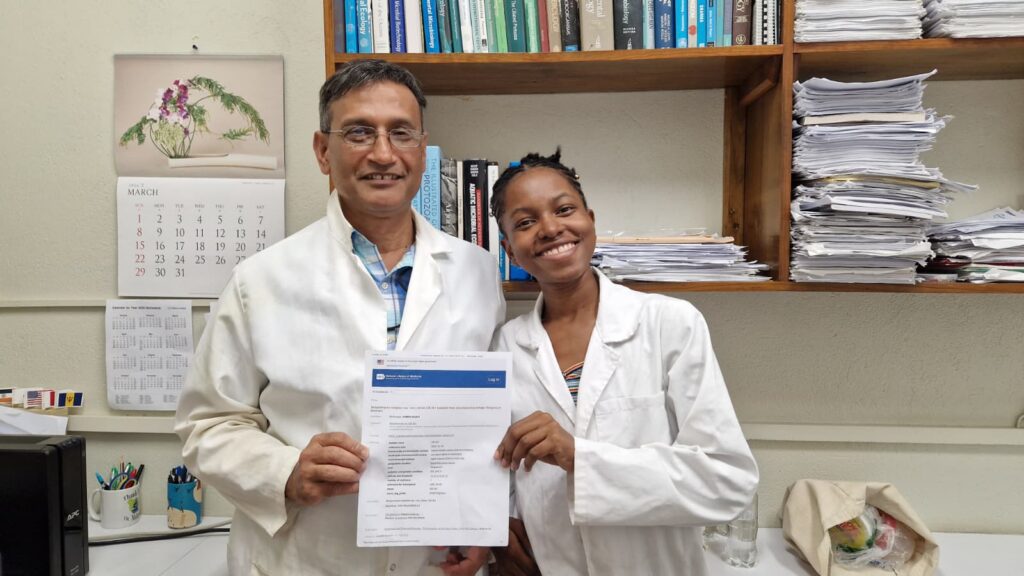
The findings, validated by the National Centre for Biotechnology Information (NCBI) in the United States and specialised culture collections in Belgium and Germany, mark a historic first for Barbados.
“This is the first time, actually, the microorganisms have been named after Barbados,” Dr Mohapatra said. “There are no microorganisms that existed before with the name of Barbados.”
Reflecting on his decision to name the species after his country rather than himself, he added: “I could have taken my name, but I prefer to give credit to the country, actually, first. That is the important one… we have to give credit to the country.”
The discovery of Streptomyces sargassi is particularly significant. Dr Mohapatra described the microbe as a “cell factory” with the potential to produce more than 20 novel antibiotics. But its utility extends far beyond medicine.
“It’s a natural hub,” he explained. “The microbe will produce enzymes as well as antibiotics, both at the same time.”
Beyond healthcare, the scientist revealed that the bacteria “also eat plastics”, offering a potential breakthrough for plastic degradation. The microbes can facilitate “environmentally sustainable degradation”, breaking sargassum down into biofuels and agricultural chemicals.
The global scientific community has begun to take notice. The American Society for Microbiology has invited Dr Mohapatra to Washington next month to present his findings – an honour extended to only six fellows worldwide.
The breakthrough also answers a call to action by Danish chemist Professor Morten Meldal, the 2022 Nobel laureate, who recently urged Caribbean scientists to pursue sargassum-related innovations.
Despite intense interest from international industrial players, Dr Mohapatra – who self-funded the decade-long project using “pocket money” – remains committed to national development.
“Many industries are approaching me to go but my main goal is to do something for Barbados. Not to give it to some other countries and they can go ahead and do that,” he said.
Supported by young scientists like Rachel Sobers, as well as close colleagues, he declared an aim to ensure the economic benefits of the discovery remain within the Caribbean.
Addressing potential ecological concerns, Dr Mohapatra gave an assurance that the microbes are non-pathogenic and naturally occurring.
“It is not a pathogen. It doesn’t produce toxins or anything like that,” he said. “It is a part of the soil ecosystem.” Since the bacteria were isolated from sargassum already on Barbadian shores, they are already a safe, integrated part of the environment. “It’s from the same systems here… that’s why there’s a lot of interest now.”
While Barbados currently faces “very limited facilities” for large-scale biotech production, Dr Mohapatra is aiming for a commercialisation timeline to begin as early as August, hoping to transform the island into a dedicated microbial genomic research hub for sargassum-based innovation.
The post Bajan scientist discovers new microbes to transform waste into medicine, industry appeared first on Barbados Today.