
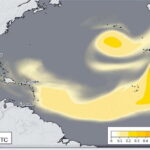
Although the thick plume of Saharan dust that blanketed Barbados over the weekend has moved away from the island, international atmospheric scientists are warning that additional dust could reach the region in the coming days.
Mark Parrington, senior scientist with the Copernicus Atmosphere Monitoring Service (CAMS), in an exclusive with this newspaper said the dust event that affected Barbados forms part of a much larger trans-Atlantic phenomenon that stretched thousands of miles from the west coast of Africa to the Caribbean basin.
The plume was tracked by CAMS (Copernicus is the European Union’s Earth Observation Programme), using satellite observations and atmospheric modelling, with data showing significant impacts across the Lesser Antilles, Puerto Rico, Cuba, Haiti, the Dominican Republic, Jamaica and the Cayman Islands.
“Our latest forecast shows that most of the plume has already cleared Barbados, but dust is still continuing to cross the Atlantic and more could be reaching the island this weekend and into next week. It does look as though the concentrations could be lower than the most recent plume,” Parrington said.
While the hazy skies that blanketed Barbados sparked concern among residents, Parrington noted that the event itself was not unusual by regional standards.
Main concerns
“The size of the plume and concentrations of dust are consistent with dust plumes we have monitored reaching the Caribbean over past years,” he said.
One of the main concerns associated with the dust plume is the increased concentration of PM10 particles, microscopic airborne particles capable of penetrating the respiratory system.
“Our forecasts, particularly of PM10 concentration at ground level, have been showing high concentrations reaching the Caribbean region and resulting in degraded air quality,” Parrington said.
“PM10 represents all particulate matter with an average diameter of less than ten microns, which means they can affect people who suffer from asthma and respiratory illnesses.”
Although CAMS does not directly assess health impacts, Parrington said its forecasting systems could identify areas where dust concentrations exceed internationally recognised air-quality guidelines.
He explained that differences in the severity of impacts between Caribbean islands often come down to geography and atmospheric circulation.
“The relative impacts across the islands will be due to their locations relative to the wind patterns that are bringing the dust to the Caribbean,” he said.
The Barbados Meteorological Services (BMS) first alerted the public to the approaching plume on May 29, when it was located about 1 375 kilometres east of Barbados.
At the time, forecasters anticipated the highest concentrations would arrive on June 1, and reduce visibility to around ten kilometres.
However, updated modelling prompted the BMS to issue a Significant Dust Haze Advisory on May 30, after projections showed the plume would arrive earlier than originally expected.
Thick plume
By May 31, meteorologists reported that a thick plume of Saharan dust was affecting the island and warned that concentrations would increase further overnight into Monday.
Residents, visitors and marine users were advised to expect reduced visibility and possible respiratory difficulties, especially those already suffering from breathing problems.
Visibility across Barbados and its coastal waters was still forecast to fall to around ten kilometres or less during the peak of the event.
Although conditions improved on Monday and the advisory was subsequently discontinued, health officials had already begun urging Barbadians to take precautions.
Four days before the dust arrived, the Ministry of Health and Wellness issued a public warning advising residents to prepare for a deterioration in air quality.
President of the Barbados Association of Medical Practitioners, Dr Lynda Williams said the current event appeared more extensive than many previous dust outbreaks.
“As we can see, it’s far more coverage with the dust than we have seen even in the past,” she said.
Williams urged asthma sufferers not to wait until symptoms developed before taking action.
“What I would encourage, especially those who have asthma, is to make sure that you use your maintenance steroid inhalers, if you have been prescribed one by a physician.
“For those who have been prescribed nasal sprays, this is the time to use them regularly. Then you will have much less possibility of having rhinitis and sinusitis triggered by the dust.”
Scientists are still studying whether Saharan dust events affecting the Caribbean are becoming more frequent or intense, but Parrington said no definitive conclusions have yet been reached.
“We haven’t yet performed an analysis along these lines with our data, but it is something we are planning to do,” he said.
He added that the relationship between climate change and Saharan dust transport remains complex and is still being examined by researchers.
“The role of climate change and different modes of climate variability have different impacts in terms of how much dust is generated from the Sahara,” Parrington said.
“There may also be some impact on the wind patterns across the Atlantic but it isn’t something we have analysed ourselves.”
However, for Parrington, the event highlights something larger than dust itself.
“The long-range transport of plumes such as this gives a clear indication of how people on opposite sides of an ocean can be connected through the atmosphere. In CAMS we are able to provide information on this by using satellite observations and stateof- the-art modelling,” he said. (NS)
The post More dust on the way, warn scientists appeared first on nationnews.com.