
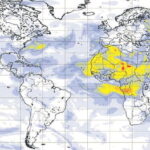
With Saharan dust outbreaks to remain a yearly reality, some immediate relief is in sight as forecasters are predicting improving conditions into next week.
Senior meteorologist with the Barbados Meteorological Services (BMS), Semelka Jackman, said while the island experienced one of its more significant dust events at the beginning of June, only a slight layer of dust remained over the island and was expected to ease last night with no major dust plumes expected through Sunday.
The forecast comes after residents spent several days coping with poor air quality, sinus irritation, watery eyes and respiratory discomfort as a thick plume of Saharan dust drifted across the island.
“We did have a thick plume of dust which affected us earlier this month. That was something we didn’t see last year, but we have seen even thicker plumes within the last five years that did come across and affect us. So it is comparable with what we’ve seen,” she said.
She noted that while every year did not produce extremely high dust concentrations, Saharan dust remained a regular feature of the Caribbean climate.
“We tend to get it more in the dry season, especially in the higher concentrations. But there is also Saharan dust within the atmosphere during the hurricane season. These high concentration levels are generally experienced during the dry season, but this year we saw that high peak at the beginning of the hurricane season.”
The massive plumes originate in the desert in North Africa, where strong winds lift fine particles thousands of feet into the atmosphere before transporting them more than 5 000 kilometres across the Atlantic Ocean to the Caribbean.
BMS previously relied largely on satellite imagery and visibility observations to assess the severity of dust outbreaks.
Jackman revealed that the BMS was introducing additional air-quality monitoring equipment that would allow forecasters to more accurately measure the concentration of dust particles.
The new sensors will provide scientists with more detailed information about airborne particles and air quality levels, making it easier to compare future dust events and assess their impact on public health.
Currently, forecasters use a combination of satellite imagery and predictive computer models to track dust plumes from the moment they leave Africa.
“You can actually see the air mass with the dust on satellite imagery in real time, so you know when something is to the east of us coming in or coming off Africa,” Jackman explained.
One of the most obvious effects of Saharan dust is the reduction in visibility as the dust creates a hazy, milky-white appearance in the atmosphere, making distant objects harder to see.
Challenges
While such conditions generally have little impact on motorists and everyday activities on land, they can present challenges for mariners.
“If there’s a moderate amount of dust in the atmosphere, we tend to have our visibility reduced to about 15 kilometres. If it’s thick, visibility might reduce to ten kilometres and very thick conditions could bring it down to five kilometres,” she explained.
The meteorologist said fishermen and other marine operators often used coastal landmarks and visible reference points to help determine their position offshore.
“If you are 15 kilometres out and your visibility is reduced to 15 kilometres, then you might not be able to see where you’re supposed to be. There may be the possibility of sea collisions because you aren’t able to see the boats that might be around if you are using visibility to help you.”
Although many commercial vessels are equipped with navigational technology to assist in low-visibility conditions, she urged mariners to remain vigilant whenever dense dust outbreaks were forecast.
Beyond affecting air quality and visibility, Saharan dust can also influence weather patterns across the region.
Because the dust originates from one of the driest places on Earth, it is accompanied by very dry air.
“So when you have dust, the atmosphere tends to be drier. You need moisture for rainfall, so you wouldn’t get as much rainfall during that time,” Jackman explained. The same dry air can also suppress tropical cyclone development as storms and hurricanes need moisture to develop.
“If there is a lot of dust around, it can hinder that development or weaken a system.” (NS)
The post Relief in sight from dust appeared first on nationnews.com.