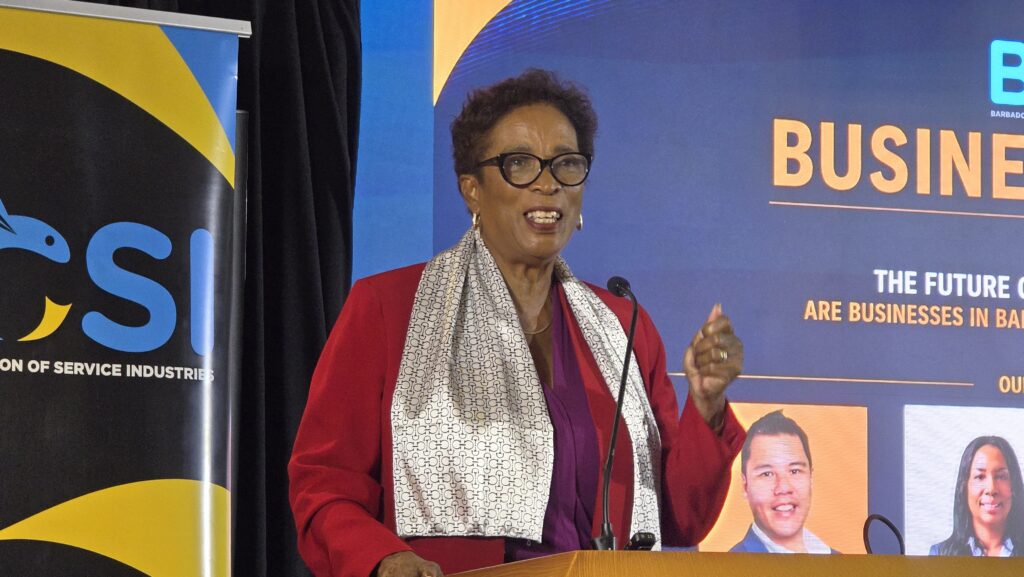
As the world moves more confidently to embrace artificial intelligence, Barbados must strengthen its digital skills to seize the opportunities the digital economy presents for small island developing states, Minister of Training and Tertiary Education Sandra Husbands has said.
Addressing the Barbados Coalition of Service Industries (BCSI) Business Forum on Friday, Husbands said digital competence had become as fundamental as literacy and numeracy and should begin from an early age, stressing that stronger digital skills were essential to improve productivity, create global opportunities and accelerate economic growth.
She declared that the digital economy could help overcome many of the disadvantages faced by small island developing states, including limited land, natural resources and population size:
“Artificial intelligence, automation, data analytics, robotics and digital platforms are not simply transforming industries, they’re reshaping the very nature of work itself. Jobs are evolving, entirely new careers are emerging, and the ability to continuously learn and adapt has become one of the most valuable skills any individual can possess, which means that we have to educate people to embrace continuous learning.”
She also urged Barbadians to embrace and market their own culture, saying it was key to succeeding on the international stage:
“Without celebrating ourselves, we cannot take advantage of the global stage. If we do not celebrate the cultural products, the things that we do, we are not going to commercialise them well and take them across the world.
“The digital revolution will give us the platform.”
Husbands told the forum, held at the UWI Cave Hill School of Business at the conclusion of the BCSI’s week of activities, that as jobs continue to evolve and entirely new occupations emerge, Barbados must position itself to keep pace.
She revealed findings from the National Digital Assessment, which exposed significant digital skills gaps throughout the Barbadian workforce.
“The assessment found that approximately 41 per cent of employees lack the essential digital skills required in today’s workplace, while 39 per cent of managers recognized the need for digital upskilling, but they lacked structured pathways and resources to address those gaps.
“Digital skill deficits were identified across age groups, geographic and socioeconomic categories. These findings make it clear that digital transformation is not simply a technology challenge, it is a people challenge.”
The skills minister also highlighted the need to equip seniors with digital skills to help them live independently and manage their daily activities online:
“We have telemedicine. They can order from the pharmacy. They can pay their bills, and not be by a bus stop in the hot sun waiting for a bus or a ZR to be able to go and do business and be totally exhausted for the next two days after that excursion. That has to stop and digital training is going to empower them to do this. This is the whole-of-country work that we are speaking about, and therefore, we have to put our hands to this task.”
Husbands suggested a national digital transformation strategy to accelerate growth and position Barbados as a stronger player on the international stage.
To achieve that goal, she announced the National Digital Skills Empowerment Campaign, a two-track programme aimed at businesses and the wider public.
The first component is the Digital Workforce Accelerator:
“One track is primarily for businesses, where our aim is to be able to sit and understand what are the specific needs you have if you’re in the tourism industry, or if you’re in the financial services industry, or if you are doing retail. What are the specific skills you need your team to know in order to function in this digital environment?”
The second track will focus on training the wider public:
“The second track is the wider national track, which will embrace using our community development facilities, our schools, private sector providers to be able to train the general public, and one of the most important partners there will be NTI.”
Barbadians have already taken up more than 12 000 NTI digital courses, but many more people still needed to be trained, Husbands said. To encourage wider participation, the programme would offer both online and classroom-based learning, recognising that many people were more comfortable learning in a traditional classroom setting.
(LG)
The post Govt launches digital skills drive appeared first on Barbados Today.