Scientists at the Barbados Atmospheric Chemistry Observatory (BACO) are investigating whether Saharan dust plays a role in the growth of the sargassum seaweed that continues to wash up across the island and the wider Caribbean.
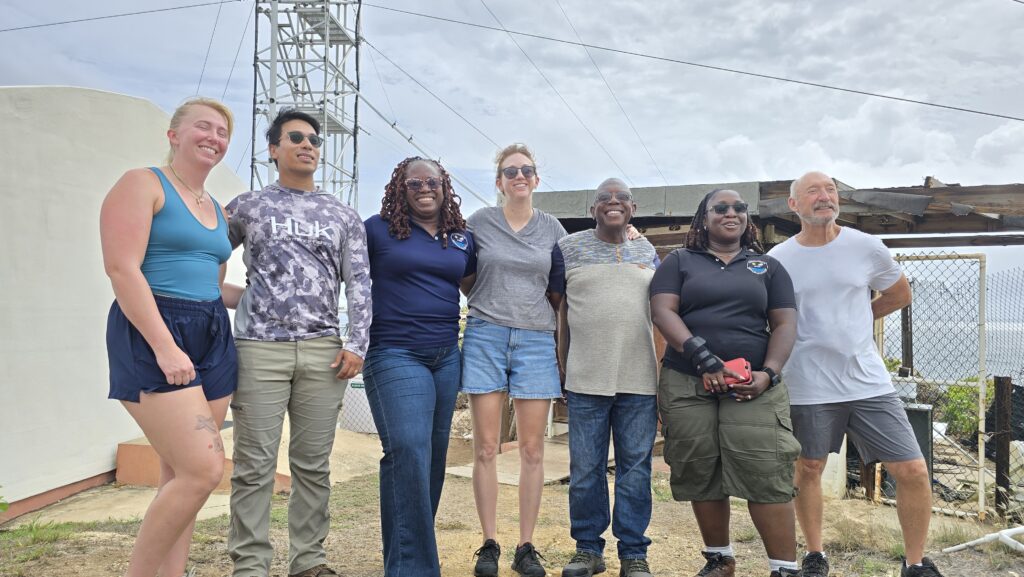
The research was revealed on Monday during a press briefing at the Ragged Point Station as it celebrated 60 years of continuous atmospheric measurements, making it one of the world’s longest-running climate and aerosol monitoring sites.
Professor of Atmospheric Sciences at the University of Miami and Principal Investigator for the Ragged Point research site, Professor Cassandra Gaston, said the station has helped scientists understand the long-range transport of Saharan dust to the Caribbean, North America and the Amazon.
She explained that while Saharan dust is known to trigger respiratory illnesses and reduce hurricane activity, researchers are now exploring whether it also contributes to the growth of sargassum.
“We’re also curious about how the dust affects sargassum. That’s a new area of interest for us because what’s feeding all the sargassum that’s washing ashore on Barbados – is the dust playing a role?”
Professor Gaston told reporters the research is still in its early stages and scientists do not yet know how significant the relationship may be.
“That’s really just ongoing research. We don’t know, honestly, how the dust is affecting sargassum. We know that the dust transport is following the wind, and so is the sargassum, by following the ocean current. We know the dust has really important nutrients for marine life and so that’s actually something we’re really curious to look into.
“Not just for understanding how the dust might be feeding the sargassum, but is there some way we can mitigate the sargassum before it comes here?”
Saharan dust also provides environmental benefits by supplying nutrients that fertilise ecosystems and help remove carbon dioxide from the atmosphere, she explained: “The dust provides nutrients, so this is really important. We care a lot about climate, and in particular, we’re looking at ways to get carbon dioxide out of the atmosphere, and the ocean and the biosphere do that for us through photosynthesis.
“The dust provides nutrients that help get that carbon sequestered into the ocean and into the biosphere. It’s a natural way of regulating the climate, so we need the dust because of that.”
The hot, dry air associated with Saharan dust also weakens hurricanes by reducing the moisture they need to intensify.
“With the dust you get this very hot, dry air layer, and that basically takes away the fuel from hurricanes, which rely on having a lot of moisture in order to sustain their intensity. That’s something that a lot of our colleagues, and NOAA, have been studying for some time now.”
Professor Gaston also revealed that researchers are beginning to observe more Saharan dust outside the traditional dust season.
“Where we’re getting more dust than usual has actually been in the wintertime and springtime. We’re starting to see upticks in how much dust comes during that season, which isn’t the peak dust season.
“We’re also getting a lot of smoke from fires in Africa coming in winter and spring as well, so we had a really large event that happened last winter that was pretty unprecedented for anything we’ve ever seen in our long-term record.”
As the station marks its 60th anniversary, the dust researcher highlighted its importance to global climate research: “There’s no long-term climate or aerosol records like this that exist other than here at Ragged Point. It’s been a really pivotal site, and it’s been really fundamental for the scientific community globally.”
The long-term record is also helping to improve forecasting, she said.
“You need a long-term record in order to improve forecasting and models. For CIMH, the dust record is really important for improving air quality forecasts.”
During heavy dust events, Professor Gaston advised people with respiratory illnesses to take precautions.
“When the Saharan dust is coming, if you know you have a pre-existing condition, following the same kind of protocols that we did during COVID would probably be a good idea. Masks are very effective for particles like dust.”
Meteorologist at the Caribbean Institute for Meteorology and Hydrology (CIMH) Dr Andrea Sealy is chair for the Pan-American region of the World Meteorological Organisation’s Sand and Dust Storm Warning Advisory and Assessment System. She said regional agencies are working more closely with the health sector to improve public advisories during Saharan dust events.
“The advisories we were working on were tailored specifically to Saharan dust incursions. That is one approach in terms of getting multiple sectors together to work together.”
Research into Saharan dust has also expanded to examine its effects on renewable energy, public health, microorganisms and hurricane development, Dr Sealy said.
Retired microbiologist Dr Edmund Blades, who has been associated with the Ragged Point facility for more than 30 years, praised the University of Miami’s longstanding commitment to Barbados:
“I’ve seen the investment in terms of equipment, in terms of people coming down, in terms of them being willing to collaborate in so many areas that that’s important. I think that legacy over time is what helps the Barbadian population to really appreciate the work they’ve been doing here.”
(LG)
The post Scientists probe Saharan dust–sargassum link appeared first on Barbados Today.