Agriculture officials are preparing to scale up domestic food production with plans to expand upland rice cultivation to ten acres at the Pine Basin, following the successful completion of the third phase of a China-Barbados agricultural project that officials said could reduce reliance on imported staples.
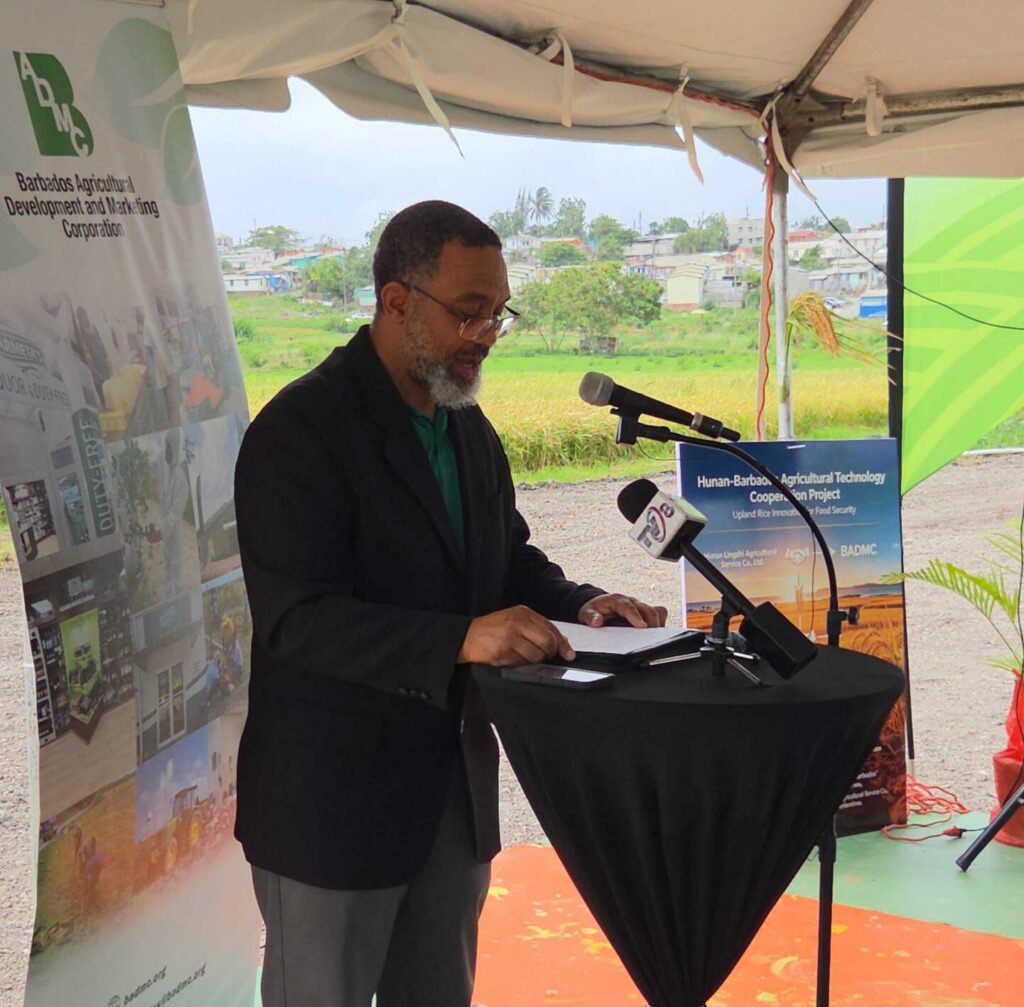
The announcement was made during the “Golden Sickle” shared food security harvest ceremony, marking the successful completion of the hybrid upland rice demonstration project under the China-Barbados Agricultural Cooperation programme.
The initiative, a joint venture between the ministry, the Barbados Agricultural Development and Marketing Corporation (BADMC), and China’s Hunan Lingshi Agricultural Service Company Limited, is being promoted as a major step forward in the island’s self-sufficiency drive
Frederick Inniss, acting CEO of the BADMC, revealed that the current two-acre (one-hectare) plot at Pine Basin will serve as the launch pad for full-scale commercial rice development:
“Under the cooperation agreement, the Hunan Longshi Agricultural Group and the BADMC propose to expand to a total of ten acres at this location for commercial rice production. This initial hectare is the first step in the full-scale commercial development and production of upland rice on the island of Barbados.”
The partnership has evolved far beyond a simple technology demonstration into a comprehensive strategic alliance, he said, noting that the project is successfully laying the foundation for long-term agricultural resilience by strengthening technical capacity, introducing innovative production systems, and supporting mechanisation.
“The demonstration trials proved that this crop could be successfully produced under local conditions, creating exciting opportunities for local grain production and a potential opportunity for reduced dependence on imported staples.”
The path to commercial rice farming has been paved by the earlier phases of the bilateral agreement. The first phase focused heavily on climate-resilient infrastructure and capacity building. Through farmer field schools, practical field demonstrations and technical training, more than 100 farmers, extension officers and agricultural professionals within the ministry gained hands-on experience.
Training covered greenhouse vegetable production, irrigation management, crop nutrition, and integrated pest and disease management.
Beyond rice, the programme successfully trialled a wide variety of specialty crops provided by the Hunan group, including sweet corn, pumpkin, eggplant, radish, melons, cucumbers, tomatoes and Chinese cabbage, all of which demonstrated impressive production potential, according to officials.
The collaboration also addressed the needs of smallholders by introducing compact micro-tillers. According to Inniss, these practical mechanisation options have direct relevance to national initiatives such as the ministry’s ‘Feed and Care’ programme, whose participants operate on relatively small parcels of land.
The second phase expanded the trials into larger demonstration plots to evaluate commercial viability and gather vital data, setting the stage for the current breakthrough at Pine Basin.
The technical milestones of the third phase leading to harvest underscore the efficiency of the new systems. According to data presented by the Hunan technical team, the project successfully utilised advanced mechanised strip drilling technology.
The automated system achieved a seedling uniformity rate of no less than 95 per cent and an emergency rate exceeding 90 per cent. Now, a three-acre plot can be fully seeded in five hours. Compared with traditional manual broadcasting methods, this mechanised approach reduces labour input by over 80 per cent and boosts overall operational efficiency by five to eight times.
Environmental sustainability has also been a focus. The upland rice variety relies primarily on natural rainfall, requiring supplementary irrigation only during dry spells. Over its 120-day growth cycle, the system reduced irrigation water consumption by 50 to 70 per cent compared with conventional flooded paddy rice farming, proving to be highly suitable for Barbados’ water-scarce environment.
To support the expanded acreage, the BADMC and its Chinese partners have imported specialised field equipment, as well as agro-processing machinery required to mill and prepare the raw paddy into table-ready rice.
Inniss expressed gratitude to the technical teams of the BADMC, its tractor services and irrigation departments, and the Hunan team leader, Jiang Wang — also known as Alan — for their efforts.
He said: “As we continue to deepen this collaboration, we remain committed to adopting innovative technologies and sustainable production practices that will improve productivity, strengthen food security, and position Barbados as a leader in agriculture and innovation within the Caribbean region.”
(RR)
The post Govt to expand upland rice production to ten acres at Pine Basin appeared first on Barbados Today.