
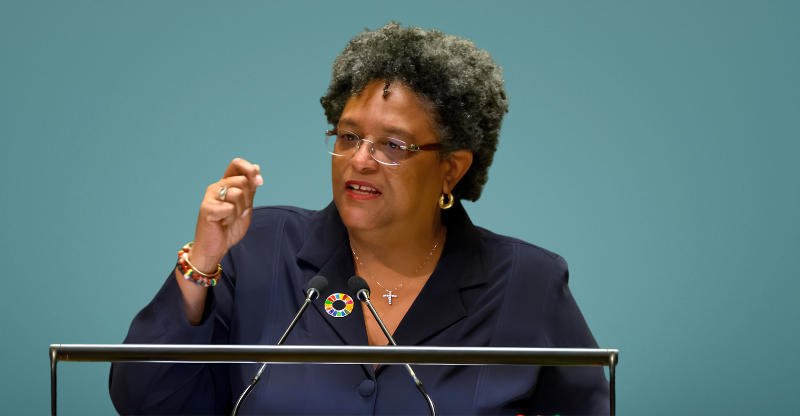
A new law will require employers to pay workers on their scheduled payday, with late wages permitted only in genuine emergencies, as the Mia Mottley administration moves to tighten protections around pay and deductions.
Leading the second reading of the Protection of Wages Bill in the House of Assembly on Tuesday, Prime Minister Mia Mottley said the measure is designed to protect workers’ rights and reinforce the principle that wages belong to employees, not employers.
“A wage packet is not an accountant entry. It is rent, it is bus fare, it is school lunch,” she said. “This is what helps people buy food or may have to go for prescriptions. It allows people to keep their body and their dignity safe.”
She explained that clause 3 of the bill requires every employer to establish a recurring pay period and a recurring payday, giving workers certainty to organise their finances.
“That certainty is critical for employees to plan out their lives,” Mottley said.
Under the proposed law, wages earned during a pay period must be paid no later than the designated payday. Employees paid by the hour, day or week must be paid weekly, those on a fortnightly schedule at least every fortnight, and those on monthly salaries at least once a month.
Breaking down the provisions in simple terms, Mottley said she wanted “every worker from the fields to the factories, from the hotels to the homes” to understand what the legislation would guarantee.
The bill does not require every employee to be paid weekly; instead, it protects whatever regular pay cycle has been established.
Using the current minimum wage as an example, Mottley noted that a worker earning the minimum rate of $10.71 per hour and working a 40-hour week should receive $428.40 before deductions.
“That money is earned,” she said, adding that workers have already committed those wages to expenses such as rent, mortgages, transport, food and back-to-school costs.
“A worker should not have to lend it back to any business by waiting beyond payday,” she said, adding that delayed wages should occur only in cases of genuine catastrophe or emergency, “but cannot be part of the everyday reality of our workers”.
The prime minister also outlined new safeguards governing wage deductions, stating that deductions would require the worker’s written consent, while employers would be prohibited from charging interest on wage advances.
“So a man can’t say: ‘I am going to give you $1 000, but you must pay me back at ten per cent.’ That’s prohibited, and it is a criminal offence.”
Employer-imposed fines and deductions for poor or negligent work would generally be prohibited, except in limited circumstances involving property damage outlined in the legislation, Mottley added.
She encouraged workers who are uncertain about any deductions to seek advice from their union or the Labour Department, adding that where notice is required for a permitted deduction, employers must clearly explain the reason.
(SB)
The post Payday to become legal obligation under wages bill appeared first on Barbados Today.