

Agricultural officials on Tuesday rejected assertions that poultry farmers are being undercut by state-sanctioned imports, insisting that foreign supply remains strictly managed and data-driven to protect domestic producers.
They were responding to James Paul, chief executive officer of the Barbados Agricultural Society (BAS), who criticised what he termed contradictory government policy. He argued that while the state provides assistance to expand poultry production, the state-owned agricultural corporation simultaneously permits imports of poultry and pork from regional and extra-regional sources.
He warned that increased imports are undercutting domestic producers at a time when both large and small domestic operations are expanding, contributing to a storage capacity crisis in which small farmers are struggling to sell their stock and facilities such as the BICO cold store are nearing capacity. Ownership changes at key storage facilities have created widespread fear among small farmers over potential fee increases, reduced profit margins, and possible business failure, he added.
But senior officials within the Ministry of Agriculture and the Barbados Agricultural Development and Marketing Corporation (BADMC) dismissed claims that state imports are harming the industry – although they restricted their remarks to the poultry industry.
At a press briefing at the ministry’s Graeme Hall, Christ Church office, Chief Agricultural Officer Paul Lucas said the BADMC, the designated state enterprise responsible for managing poultry imports, rigorously controls volumes throughout the process.
Presenting data for the first six months of 2026, Lucas highlighted that domestic demand remains robust while import volumes have actively fallen.
”As stated earlier, the poultry production in Barbados has increased within the last five years, and it is evident that Barbadians love chicken,” Lucas told reporters. “It is also the preferred protein source among many residents. So for the first six months of this year, 2026, Barbadians consumed more than 8.4 million kilogrammes of poultry, and more than 90 per cent was local production.”
The chief agricultural officer pointed out that foreign imports had declined notably over the same six-month period compared with the previous year.
Lucas noted a year-on-year decrease in imports from 582 446 kg in 2025 to 485 840 kg this year.
“And so based on this data, we are able to determine that the imports have not overshadowed the local production,” he said.
BADMC acting chief executive Fredrick Inniss detailed the regulatory frameworks governing the corporation’s purchasing decisions. He explained that following extensive engagement with poultry industry figures dating back to 2021, the BADMC board instituted severe import restrictions to protect market share.
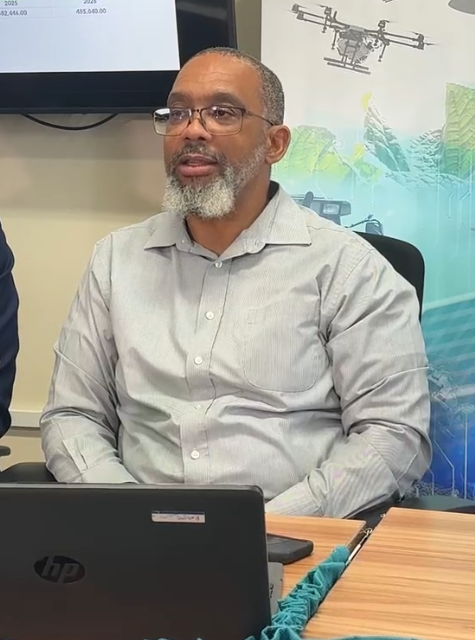
Acting CEO BADMC, Fredrick Inniss. (Photo Credit: Ministry of Agriculture and Food Security)
Inniss said: ”In that construct, we actually limit the importation and sale, particularly during what is termed the off-shoulder periods, the periods of time where we have lower commercial activity, such that the sale into the island is restricted to about 45 000 kilograms of chicken wings specifically.”
He emphasised that while the BADMC facilitates the importation of items such as turkey wings and turkey necks, management works to maintain access in line with formal agreements. Occasional spikes in past imports were targeted measures designed to address deficits rather than undermine farmers, he said.
”Over the course of the last few years, the BADMC, in conjunction with the Ministry of Agriculture and the stakeholders… identified periods where there was a need to import poultry products to bolster where there were periods of difficulty within the local sector specifically.”
Inniss cited whole-chicken import figures of approximately 290 000 kilograms in 2024 to address shortfalls.
“So it is not simply a wholesale case of the BADMC bringing chicken wings or whole chicken product onto the island to the detriment of the sector. We actually are working assiduously to ensure that we work hand in hand with the sector.”
Dialogue continues through a dedicated poultry committee managed by a senior ministry officer, ensuring that industry concerns are continually evaluated, the BADMC chief added.
Deputy Chief Agricultural Officer Barry Callender told reporters that ministry decisions were grounded in objective data gathered directly from producers, restaurants, and industry players.
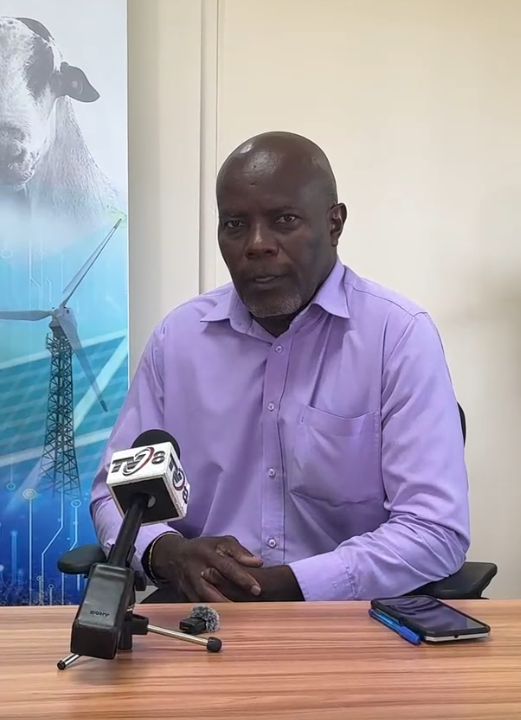
Deputy Chief Agricultural Officer Barney Callender. (Photo Credit: Ministry of Agriculture and Food Security)
”The ministry is responsible enough not to go out there and make wild decisions based on no facts,” Callender said. “The ministry is not going to allow importation that is going to hinder or bring the production of the local farmers into question.”
Acknowledging the growing output from farmers, Callender noted that the market’s primary challenge may stem more from homegrown success than from foreign competition.
”The production levels within the sector have increased significantly, and that is something that we as a poultry committee and a sector have to look at to see how best we can make sure that the farmers are still satisfied and in some way not hindered by the overproduction.”
(RR)
The post Agriculture officials reject BAS poultry import claims appeared first on Barbados Today.