
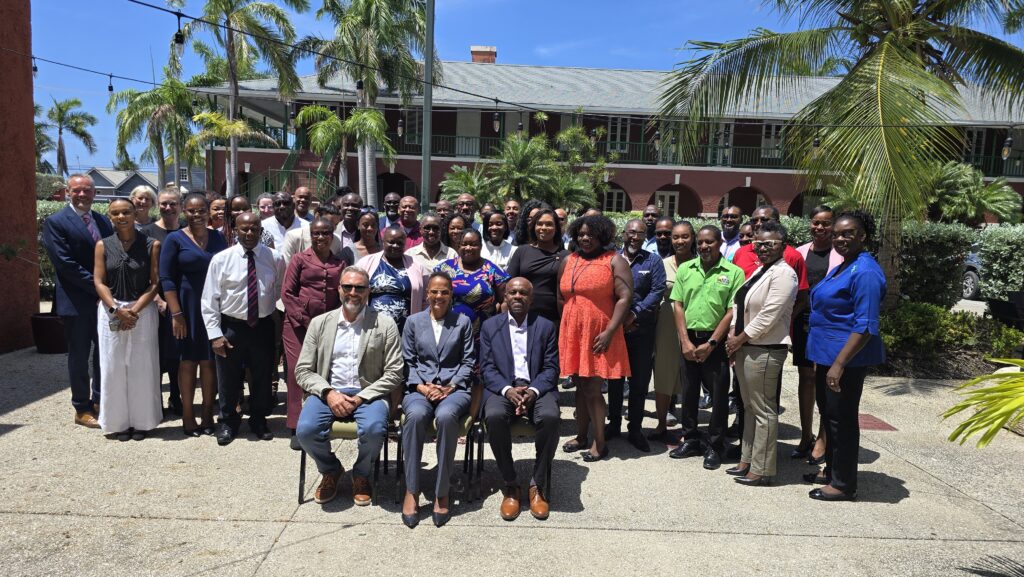
Barbados must strengthen the data and reporting systems that support its climate commitments to show results in its quest to secure international climate finance, Deputy Prime Minister and Minister of Environment Santia Bradshaw has said.
As agencies involved in environmental protection gathered for a workshop and consultation to strengthen institutional and technical capacity, Bradshaw called for greater transparency to meet requirements of the Paris Agreement, the legally binding international treaty on climate change.
“Put simply, what we cannot measure and what we cannot properly manage and what we cannot demonstrate, we will find increasingly difficult to finance,” Bradshaw told the inception workshop and first round of formal consultations for the Global Environment Facility (GEF) Capacity Building Initiative for Transparency (CBIT) project.
Transparency was necessary for Barbados to measure its climate action, demonstrate results and strengthen its ability to access international climate finance, Bradshaw said.
“Climate change is not a distant threat for Barbados. It is also not an abstract issue to be discussed only at international conferences. It is a reality that is already affecting our communities, our economy, our infrastructure, our coastline, our water resources, our food systems, and the future opportunities which are available to our people.”
Barbados therefore had to measure, manage and communicate its response to climate change, she said, adding that the initiative was about more than reporting.
“Today, therefore, it is not simply about reporting. It is about strengthening how Barbados governs climate action. It is about strengthening our ability to measure national progress. It is about building the evidence that allows us to make better decisions.”
As each signatory to the Paris Agreement is required to identify its own contribution to fighting climate change – known as nationally determined contributions (NDCs) – Barbados has submitted its second NDC, maintaining its commitment to a 1.5-degree pathway and targeting a 45 per cent reduction in absolute emissions below 2008 levels by 2035.
Demonstrating results was also critical to securing international climate financing, the environment minister added.
“And if we are going to seek international climate finance, we must be able to show where the money is going and what it is achieving. And if we’re going to call on the international community to increase its ambition, then we must be able to demonstrate our own progress.”
Bradshaw said transparency should not be viewed simply as an international reporting obligation but as a “national strategic asset” that could help Barbados demonstrate progress, identify gaps and determine where policies were working.
The CBIT project is intended to strengthen the systems needed to measure, verify, report and demonstrate the impact of Barbados’ climate actions.
“If we are investing in climate-resilient agriculture, for instance, we need to be able to measure the results. If we are supporting renewable energy and clean technology, we need to be able to quantify the reductions. If we are protecting our natural resources, we need to be able to demonstrate the environmental benefits.”
Bradshaw also called for greater coordination among government agencies, noting that climate change cuts across every area of national development.
“We cannot operate in silos, and therefore if something is happening in the Ministry of Energy or the Ministry of Agriculture or Environment, it is important that we see ourselves as stakeholder agencies working to achieve common results.”
She said transparency could not be the responsibility of one ministry.
“Climate change cuts across every part of our national development, and that is why transparency cannot be the responsibility of any one ministry. It must be a whole of government approach and a whole of government responsibility, and ultimately it is a whole of country responsibility.”
Stronger transparency systems could improve coordination, standardise data collection, strengthen quality assurance, reduce duplication and support evidence-based policymaking, Bradshaw added.
But she said the ultimate purpose of climate data was to improve Barbadians’ lives.
“Climate policy is not simply about tons of carbon dioxide. It is about families, it is about livelihoods. It is about business. It is about our core strengths. It is about our food, our security, and the prosperity of future generations.”
The CBIT project, valued at US$1.25 million (Bds$2.5 million), is being implemented with the Inter-American Development Bank (IDB) as implementation partner.
IDB Chief of Operations Francesco De Simone said its main objective was to support Barbados’ transparency framework through the design and implementation of a domestic monitoring, reporting and verification system for the country’s nationally determined contribution.
“This operation serves as the anchor for other initiatives supported by the IDB to strengthen national systems for efficient and consistent reporting in line with the enhanced transparency framework under the Paris Agreement.”
He said the initiatives aligned with the IDB’s Barbados country strategy, particularly its focus on climate resilience, and stressed the importance of coordination among government agencies and stakeholders.
“All of these activities are well aligned with the IDB country strategy with Barbados and specifically with one of the pillars of our country strategy that focuses on climate resilience. The bank encourages close coordination and collaboration among the relevant agencies and key stakeholders to establish synergies and ensure efficient use of resources.”
Bradshaw encouraged stakeholders participating in the consultation to provide constructive feedback and take ownership of their respective roles.
She said Barbados’ international advocacy on climate finance must be matched by strong domestic systems.
“Our advocacy internationally must be matched by capacity at home and therefore if we are calling for greater climate finance, we must be able to demonstrate what it is achieving.”
Bradshaw said the CBIT project provided an opportunity to strengthen Barbados’ credibility and ensure its climate commitments were backed by evidence and measurable results.
(LG)
The post Barbados seeks stronger climate reporting systems appeared first on Barbados Today.