
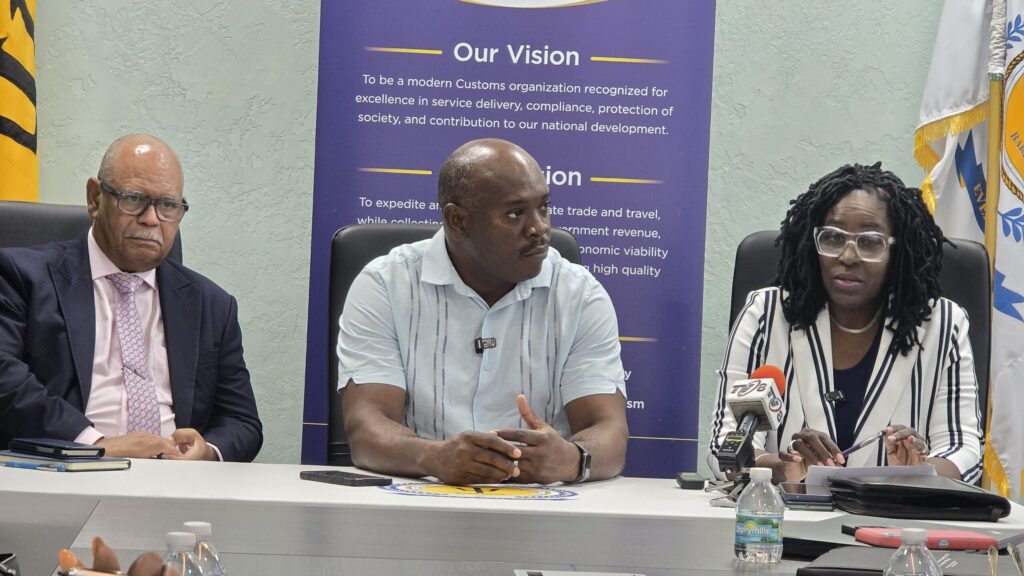
Minister of Finance Ryan Straughn has warned businesses not to submit false or unrealistic invoices, explaining that under-invoicing hurts revenue collection and gives some businesses an unfair advantage over their competitors.
Straughn issued the warning at a press conference on Tuesday as part of the 121st anniversary celebrations for the Customs and Excise Department.
The minister admitted there are challenges in making sure businesses submit the right invoices so the department can collect the correct amount of revenue. He said they are working with stakeholders to fix these problems.
“If you have one set of businesses not supplying the appropriate information, it provides an unequal playing field with respect to competition in the economy, and therefore it is important that we ensure that everybody is paying the same levels of duties and taxes into the system so that at least the playing field is as level as it can be,” he said.
Straughn stressed the importance of compliance as Barbados prepares for a Financial Action Task Force review next year, 2027, warning that the country must ensure it stays off international monitoring lists for money laundering and terrorist financing.
“It is important that we get these trade-related issues resolved as part of Barbados being able to indicate that we’re on top of these issues so that we don’t get onto a gray list, black list, orange list, blue list, any list.
“We want to stay off the list, and it’s important that the trade side, and we’re going to be communicating more with the stakeholders on that moving forward, as to why it is important and therefore, we want to urge the public, whether you’re an individual or business, to ensure that you submit the right information at the right time,” he further added.
The Finance Minister also highlighted how important Customs is to revenue collection. He pointed out that the department brings in nearly one-fifth of the government’s total income, which helps fund public health, education, and social programmes.
“The truth is that the Customs Department collects about 20 per cent of the government’s overall revenue, and that is critically important to supporting the public policy that the Barbados government has executed over the years. We all in this room have enjoyed free education…we also support a very strong and robust public health infrastructure, allowing Barbadians not to go bankrupt as is the case in some other places…The revenue that Customs collect, support, along with a range of other social interventions that the government wishes to execute to ensure that those of us who are most vulnerable in society, that we can ensure that we can look after them as best as we can and therefore the Customs Department job is very important.”
Straughn outlined the main concerns facing the department when businesses fail to comply.
“From the ministry’s perspective, you have 3 things going on at the same time: 1) you present information that is fraudulent– that potentially means that revenue is not being collected in the way that it should be—and that could be either the values that you’re submitting for the particular items or 2) a misclassification within the tariff which then obviously cascades through the process and therefore 3) we want people to give the information up front, so that our post clearance function is not burdened with respect to more work at the back end.”
He said that making trade easier depends on businesses giving the right information from the beginning.
“If you are bringing in vitamins, but when we check, you realise that you have crystal meth on these types of illicit substances packaged as if they were vitamins, that presents not just a border security issue but a really public health issue for the country. This is not legitimate trade which is why compliance matters.”
The new Comptroller of Customs, Lynette Padmore, also raised concerns about businesses that get government concessions. She said these concessions can be given for manufacturing, raw materials and equipment.
“We have had experiences with this before, where persons import, and they’re granted concessions for raw materials, they’re granted concessions for equipment, etc., and when we turn up to the premises to verify that these are what were imported and what are supposed to be used in your manufacturing process, the items are not there,” she said.
“We also have persons who may import under concessions, and then the items are disposed of in a manner against what they would have been imported for, so those levels of compliance are also necessary because if the government is assisting you, we would expect that you help us.”
Straughn said tourism investment benefited from the Tourism Development Act and other special development legislation, contributing to an increase in concessions following the COVID-19 pandemic.
He also pointed to rising global costs, particularly in the construction sector, which raised the value of concessions.
“Obviously, the demand for construction materials within the context of tourism, especially investment, has been the key driver during that time as well.”
The Finance Minister also explained that concessions included incentives for electric and hybrid vehicles as the Government pursued its objective of greening the national vehicle fleet. He said those incentives will soon come to an end.
“So government’s policy has been over the last 4 years to try to green the country’s fleet so the transport board, for example, almost 100 per cent of its fleet now is electric and therefore, Government transportation as well as private transportation, you’ve seen a significant increase in that, and therefore we took a deliberate decision to incentivize the greening of the country’s fleet.”
“Now we will transition and move that back to normal soonest, but the reality is that we needed to make sure that we reduce the amount of gasoline and diesel vehicles coming into the country, and therefore that was part of the reason for that.”
Straughn acknowledged that the department does not have enough staff to inspect businesses daily, so compliance and trust are very important.
He said businesses receiving concessions for a specific purpose are expected to use them accordingly, while Government is looking at digitally tracking inventories across the economy.
“That’s why we work with the Chamber of Commerce and the Small Business Association and Manufacturers Association to try to make sure that the service sector and those service organisations can also help to enforce the standards that we want to be able to have enforced.”
(LG)
The post Customs flags misuse of business concessions appeared first on Barbados Today.