
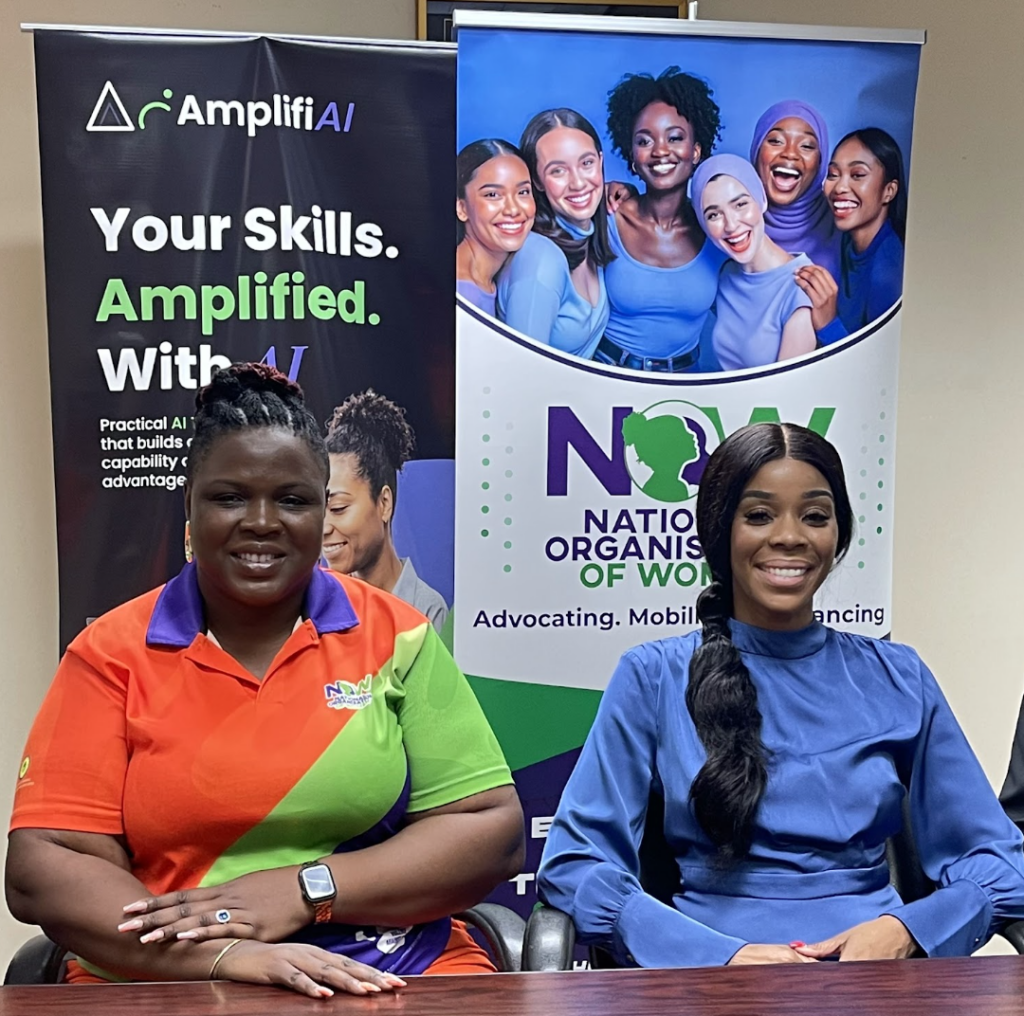
Artificial intelligence could help female entrepreneurs overcome the cost of hiring additional help as they grow their businesses, according to National Organisation of Women (NOW) president Melissa Savoury-Gittens.
Savoury-Gittens said women who operate small businesses need assistance but cannot afford to hire an employee, making AI a potential low-cost alternative for handling some of their day-to-day tasks.
“When we did the digital marketing class earlier, we had people that had businesses, but a lot of persons are small businesses. They need help,” she said.
“So they may need an assistant, but guess what? They cannot afford to pay an assistant. And that’s where AI comes in.”
She was speaking during the launch of NOW’s “Build a Business with AI” programme, in partnership with AI capability firm Amplifi AI Inc, at the Ministry of People Empowerment and Elder Affairs in Warrens.
Savoury-Gittens suggested that AI could assist entrepreneurs with tasks including managing emails, responding to text messages, handling customer enquiries and organising calendars.
“AI can read our emails for us. They can respond to our messages for us.
“So when you put your ads out there, you can get an automated response and you can get things put in the program. You can have your calendar started.”
She stressed that the intention was not to discourage entrepreneurs from eventually employing people, but to help them manage their operations while they are unable to afford additional staff.
“So instead of paying for an assistant, we’re going to teach you now how to make AI your assistant that can do all the work for you that you can still advance in your business,” Savoury-Gittens said.
Chief executive officer of Amplifi AI Inc, Janelle Germain, said the affordability issue also extended to access to quality AI training. Germain said the company’s research had found that even “even at the highest executive level, people understand the most basic aspects of AI”.
She said: “They think of AI, they think of ChatGPT. They think of AI, they think of creating a few, maybe writing an email or preparing a quick document. But there’s so much that can go into utilising and achieving in AI if you know how to do it.”
According to Germain, this creates another divide between people who can afford specialised training and those who cannot.
“The persons that can afford, they will be trained and they will get ahead.
“Then there’s a gap between the persons who may not be able to afford the level of training required to be able to advance their skillset in AI.”
The training programme was therefore aimed at making practical AI training more accessible to people involved with NOW, said Germain.
Savoury-Gittens also raised concerns about the broader challenges facing NOW and its ability to continue its work supporting women.
She said while there had been a decline in volunteerism generally, she believed NOW remained in a strong position.
“I think that NOW is even in a stronger position now… than opposed to 10 years ago.”
But she cautioned that having more women in positions of influence did not mean the work of advancing women’s rights was finished.
“We still need to continue to fight for women, and we still need to continue to help advance and empower our women.”
As NOW had a significant amount of work to undertake, its presidency should eventually become a paid, full-time position, Savoury-Gittens said.
“I think that the presidency of NOW should be really be a full-time position, a paid position, because there is so much work to be done.”
She noted that NOW receives “very minimal” government assistance, leaving it dependent on partners, sponsorships and grants to sustain its work.
“That’s why we need partners, and that’s why we’re out there always asking and pleading, um, to get sponsorship, grants, and all those other things we’re trying to get so that we can sustain the organisation.”
(LE)
The post AI seen as affordable alternative for women entrepreneurs appeared first on Barbados Today.