
After 40 years of decline, coral reefs numbers in Barbados and the Caribbean are under serious pressure. Now, a new global assessment warns that decades of coral reef decay are worsening because of rising ocean temperatures, coral disease, unsustainable fishing and the growing impact of sargassum.
The recently released Status of Coral Reefs of the World: 2025 report, supported by the Global Coral Reef Monitoring Network (GCRMN) and the International Coral Reef Initiative (ICRI), shows that reefs are changing at an unprecedented rate.
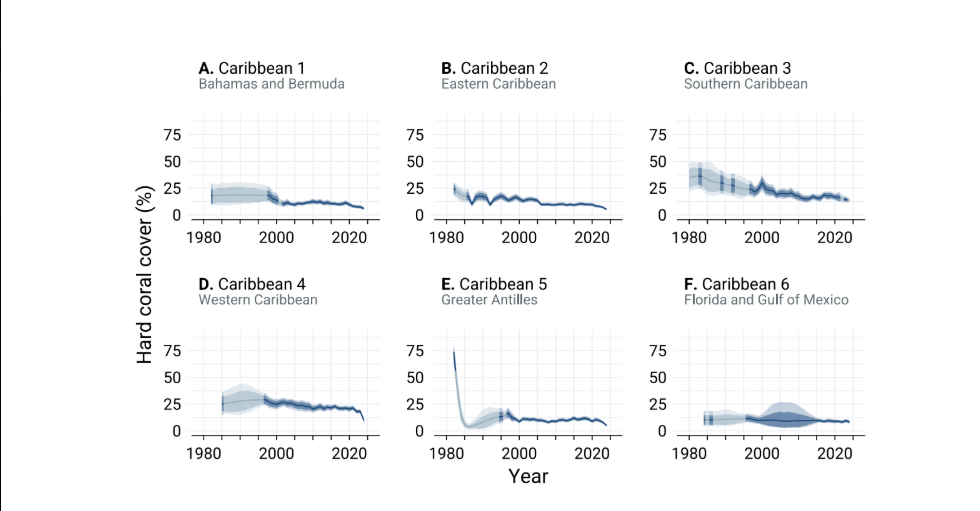
Modeled temporal trends of hard coral cover in Caribbean subregions from 1980 to 2024. The solid line represents the estimated median hard coral cover while darker and l. Credit Status of Coral Reefs of the World 2025.
“Coral reefs are changing at an unprecedented rate across many regions,” the report states, warning that as ocean temperatures continue to rise because of climate change, “the window to safeguard these ecosystems is rapidly closing”.
The Caribbean has already paid a heavy price. The report notes that the region’s coral reefs have been declining for more than four decades, with human-driven climate impacts, coral disease, coastal development, unsustainable fishing and invasive species all playing a part.
As a result, hard coral cover dropped by 51.8 per cent between 1980 and 2023.
The damage did not stop there, with the report outlining another decline between 2023 and 2024. This was linked to the fourth global coral bleaching event and the continued spread of stony coral tissue loss disease (SCTLD).
At the same time, more macroalgae are growing on reefs, raising concerns that some reefs may be changing into very different types of ecosystems.
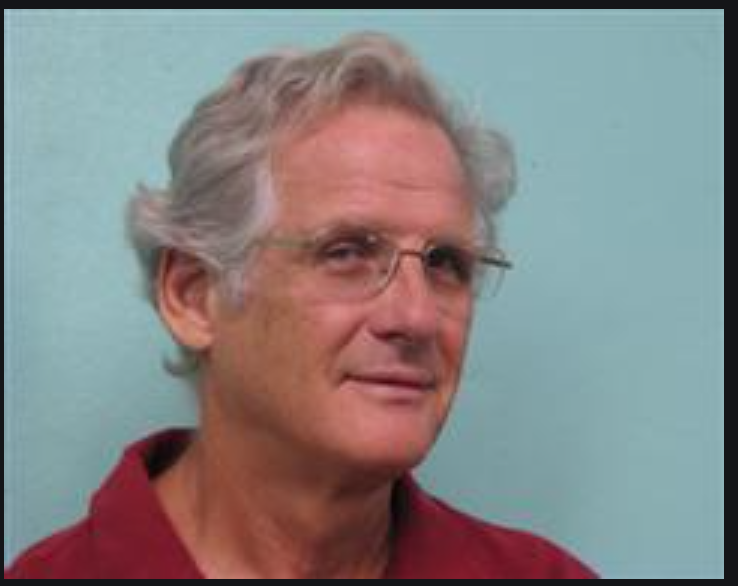
Marine biologist and emeritus professor of marine affairs at The University of the West Indies Professor Robin Mahon, said the latest findings were stark, but not unexpected.
In fact, he said, the region has been hearing essentially the same warning for decades.
“It’s just like a story being played over and over for the last 40 years,” Mahon told Barbados TODAY.
He said steady degradation, overfishing, the loss of herbivores and pollution had all combined to leave Caribbean reefs in “very bad shape”.
And while climate change has made things worse, Mahon said more focus is needed on managing reef fisheries and protecting herbivorous marine life.
“Climate change, as you would have seen in the report, has added to the problem, but until we’re ready to manage the reef fisheries so that the herbivores can be spared, we probably should just stop worrying about it.”
Sargassum is another growing concern.
Mahon said that when large quantities of seaweed pile up in shallow bays and begin to rot, they can suffocate marine life underneath.
“When a bay like River Bay or Skeete’s Bay or any one of the small bays fills up with the sargassum, and it starts to rot, everything under it dies,” he said.
While such bays may not contain major coral areas, Mahon said corals and other marine life still inhabit them and can be killed when decomposing sargassum remains in shallow water.
“So it definitely is having that kind of a negative impact when it comes ashore in shallow water.”
For Mahon, the report’s value lies in bringing the many threats together and showing just how serious the cumulative impact has become.
Although the outlook for reefs is worrying, Barbados is investing heavily in protecting its coastline, which supports its marine ecosystems, communities and the economy.
Fabian Hinds, acting deputy director of the Coastal Zone Management Unit (CZMU), said the $105.8 million coastal resilience programme, announced by Environment Minister Santia Bradshaw, is expected to start construction later this year. He sees it as a key project to help reverse much of the damage along important parts of the coast.
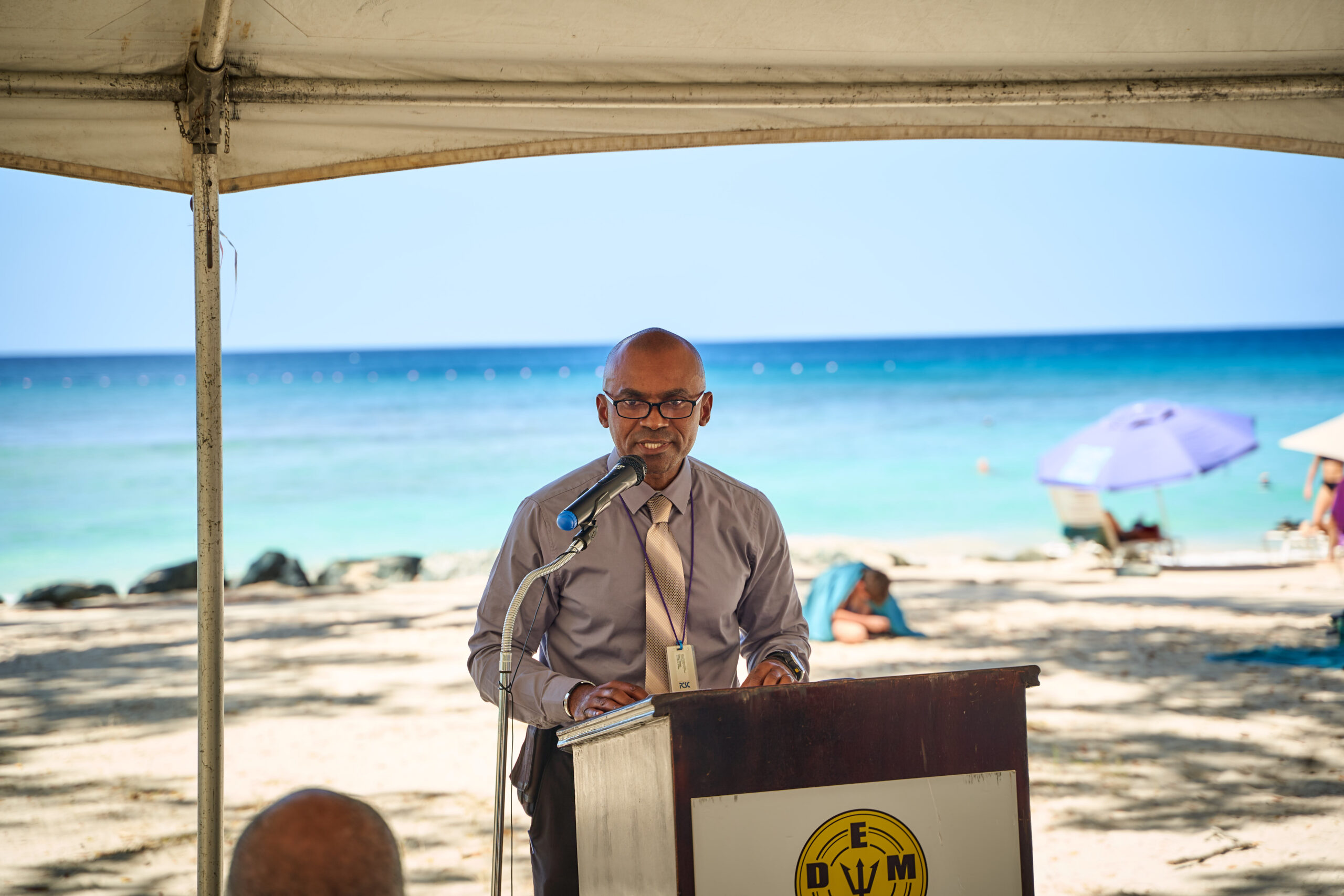
Acting Deputy Director of the Coastal Zone Management Unit (CZMU), Fabian Hinds. (Photo Credit: Shamar Blunt)
He pointed to the Richard Haynes Boardwalk as one of the country’s largest coastal restoration projects.
“The Richard Haynes Boardwalk is a 1.2 kilometre long sea defence structure, arguably the largest single undertaking of coastal restoration works this country has ever undertaken in one go,” Hinds said.
He also highlighted work in Welches, downtown Bridgetown and along Folkestone, including the construction of a new beach and pocket beaches.
More work is planned from Oistins through Rockley to St Lawrence Gap, as well as in the Mullins, Road View and Sand Street areas.
Hinds stressed that protecting Barbados’ beaches is about more than just keeping them beautiful.
“If we allow our coastlines to fully deteriorate, beaches to disappear, you will not have a sea turtle nesting habitat. You won’t have a habitat for the crabs, the shore birds, the coastal vegetation,” he said. “We need the beaches from an environmental perspective.”
He also described the coastline as essential to Barbadian life and the country’s economy.
But with Barbados’ coastline stretching roughly 97 kilometres, Hinds acknowledged that protecting it will have to be a gradual process.
“We can’t do the entire 97 kilometres of course in one fell swoop,” he said. “So we’ve been systematically trying to identify segments that we could do the work on.”
For Professor Mahon and Hinds, the message from the global reef assessment is clear: Barbados and the wider Caribbean cannot ignore reef degradation. For an island whose economy, culture, communities and marine life are all closely tied to the sea, what happens beneath the waves could decide what survives above them.
(SB)
The post Study confirms coral decline as Barbados acts to protect coastline appeared first on Barbados Today.