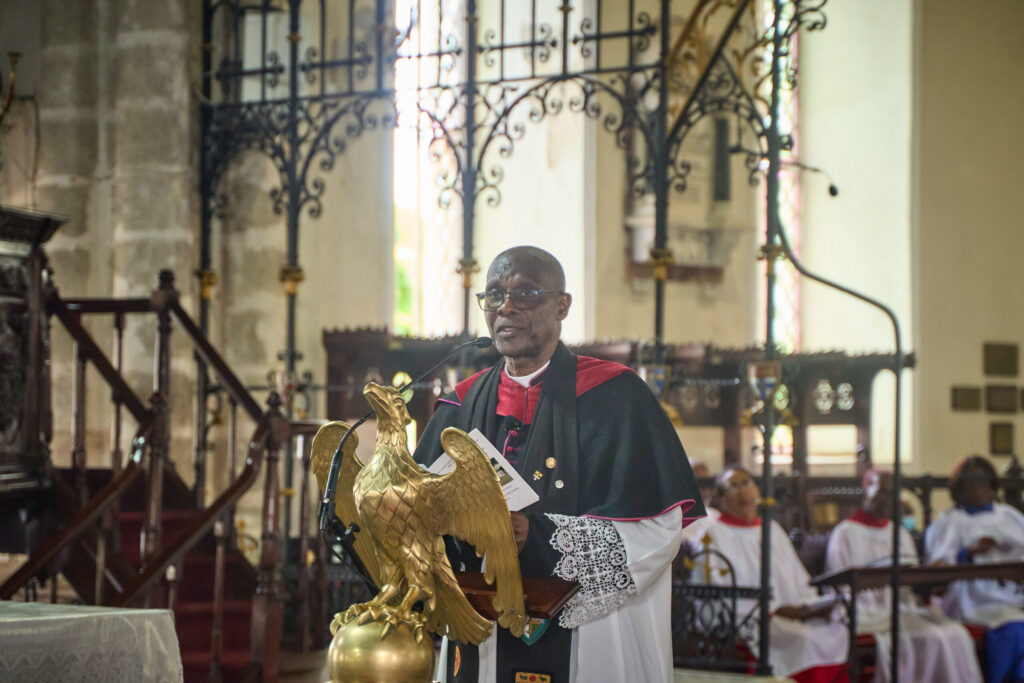
The Dean of St Michael’s Cathedral has called on the legal community to build a justice system grounded in consistency, fairness, equity and mercy, urging judges and lawyers to place restoration alongside punishment.
The Very Reverend Dr Jeffrey Gibson said the criminal justice system should seek not only to hold offenders accountable, but also to restore individuals and strengthen the wider community.
Speaking at the church service to open the new law year, Dean Gibson challenged the nation’s highest legal minds to look beyond punitive measures and actively pursue the holistic restoration of both offenders and the wider community.
Chief Justice Leslie Haynes led the justices of the Supreme Court and other officers of the court into the service at the cathedral, a tradition dating back to a time when the Anglican Church was the official church of state. They were joined by the President Jeffrey Bostic, Attorney General Wilfred Abrahams, Minister of Legal Affairs Michael Lashley; and Bar Association president Larry Smith followed by several attorneys, including the newest members of the Bar.
Grounding his message in the Book of Deuteronomy, the dean focused on the biblical mandate to the Israelites as they stood on the precipice of the promised land after 40 years of wandering.
“Justice and only justice you shall follow, that you may live and inherit the land,” he said.
The senior cleric, who occasionally stands in as President of the Republic, was quick to clarify that true justice in this context extends far beyond standard courtroom verdicts. Exploring the original Hebrew text, he noted that the concept signifies right relationships and a community ordered exactly as intended by the Creator, where the widow, the orphan, the stranger and the powerful are all treated under the exact same law because they are made in the same image.
Focusing on the realities of Barbados in 2026, the dean outlined four essential hallmarks required for a truly just society, paying particular attention to the complex issue of criminal sentencing.
First, he stressed the absolute necessity of consistency, warning the judiciary against having “one law for the rich and another for the poor”, or fluctuating standards based on the day of the week. He noted that while consistency does not dictate identical sentences for every single case, it demands that similar cases be treated alike so the public can clearly see that the law does not play favourites.
“Inconsistency erodes trust,” Dean Gibson cautioned the legal fraternity. “And without trust, people don’t believe the land of Barbados is ready for all of us to inherit. Consistency tells us this is a society of laws, not of moods.”
The second hallmark, fairness, was presented as the fundamental guarantee of proper judicial process. The Dean emphasised that true fairness ensures every Barbadian, regardless of family name, residential address or socioeconomic background, can stand on equal footing before the law. He argued that when bias is firmly set aside and an individual is genuinely heard, even those receiving the harshest penalties, such as life sentences, can accept the outcome as procedurally fair. This transparency, he argued, is what keeps society from falling into cynicism.
While consistency and fairness form the skeleton of the justice system, Dean Gibson described equity as its beating heart. He challenged the gathered magistrates and judges to look beyond the rigid details of a charge sheet and see the human being standing before them.
Equity, he explained, asks what a specific person needs to be restored and what the wider community requires to remain safe. Acknowledging that the exact same sentence may not suit a hardened criminal and a youth who made a reckless choice, or a first-time offender battling severe addiction, he declared, “Equity ensures that justice doesn’t crush the vulnerable while letting the cunning escape.”
The cleric identified mercy as the final and most difficult hallmark to implement, yet insisted that it is vital for a flourishing society. Mercy, he argued, does not cancel justice; rather, it questions the fundamental purpose behind any punishment. He outlined three critical roles of sentencing: retribution to ensure wrongdoing has consequences and victims are not forgotten; rehabilitation to raise responsible citizens who can eventually return and contribute; and the protection of the community to maintain the peace.
“Justice tempered with mercy holds all three together,” he affirmed. “It says, we will be firm when we must be firm. And we will be redemptive where we can be redemptive.”
Dean Gibson pointed to the ultimate ethic of Jesus Christ, noting that the Christian perspective demands justice with a human face. He reminded the congregation that Jesus did not come to abolish the law, but to fulfil it, embodying a perfect balance of accountability and grace. Illustrating this point, the dean referenced the biblical account of the woman caught in sin, highlighting how Jesus stopped the stones from falling while simultaneously issuing a command for transformation.
“He said to the woman, neither do I condemn it. Go and sin no more,” he recounted. “Retribution and rehabilitation in one sentence. Jesus revealed a purpose. Not vengeance, but restoration.”
He issued a final charge to both the judiciary and the wider faith community to actively support rehabilitation programmes, advocate for the forgotten and insist on unwavering fairness in every courtroom across the nation. By viewing justice not as an abstract idea but as a condition for life together, the Dean said Barbados can remain a beautiful land where victims are honoured, offenders are restored and communities are genuinely healed. (RR)
The post Dean calls for restorative justice system appeared first on Barbados Today.