
Animal welfare groups have called for enforcement of existing laws criminalising animal abuse, as concerns grow over how reports of cruelty and neglect are being handled.
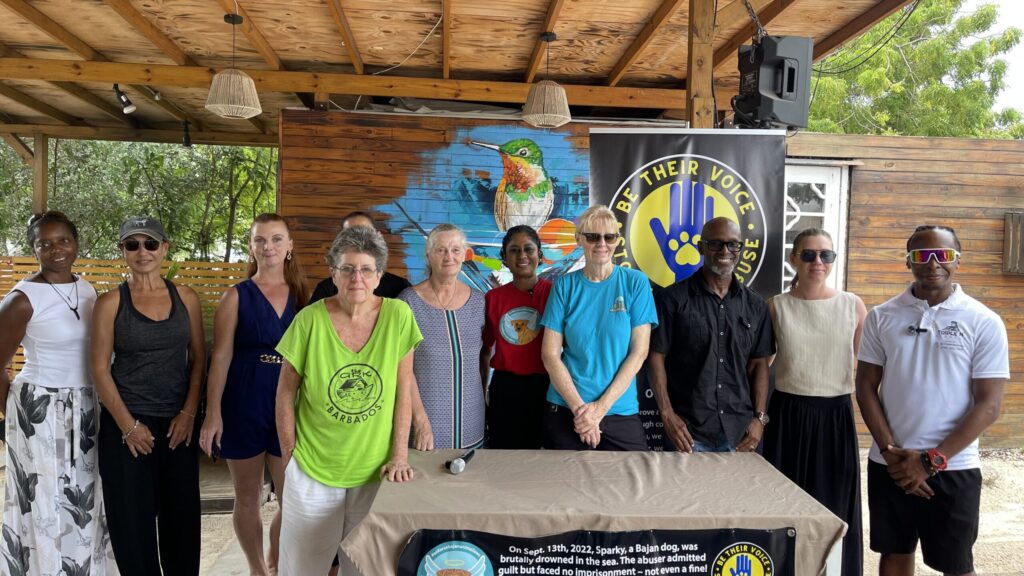
The Be Their Voice and ROAR Barbados advocates held a press conference at Bali Beach Club and Restaurant on Tuesday to raise concerns about the lack of knowledge and general disregard for reports of animal abuse.
Be Their Voice President Lavern Beresford said government must enforce the legislation already in place and ensure the relevant departments act on reports.
She told reporters: “The police stations don’t even know how to handle reports when it comes to animal abuse. And that is just the sad reality of where we are today on this island. What do we want to see? What do we hope to achieve? We would like for government to get involved. We would like for government to enforce the legislation that is there. We would like for the various departments that have the responsibility to enforce these laws to act on them.”
Animal welfare groups and individuals were increasingly being left to report cases, rescue animals and seek solutions themselves, Beresford said.
ROAR spokeswoman Gill Croney pointed to the Animal Protection Act, which she said already provides for a range of offences involving animals.
“In principle, what the Act does is criminalise the mistreatment, neglect and abandonment of animals. We all see probably on a daily basis examples of dogs being chained, no food, no water, and certainly being dumped. The main offences: abandonment. Leaving a pet or a captive animal to fend for itself is a criminal offence.”
Physical abuse, including causing unnecessary suffering, injury or pain through beating or poisoning, was also prohibited, Croney said.
“Poisoning or dumping can carry penalties as severe as a $5 000 fine and 12 months in prison. Dog fighting, training, promoting or participating in dog fighting is strictly illegal,” she said.
She said enforcement responsibilities are divided between the Animal Control Unit of the Ministry of Health and the Ministry of Agriculture’s Veterinary Services.
Croney noted that animal welfare organisations are mentioned in the legislation in relation to reports of animal rescue and neglect, but they do not have the authority to remove animals from their owners.
She also pointed to other legislation governing animals, including the Dog Licensing Control Act and the Animal Civil Liability Act.
“”Word salad, no teeth, no fines, loose links to the main act about kennel conditions, but that’s all, and that’s not enforced about licensing your dogs,” Croney declared.
She said the Animal Civil Liability Act largely treats animals in terms of economic value, including circumstances where livestock causes damage or an accident.
Croney argued that greater enforcement was needed because animal abuse could be linked to wider forms of abuse.
She called on members of the animal welfare community and the public to take action when they encounter abused animals rather than simply sharing social media posts asking if someone can help.
Triple N Kennels CEO and head trainer Rashad Neblett said more people were seeking training and learning how to coexist with dogs, but some owners remained unwilling to take responsibility.
“A lot of people are scared to walk their dogs because people don’t have their dogs secured or their property secured. We all know that the government lacks on the other end of accountability, we can all agree on that. I think where I look at it is holding every human accountable.”
Neblett said responsible ownership required people to educate themselves about caring for and handling dogs.
“Yes, I want the government’s strength and backing but I need every human to educate themselves first and then can we hold you accountable,” he said.
He said training, a loving home, proper feeding and secure property were all important to responsible dog ownership.
“We go hard for advocating for animal rights. We go hard for advocating that dogs can be better. There really isn’t a bad dog out there. They’re only bad owners. And that’s the honest truth.”
Ocean Acres CEO and founder Caren Whittaker said animal abuse was part of a wider social issue.
“Abuse is abuse,” she said, arguing that addressing animal cruelty also required attention to prevention and education rather than focusing only on responding to individual cases.
Whittaker said animal welfare organisations ultimately wanted to see a reduction in the need for their services.
“We would love to be out of business,” she said, stressing the need for Government support, education at the grassroots level and greater emphasis on spaying and neutering.
“This is about people,” Whittaker said.
(LG)
The post Animal abuse: Groups demand govt action appeared first on Barbados Today.