
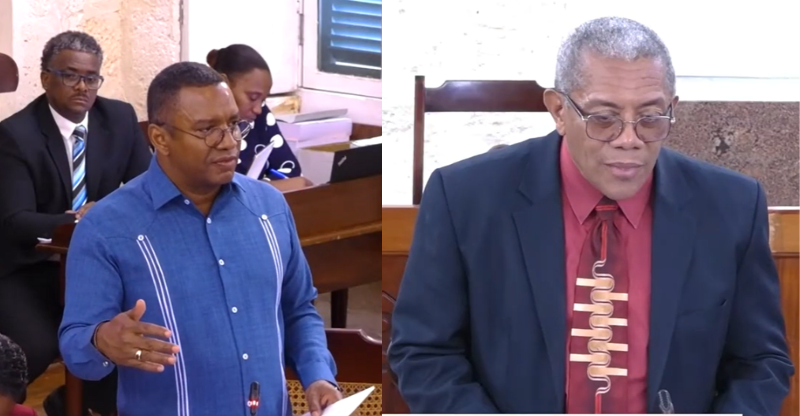
The Senate on Wednesday moved to strengthen enforcement against money laundering and terrorist financing, passing bills aimed at demonstrating that the country’s safeguards work in practice ahead of an international review next year.
The Money Laundering and Financing of Terrorism Prevention and Control (Amendment) Bill and the Financial Services Commission (Amendment and Validation) Bill were intended to keep pace with global regulation.
Attorney General Wilfred Abrahams told the Upper Chamber that failure to meet obligations could place Barbados back on international grey or blacklists.
Abrahams explained that while the previous round of assessments focused on establishing the necessary legal structures, the upcoming fifth-round evaluation, including an on-site visit scheduled for June 2027, will test whether those systems produce concrete outcomes.
He said: “The last round of evaluation required you to have a structure in place. This go-around is not about structure; it is about effectiveness. We proved the last time we had the structure. Now everybody wants to know how effective we have been.”
He noted that the legislation gives the Compliance Unit greater powers, establishing the Chief Compliance Officer as its official head to directly supervise designated non-financial businesses and professions, including attorneys-at-law, accountants, real estate agents, dealers in precious metals or stones and gaming operators.
“If you are required to register with the Chief Compliance Officer and you do not register, they can stop you from actually practising. We do not have an accurate idea of who from which professions are actually practising in this sector, and if we don’t have a proper accounting, we’re not being effective,” Abrahams said, noting that failure to meet these obligations threatens the country’s access to international banking channels and foreign exchange.
Under the amended provisions, supervision will focus on specific high-risk operations rather than lower-risk practitioners. Penalties for record-keeping breaches and failure to report suspicious transactions to the Financial Intelligence Unit will increase substantially, with administrative fines replacing criminal prosecutions for non-malicious failures.
The accompanying Financial Services Commission (Amendment and Validation) Bill strengthens regulatory powers, facilitates compliance with international multilateral memoranda of understanding for cross-border information sharing, and retroactively validates fees collected under previous orders.
Independent Senator Andrew Niles cautioned the chamber about the operational effects of increasingly stringent regulations. He urged the Mia Mottley-led administration to ensure that legislative compliance does not result in systemic paralysis for local commercial activity.
“When we effectively put these legislations in place, it works really well. We know why it is there, but how do we translate this down to the functionality of the country right at the bottom end?” Senator Niles asked. “We don’t want a paralysis in the country because of legislation. We don’t want the legislation to stop businesses from operating.”
Responding to the independent lawmaker’s concerns, the Attorney General assured the Upper House that extensive public education and consultations would take place to ensure smooth implementation.
“We are going to have widespread consultation with all the affected sectors with respect to the impact and operation of the legislation, and we’re also going to have widespread public information as to what the public needs to be aware of,” Abrahams said.
“Part of what we’re doing involves full discussion with all of the stakeholders in these sectors because when the assessors come, they are going to meet with all of the stakeholders.”
(RR)
The post Senate passes anti-money laundering amendments ahead of 2027 review appeared first on Barbados Today.