
Patients over 65 account for 65 per cent of those attending the Queen Elizabeth Hospital’s Accident and Emergency Department, where doctors are seeing more strokes and complications from chronic diseases, A&E head Dr Anne-Marie Cruickshank has said.
Trauma, motor vehicle accidents and assaults make up the rest of the emergency calls, she told reporters.
She said: “Lately I’ve been seeing an increase in the number of strokes presenting to the A&E, as I would say 65 per cent of our patients are more than 65 years old. The elderly who are living longer in Barbados are now coming with the complications of age and NCDs.”
Older patients were also suffering from dehydration and infectious illnesses, including influenza and COVID-19.
She explained: “Elderly persons are not always mobile; some of them are bedridden; they can’t say when they’re thirsty; they can’t go for bottles of water as young and middle-aged [persons can].
“We’re also seeing the elderly presenting with increasing infectious cases, so the influenzas and the COVIDs. We are seeing predominantly in the elderly persons who essentially are immunocompromised and may not be able to ward off infections as a middle-aged or a younger person, and family members bringing infectious cases home and the elderly patients succumbing to that infection.”
Dr Cruickshank linked the rise in stroke cases and other serious conditions to poor management of chronic illnesses such as diabetes and hypertension.
Patients were failing to visit their doctors, take prescribed medication, follow appropriate diets or exercise, contributing to advanced complications of chronic diseases, she said.
As a result, she said, A&E was now seeing “heart attacks, strokes, end-stage renal disease” and heart failure cases “every day”.
She urged people with chronic diseases to take greater responsibility for their health. “You need to go to your primary healthcare physician and follow the instructions and the management and the treatment that your primary doctor is advising you.”
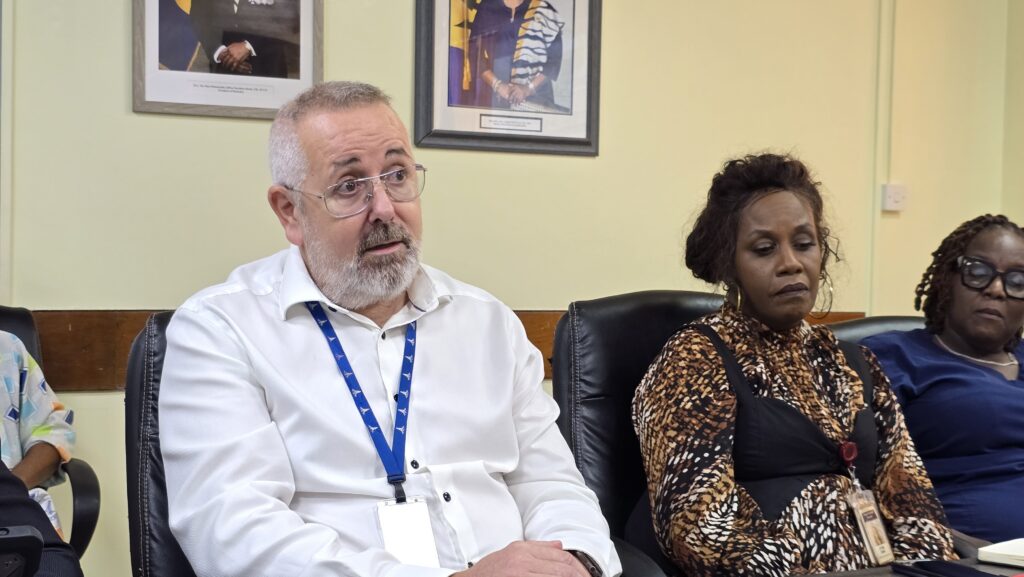
Dr Cruickshank was speaking during a QEH press conference on Thursday to update the public on the ongoing relocation of departments and services as part of major redevelopment and refurbishment works.
Despite the increased demand, QEH Chief Executive Officer Neil Clark said improvements had been made at several stages of the A&E process: “A&E waits are not an issue for A&E, it’s an issue for the whole of the health system. It’s the bottleneck for the health system.”
He said registration, triage, laboratory, diagnostic, and specialist doctor response times had improved. The remaining delays were in seeing an A&E doctor and securing an inpatient bed.
“We’ve improved the registration times; we’ve improved the triage times…we’ve improved the lab times, we’ve significantly improved the diagnostic response times. We’ve improved the speciality doctor response times, and the only time that remains within the A&E flow is the time to see an A&E doctor and the time to get to bed; for both of those we have plans.”
The department had recently brought in additional staff to help reduce waiting times. The hospital was also working with the Ministry of Health to reduce A&E pressure by directing patients who did not need emergency care to other services.
A cadre of doctors from Ethiopia who joined the department on September 28 were undergoing supervised training to familiarise themselves with QEH policies and procedures, he said.
The department had also received three blood gas machines donated by Saul Barbados to help manage critically ill patients in the resuscitation room.
The department also received more than 160 new trolley beds, along with additional recliner chairs for patients who did not require trolley beds.
Dr Cruickshank added: “They can be on a recliner chair, especially in the observation unit while they’re waiting for specialities, results, investigations, admission, etcetera, much more comfortable for them in the observation unit.”
She said the hospital added 18 recliner chairs last week to the 10 already in the department.
Chief operations officer Louise Bobb said the hospital’s programme to make better use of its beds had also helped ease pressure on A&E through a new Acute Care Unit.
She said the hospital’s overall bed capacity had not increased, but it was using existing space more efficiently.
Bobb said: “Placing the right patient at the right time, in the right space meant us reimagining how we would use the capacity that we have to meet the demands that we have. As [Dr Cruickshank] indicated, persons are presenting with greater acuity of conditions, and the input is greater than it has been in years hitherto this moment. So the optimisation of the bed that we have has led us to the creation of an acute care unit.”
The unit provides a temporary space for patients admitted while they await beds on other wards, helping reduce congestion in A&E.
“The target, and the bed management team works very hard and very assiduously at this, is to leave no more than five patients waiting for admissions between shifts. We have had, when we are in surge mode, as many as 20 to 27 patients waiting for admissions, and when that occurs, all hands go on deck.”
The programme began in July, with further measures planned to improve patients’ progress through A&E, inpatient care and discharge, she added.
(LG)
The post Most QEH emergency patients over 65 — A&E chief appeared first on Barbados Today.