By: Robert Chase
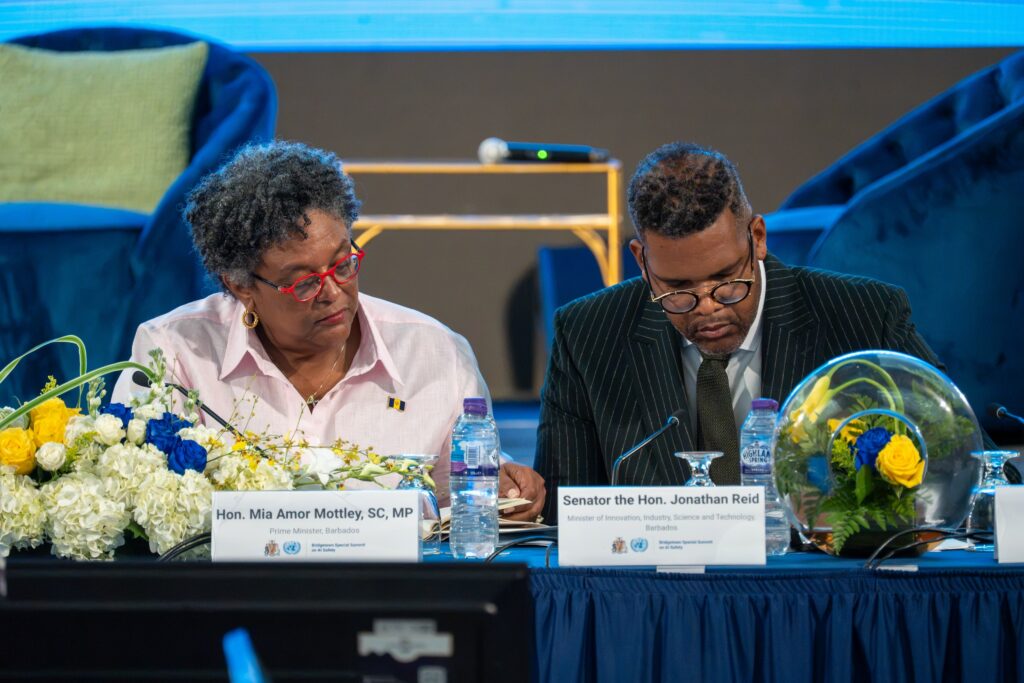
Today, Barbados will find itself at the centre of an important UN-led international conversation about Artificial Intelligence.
So, do they really think Skynet is coming?
Should we be worried about some Terminator-like future?
Maybe.
When the people developing increasingly powerful AI systems tell us their systems require safeguards, I pay attention.
But while global experts discuss how to manage the genie now that it is out of the bottle, my thoughts are closer to home.
My wife built a small family-owned call centre providing services to overseas clients. Today, I help her run it. We employ approximately 50 people, many of them women.
Their jobs sit close to the front line of the AI revolution.
That makes this AI conversation more personal than theoretical.
I understand the power of AI. But what does it mean for us?
I am grateful for the opportunity I had to study at Harvard in 2023 with support from the Government of Barbados. I therefore feel a need to pay that opportunity forward, in whatever small way I can, by adding to this conversation.
My graduate studies at Harvard included research methodology, quantitative methods and exposure to artificial intelligence, machine learning and big data. I also hold an M.Sc. in Electronic Commerce from UWI.
So yes, I understand something of the remarkable technology behind AI.
But what does all that technology have to do with the price of bread—or electricity?
Potentially quite a lot. Questions about data, computing infrastructure, energy and the AI models our businesses depend upon deserve national attention.
But as a small-business owner and citizen, my questions come closer to home.
Where can AI make our business better? Where does it introduce risk? And how do we ensure that our family business and those 50 jobs thrive?
Don’t start with the technology
There is a temptation to treat AI adoption as an IT project.
Find the techie. Buy the software. Connect the data. Automate something.
But I believe the AI conversation needs to be more about delivering value and managing risk. Before asking, “Which AI should we buy?” business leaders should perhaps first ask: “Where does AI create value or risk in this business?”
And when we consider employment, perhaps we should stop beginning with:
“Which jobs will AI replace?”
A job is really a collection of tasks.
Some are repetitive. Some require analysis. Others require empathy, creativity, judgement or accountability.
Which tasks should be AI-aided?
Which tasks can reasonably be AI-led?
And which tasks should be AI-blocked because the risk or need for human judgement means they ought to remain human?
Then redesign the job.
We are actually experimenting with this now.
We are developing an AI quality-assurance triage agent designed to review every pharmacy-related order passing through our operation and flag potential errors for a human staff member to assess.
The AI does not make the judgement call. The human does.
Without AI, however, a staff member could never review every order in the time it moves through our operation without slowing the entire process.
In this application, the AI is not replacing the human. It is enabling us to develop a new AI-assisted quality-assurance role that we did not have before.
That is the kind of job redesign I mean.
We are determined to preserve those jobs and, better yet, grow the business and create more of them. But good intentions won’t accomplish that.
Our clients operate internationally. Our competitors do too. Refusing to use the technology will not protect our employees in the long run. It could simply make the business they depend upon less competitive.
That is why getting the new job design right may ultimately matter as much as getting the technology right.
Maybe more.
A dream that dimmed—and then changed.
When I left Barbados for Harvard in 2023, I was passionate about one particular opportunity for diversifying our economy.
Services.
Not necessarily services delivered to someone standing in Barbados, but services delivered by Barbadians over the Internet to businesses and consumers globally.
Then I saw just how rapidly AI was learning to perform some of the very work I imagined Barbadians exporting.
For a while, the dream dimmed.
But, as we say, ‘a mind tell me’ that perhaps I was looking at it the wrong way.
Maybe AI isn’t the death knell. Maybe it is a wake-up call to a bigger opportunity. Because here is the “aha”moment:
We aren’t the only ones being disrupted.
Call centres, accounting, law, engineering, teaching and even parts of medicine are being transformed everywhere. And many of those services can be traded digitally across borders.
Disruption can destroy old advantages. But it can also destroy old barriers. Where should the machine stop and the human begin?
I believe one of the pivotal competitive capabilities in this new services era will be figuring out the right division of labour between humans and machines.
Answering that question requires more than technologists.
It requires employees who understand the work, managers who understand customers and processes, and leaders who understand where their businesses create value and what risks they can reasonably tolerate.
So perhaps we should institutionalise that process.
Government could consider an AI Work Redesign programme, initially targeting knowledge-based jobs most exposed to AI.
Carefully designed incentives could encourage companies to bring workers and managers together to break jobs into tasks, identify which are best AI-aided, AI-led or AI-blocked, and then redesign the jobs accordingly. Support should reward genuine additional investment in job redesign and worker development—not simply subsidise the purchase of technology.
There is precedent for Government acting to protect employment during a crisis. The BEST programme did so during COVID-19.
This would be different: acting before disruption becomes displacement.
Government, working with UWI and the Social Partnership, could develop the practical framework, while businesses and the people who actually perform the work provide the domain knowledge.
Could this become a new competitive advantage for Barbados?
Minister Jonathan Reid has challenged us to think boldly about the Barbados we must dare to dream of—and then build.
Perhaps our question, therefore, should not only be:
“How do we protect Barbadian jobs from AI?”
It should also be:
“How do we use AI to make Barbadian workers and businesses capable of competing for more of the world’s work?”
Barbados has spent generations investing in its people. AI does not necessarily make that investment obsolete.
If we become exceptionally good at redesigning work around the complementary strengths of people and AI, perhaps that capability itself becomes a new Barbadian competitive advantage.
So, as the experts gather here to discuss powerful models, AI safety, data, compute, infrastructure and governance, we should absolutely pay attention.
But around our own conference tables, boardroom tables, rum-shop and dominoes tables, let’s have another conversation too:
“How do we build the people, businesses and newly designed jobs that allow Barbadians to compete for a larger share of the global services economy being rebuilt around AI?”
Because Skynet may or may not be coming.
AI already is.
And perhaps our task is not simply to survive the disruption.
Perhaps it is to compete in it.
The post Do they really think Skynet is coming? appeared first on Barbados Today.