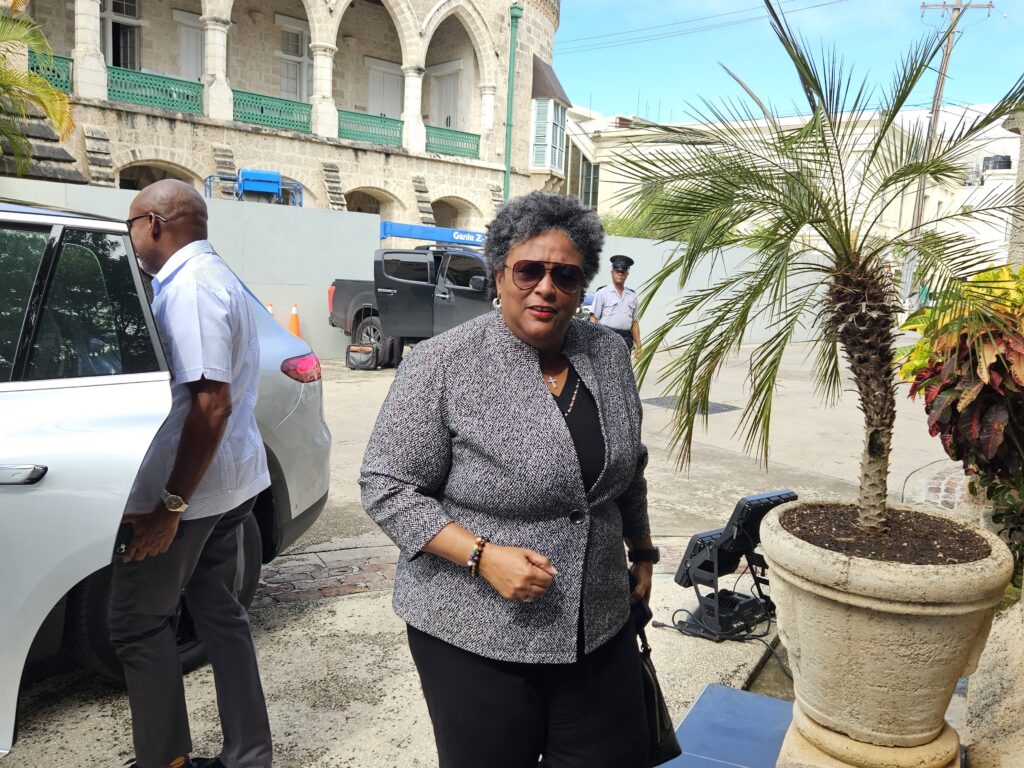
Families earning $75 000 or less a year could receive as much as $200 000 in grants to strengthen their homes before disasters strike under draft legislation that Prime Minister Mia Mottley said Tuesday would shift the country’s focus from recovery to prevention.
The Resilience and Regeneration Fund Bill, which Finance Minister Ryan Straughn brought to the House of Assembly was one of the most important measures brought before the chamber since Barbados became an independent nation, she told lawmakers.
The prime minister framed the bill around three existential crises confronting small states: safeguarding national sovereignty in a shifting global order, managing the risks of artificial intelligence alongside its opportunities, and confronting climate change and biodiversity loss.
“Helping to prevent damage or minimise damage before a disaster is far more effective than seeking to recover post-disaster,” Mottley said. “And that is fundamentally what building resilience is about. How can I make my life, my house, my livelihood more resilient to any shock that may happen?”
Unlike the 2006 Catastrophe Fund, which was designed primarily to offer a modest payout after damage had already occurred, the proposed fund broadens its scope beyond hurricanes and floods to cover pandemics, cyberattacks and economic shocks.
Mottley noted that rising insurance premiums and shrinking reinsurance coverage – both regionally and in markets such as Florida and California – mean households and governments cannot rely solely on traditional post-event payouts.
Under the household resilience measures outlined by the prime minister, families earning $75 000 or less a year would be able to access pre-disaster grants to strengthen vulnerable homes, as well as borrow up to $25 000 at an interest rate of one per cent for resilience upgrades such as water tanks, renewable energy systems or generators.
Homeowners with properties valued at $200 000 or less could also qualify for reconstruction grants of up to $200 000 following a catastrophe, subject to eligibility rules and deductions for any insurance payouts so there is no double recovery.
Small businesses and self-employed workers with an annual turnover of $500 000 or less who maintain good tax compliance with the Barbados Revenue Authority would also be eligible for support during severe cash-flow disruptions caused by a catastrophe.
Mottley stressed that compliance does not necessarily mean clearing an entire balance overnight, pointing to existing payment arrangements that allow businesses to stay in good standing if they honour agreed terms.
“This is a solidarity levy, and the reality is that people pay out of each dollar,” Mottley said in defending a proposed 0.25 per cent contribution rate for employees and the self-employed, matched by employers, with no income ceiling. “Those who have put in more have to pay so that those who are less protected can gain ultimately.”
To back up household and private contributions, Mottley said the State would commit 0.35 per cent of the previous year’s gross domestic product annually, alongside natural disaster clauses in debt instruments aimed at freeing up liquidity over two years in the event of a major shock.
She also pointed to governance safeguards modelled on the National Insurance Scheme, independent assessment committees for physical and economic claims, a 40 per cent cap on investments outside the Caribbean Community (CARICOM) Single Market and Economy, and annual audits laid before Parliament.
Mottley tied the legislation closely to practical household preparation ahead of the next hurricane season, urging Barbadians not to be lulled into complacency by a quieter storm season. She recalled how makeshift post-Hurricane Janet repairs popularised flat roofs and wide overhangs that catch uplift winds, and called for public education checklists, wider release of resilient housing designs from the housing ministry, and active outreach on building standards.
“Now is the time for Barbadians to be checking their roofs and determining whether they need to cut the overhang, determining whether they need to put on the hurricane straps, determining whether they need to do other things to strengthen the roof before it is too late.”
Beyond domestic preparedness, Mottley linked Barbados’ resilience push to international climate negotiations following recent talks in Antalya, Turkey, and ahead of the next summit in Addis Ababa. Citing the urgent need to curb short-lived but potent methane emissions and limit global warming to 1.5C, she urged citizens and parliamentarians to back the global “1.5 Voices for 1.5” campaign.
“For those who believe that they are outside of harm’s way, you’re living in a fool’s paradise,” Mottley warned. “So I ask you, each of us play our part.”
(RR)
The post PM defends 0.25% disaster resilience levy appeared first on Barbados Today.