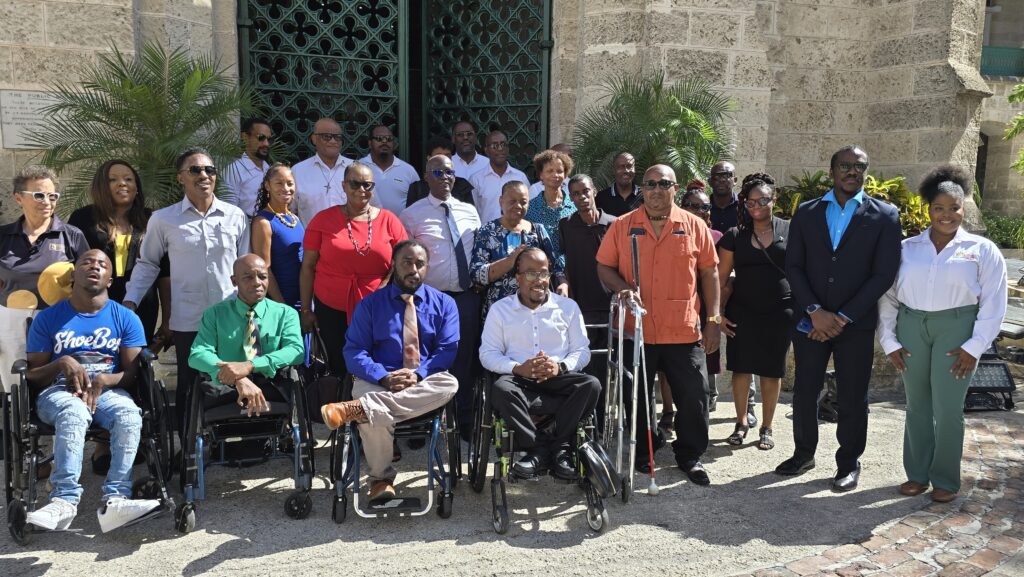
Wheelchair users and disability advocates find several government offices and healthcare facilities difficult to access, they said Wednesday, as the Parliament Buildings became the first to be assessed under the government’s Access for All project.
The project, which aims to make public buildings more accessible, begins with government facilities before encouraging the private sector to follow suit.
Minister of People Empowerment and Elder Affairs Adrian Forde announced the project earlier this year, stressing the importance of providing not only mobility aids for persons with disabilities but also the “infrastructure to support them”.
At the project’s launch outside the 152-year-old neo-Gothic building on Thursday, Forde said the government had a responsibility to lead by example. He pointed in particular to the Persons with Disabilities Act 2025, which makes provision for accessible parking, bathroom facilities and other accommodations.
The government could not pass legislation requiring such provisions without ensuring its own buildings met those requirements, he said.
Forde said: “We have walked the walk in terms of deliverance of a project that will transform the ability of persons with disabilities to be able to move around Barbados and access all the services like everyone else.”
He told those attending the ceremony that members of the Barbados Council for the Disabled conducted the building assessments after receiving specialised training to carry out the audits.
“They went to international training seminars to be able to do the assessments and the audits on buildings,” he said. “These persons who did the assessment from the Council for the Disabled were trained at the highest level to do these assessments.”
But wheelchair user Sean Cooke said several government buildings remained difficult to access. He named the Immigration Department and the Treasury building as two places where he had experienced challenges.
When he could not reach certain areas, he had to seek assistance or ask officials to come to him so he could conduct business elsewhere, he added.
He said: “We ask for help if it’s an area that I cannot get to. Persons have to come to us, and then maybe we can conduct business maybe in a designated area, yeah, but to get to specific places, right now, it’s difficult because of the space.”
Cooke also said healthcare facilities needed attention. He noted that some were not adequately accessible, even for people who might need emergency services.
He welcomed the initiative and said he hoped Barbados would become fully accessible within the next five to ten years.
Certified accessibility assessor Christopher Gilkes said accessibility must be considered from the start of the building process, not dealt with after construction.
He noted that some ramps did not meet the required specifications, which made them difficult for wheelchair users to navigate: “There are certain requirements and specifications when constructing a ramp, so when I go to places, and I see that the ramps are a bit too high, we have to then intervene to ensure that everything is in place when they’re building.
“So I think that we should be involved from the beginning of the process and not in the middle or after.”
Gilkes conducted the assessments alongside Roseanna Tudor, operations manager of the Barbados Council for the Disabled. He stressed that accessibility involved much more than installing ramps: “When we speak to accessibility, most persons focus on ramps, but accessibility is beyond ramps.
“It’s about having accessible bathrooms, accessible information, and even certain things like a door space. Some wheelchairs are unable to fit through a door space, and that is even within some of the healthcare facilities. So then that becomes a challenge.”
The Parliament Buildings, the first to be assessed, presented challenges because of their historic design; modern accessibility solutions were adapted to respect their heritage.
Special evacuation mats had been introduced to address emergency evacuation challenges, particularly given the building’s single elevator and historic stairways.
Phase two of the project will address access to the Senate chamber and the House of Assembly, as well as further improvements to the buildings. No date has yet been set for phase two.
“We stand today in a place where the voices of Barbadians are meant to be heard,” Tudor said. “Whose voice might we never hear, because that person could not get into the room.”
Senator Janelle Odle, the National Disability Advocate, said making Parliament accessible was particularly significant because it was the house of the people and everyone should be able to take part in its proceedings.
She said: “Every barrier we remove brings us one step closer to the Barbados we want to become.
“The mere concept of universal access means that accessibility should be for all persons, so there’s no you and us or us and not you, but everyone.”
Businesses and institutions should build accessibility into their planning and operations rather than treat it as an afterthought, Odle added.
Colleen Walcott, executive director of the Social Empowerment Agency, told Barbados TODAY that the cost of phase one was still being calculated, as invoices were being collected.
In a further update, she said, the agency’s newest client centre at Glebe, St George, was expected to be completed by December.
(LE)
The post Disability advocates say more needed as Parliament accessibility work begins appeared first on Barbados Today.