
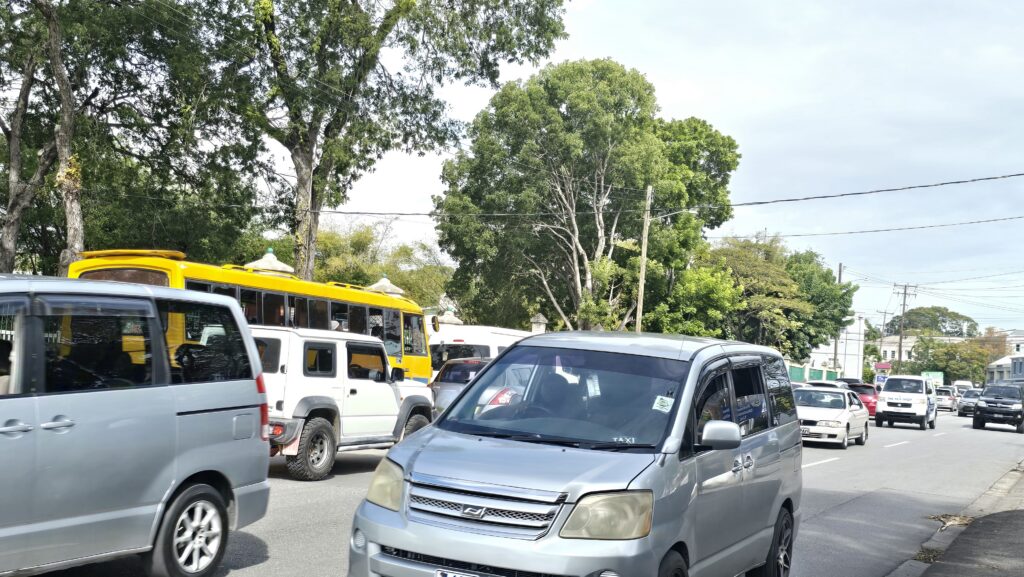
The island is facing an escalating traffic crisis, with more than 181000 registered vehicles now cramming the island’s narrow road network as a senior traffic manager painted a stark picture of one near-continuous gridlock from morning to evening.
As the first national consultation on traffic began at Deighton Griffith Secondary School at Kingsland, Christ Church, Jason Bowen, the deputy chief technical officer for design services at the Ministry of Transport and Works, revealed that while road deaths have declined over the last four decades owing to improved junction designs and roundabouts, property damage accidents are on the rise, and congestion is reaching record levels.
Up to February, there were over 181 544 vehicles on the island’s roads, Bowen stated, noting that the growth in vehicle ownership has consistently outpaced infrastructure capacity.
The Ministry of Transport and Works (MTW) recently conducted “floating car” surveys, driving congested routes along the west coast on Highway 1, Station Hill (Highway 3) and Collymore Rock (Highway 6) to record actual travel speeds. The results were sobering to officials. Despite speed limits of 60 or 80 kilometres per hour, morning peak speeds on key arteries have plummeted to a crawl.
“The speeds that we are seeing — like 24 km/h per hour in some cases, as low as five km/h on some roads — this is just to show how bad the situation is,” Bowen told the audience. He warned that the “lunchtime rush” is now merging with morning and evening peaks, creating a scenario of total gridlock. “The problem is now almost the entire day.”
A significant portion of Bowen’s technical analysis focused on the “school run” phenomenon. Using Google Maps’ typical traffic features, he highlighted how congestion in Clapham, Government Hill and St Lawrence is driven largely by parents dropping off children. “When school is out of session, these roads generally tend to be free and clear,” Bowen observed.
He explained that a single minute taken for a child to cross the road at an uncontrolled crossing, multiplied by 100 cars, creates a massive “spillback” that can paralyse major junctions such as the Garfield Sobers and Everton Weekes roundabouts. “If you get 100 cars doing that, you can understand the kind of congestion you would experience.”
Beyond the school zones, Bowen identified several high-pressure areas where the demand simply exceeds the design. The JTC Ramsay (Bussa) and Norman Niles Roundabouts are facing significant capacity problems.
“More traffic is trying to use the junction than the junction was actually designed to handle,” Bowen explained. He also pointed to the “knock-on effect” of safety improvements, noting that while traffic signals such as those at the Porters junction in St James improve safety, they can inadvertently increase congestion.
Public Service Vehicles (PSVs) stopping in the middle of the road to pick up passengers and “indiscriminate parking” in Bridgetown contribute to the gridlock. Bowen cited Broad Street as a prime example, where vehicles frequently ignore “no waiting” restrictions, forcing other motorists to manoeuvre around them and slowing the entire flow of city traffic.
Addressing the public’s call for better roads, Bowen outlined several upcoming maintenance projects for Christ Church. Surveys and designs have begun for Enterprise Road, with a start date set for early March. Work on Fairy Valley and Thyme Bottom is scheduled for March 23, while mains replacement at Lodge Road is currently in the redesign phase.
But Bowen warned that upcoming Highway 7 improvements will be particularly “tedious and complex” due to the dense network of underground utilities. “All of these lines here represent other utilities or drains … gas mains, water lines, sewer lines,” he noted while displaying utility maps. “This is going to cause some significant challenges on this road.”
As the ministry moves forward with these designs, Bowen emphasised that solving the congestion crisis will require addressing a combination of technical capacity, driver behaviour, and the sheer volume of vehicles on the island’s limited road space.
The post ‘All-day peak’: Barbados ‘nears standstill’ as 181 000 vehicles choke roads appeared first on Barbados Today.