Businesses supervised by the Anti-Money Laundering Authority are steadily getting their records in order, but those that ignore a warning letter could face penalties, Compliance Officer Jamila Williams-Phillips said on Friday.
No business had yet been penalised, Williams-Phillips said, but she warned that the unit could begin imposing sanctions on businesses that remain unresponsive after being notified of deficiencies.
As the authority’s compliance unit held an open day in National Heroes Square, Williams-Phillips said the unit relies instead on warning letters, which she said usually did the job.
She said: “It identifies for you what it is that you could potentially lose or be penalised with if you do not then comply with us, and that normally activates persons to get them to actually complete what they’re supposed to do.
“So far, we have not had to penalise any person like that, but going forward, if it is that businesses are not responsive, we will be implementing that process.”
Asked how businesses had responded to the letters, she said the response had been favourable.
The majority of non-compliance issues were found among real estate agents and attorneys-at-law, Williams-Phillips reported, largely because those are the sectors with the most registrants.
“Those are our largest entities, so that’s where you will find a higher number.”
The unit sends questionnaires to the businesses it supervises and risk-assesses the replies internally, which determines whether a business faces an on-site examination or a desk-based review. Deficiencies are recorded in a report, and the monitoring department then works with the business on an action plan.
Once that is done, Williams-Phillips said, the unit allows time to pass and then checks again.
“We follow up to ensure that you didn’t just say [you’re complying] to get us out of your face, that you’re literally doing these things correctly,” said the compliance officer.
The unit has been in operation for about five years, having been set up at the end of 2019 and begun work in 2020, and she said the difference was showing. Businesses are more receptive than in the early years, and some visited this year already had elements of a compliance programme in place, even if everything was not perfect.
“So it’s becoming easier as the years go on now that they’re more aware,” she said.
In the early years, she said, many businesses did not see money laundering as an issue at all. She gave the example of a client acting for somebody else without saying so, so that money enters the financial system on behalf of a person the business never identified.
“So we have made sure that we have hammered home in our sectors the importance of know your customer information, verifying everything, and recognising how to do your customer due diligence.”
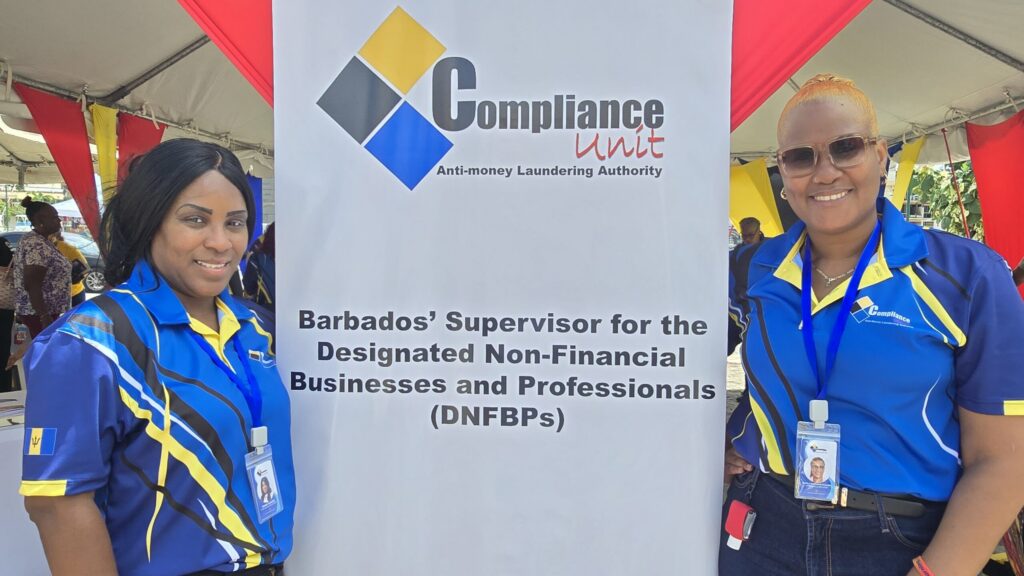
The unit supervises the designated non-financial businesses and professions (DNFBPs), which include attorneys-at-law, real estate agents, accountants and dealers in precious metals and stones .It trains the four sectors every year, and its next session runs on October 1 and 2 at Wyndham Grand Barbados, where the 150 places are almost fully taken. Williams-Phillips said it was “not just a talk shop”.
She also clarified that suspicious transaction reports (STRs) never come to the Compliance Unit: they go directly to the Financial Intelligence Unit (FIU), which analyses them. “We are never involved as a regulator,” she said.
Chief Compliance Officer Shari Squires said the open day, the unit’s second but the first held in public, was about explaining the unit’s role to ordinary Barbadians.
The event, dubbed ‘Compliance Officer Day’, which falls on Saturday, was held on Friday. Staff handed out “Know Compliance” flyers, and the unit also offered health checks, photo booth sessions and games about its work.
A public campaign is running through September and October, including a weekly Mornin’ Barbados TV slot working through the business sectors in turn. October will focus on the anti-money laundering legislation, which was passed in the House of Assembly last week and in the Senate this week, and on a new registration system for the DNFBPs.
Squires’s message to the public was not to hesitate when an attorney or an estate agent asks for identification, a source of funds or proof of address, because the law requires them to collect them.
“By your providing information to what we call the gatekeepers, the attorneys, real estate agents, to those entities, that is helping us to protect Barbados from any money laundering activities happening in our financial system.”
(LG)
The post Anti-money laundering unit reports improved biz record-keeping appeared first on Barbados Today.