
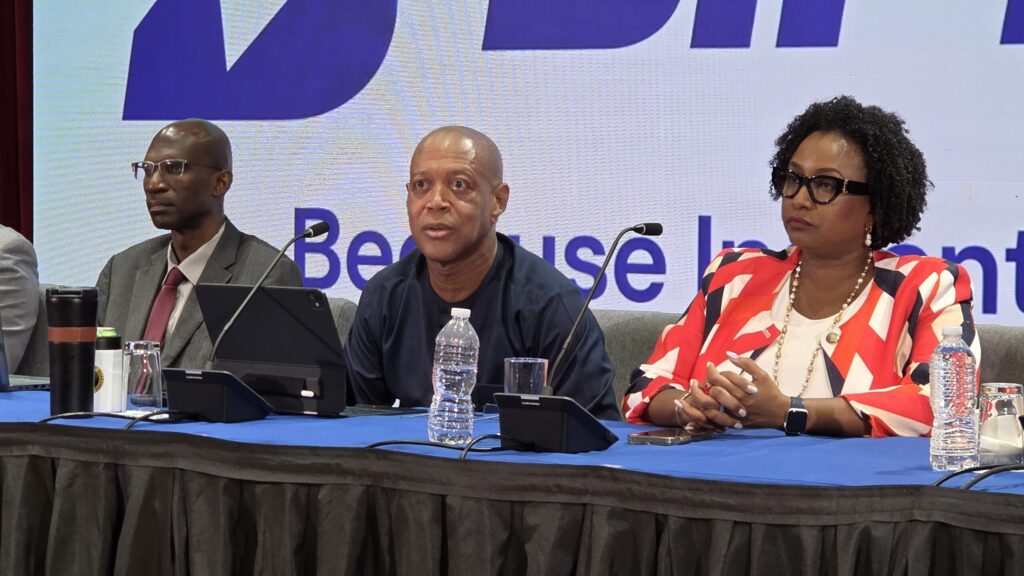
Despite processing 750 000 transactions worth $1.3 billion within its first month, the BimPay platform is facing operational issues largely attributed to financial institutions, Governor of the Central Bank of Barbados Dr Kevin Greenidge has said, as the regulator moves to enforce stricter standards and protect customers from delays and errors.
Dr Greenidge reported a failure rate of 0.2 per cent since the platform went live on June 12, acknowledging ongoing problems including delayed salary payments, difficulties accessing tokens, inconsistent spending limits and transaction delays, despite strong uptake of the new instant payment system.
He told journalists: “In the last month, that 0.2 per cent failure represents salaries that did not reach a worker[‘s] account on pay day. It represents pensions that do not reach a pensioner on time, and that is what a failed payment is… Where institutional payments have been failing, we at the Central Bank have not simply noted it and wrote the institutions. We have required that institutions find the cause, fix it, and report to us on both accounts. And while the institution is doing that we require that they put monies in the accounts of that customer’s account and then after reconcile it.
“In other words, we are asking to issue what we call provisional credits, meaning that if a person’s salary or the pension did not arrive because something failed between the employer and their financial institution, that financial institution is to credit that person now and sort the problem out afterwards. You, as a person, should not have to wait on their systems, and that is the standard that we have set, and that is something that we continue to push.”
This requirement was already yielding results, said Dr Greenidge, stressing that financial institutions were not permitted to charge late fees arising from system-related delays.
He also pointed to human error, noting that incorrect account numbers in payroll submissions had contributed to some missing salary payments.
The governor described as “troubling” the practice of some banks imposing lower spending limits on the BimPay app than on their own platforms, insisting that “BiMPay limits must align with the limits already existing for that customer, plain and simple”.
He continued: “A customer can have, for example, a $2 000 limit on their banking app with your particular institution, and that same customer, same bank account, same risk profile, on the BiMPay app, which is the national payment app, that customer is being capped at $500. Nothing about the customer has changed.
“The only thing that has changed is the app they’re using. It makes no sense. It is not correct. Our position is this: a lower limit cannot simply be imposed because the customer is using the national payments app.”
Any variation in limits must be justified and submitted to the Central Bank for approval, he said.
Addressing transaction issues, Dr Greenidge explained that some users received payment confirmations that were not immediately reflected in recipients’ accounts, again attributing this largely to financial institutions’ systems.
“In some cases, the money arrives at the recipient’s financial institution – the person you send it to – but it is not promptly posted to their account. In the other case, the customer sending the money receives a successful confirmation, even though your institution did not complete your transaction and never debited your account. Both matters are with the institutions.”
He emphasised that BimPay was designed as an instant payment system:
“The system is an instant system. If money leaves an account, it must arrive in the next account within a very short limited time, and that should be the rule. In the rulebook that all institutions have used that they have signed on regarding the BiMPay app, it says five seconds.
Every institution had signed on to the standard of completing transaction transfers within ten seconds, he said. “Money should not be held in a suspended account or credited to a recipient letter, a credit letter. It must be instant,” while noting that the Central Bank was examining all financial institutions to ensure there was no queuing or delay.
Dr Greenidge also highlighted onboarding challenges, particularly difficulties users faced in accessing token links required to connect their bank accounts to the e-wallet. Of 24 000 users who registered, only 14 000 completed the linking process.
“In several institutions, token access has been located too deeply within their existing bank digital banking channels, or labelled incorrectly, or requiring the customer to navigate through additional services to find it. If a customer can’t find the door, they can’t come in. It’s simple as that…. Persons have therefore registered and downloaded interest in using it, they are trying to link, could not find their way, and just give up. And that gap between downloading 24 000 and 14 000 actually linking for us reflects on-board friction arrangements established by the institutions.”
In response, the Central Bank has issued a common customer access standard requiring token generation to be placed prominently on the first page of banking apps or online platforms, accessible via a clearly marked button. Some institutions have already complied, while others have been instructed to revise their proposals to meet the standard.
(JB)
The post Central bank orders alignment of spending caps amid user complaints appeared first on Barbados Today.