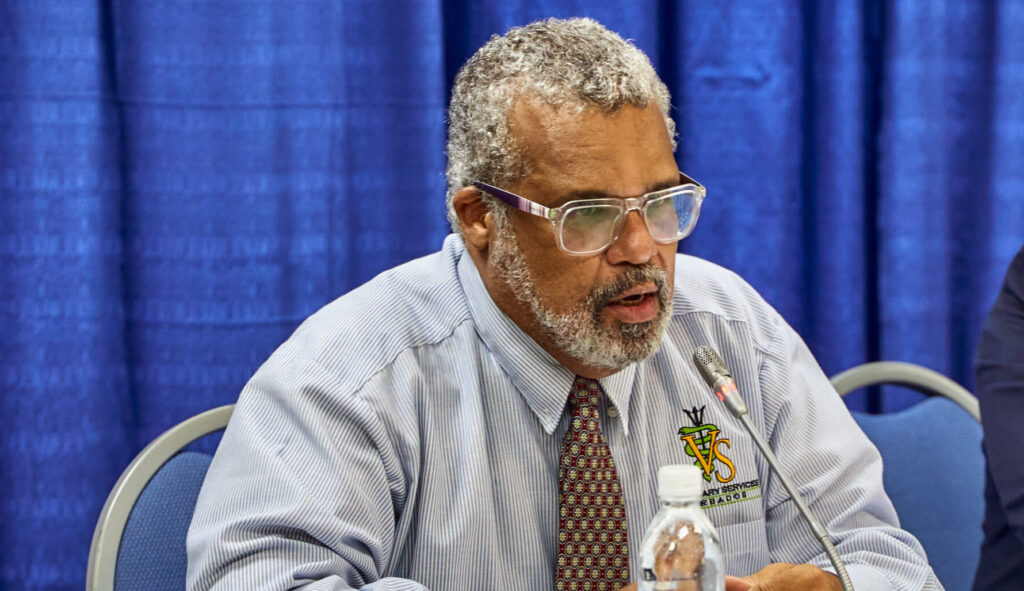
Ambassador of Barbados to the Caribbean Community (CARICOM) David Comissiong eyes the Full Freedom of Movement regime as an opportunity for the country to address its ageing society and gaps in the labour force.
Commencing on Wednesday, citizens from Barbados, Dominica, Belize and St Vincent and the Grenadines will be granted freedom to live, work and access basic services without work permits or residency requirements across the four territories.
In an interview with the Sunday Sun, Comissiong expressed that access to the neighbouring country’s skilled nationals will open a number of opportunities to address the risks of a rapidly increasing elderly population.
“Barbados really has in a sense been a victim of its developmental success in that Barbados has now developed the demographic profile of a developed country. Barbadian women are having less children than in the past and Barbadians are growing older and living much longer than in the past.
“These are good things, but at the same time, what it means is that we are having an expansion of the percentage of our population that is elderly and that are retirees,” he explained.
“At the same time, we have experienced a shrinking of that component of our population that consists of young, economically active people working and contributing to the national insurance and income tax revenues.
“We are facing a very serious predicament of being in danger of not being able to properly support our rapidly increasing elderly population. We are also finding that there are serious gaps in our labour force and we don’t have suitably skilled Barbadian workers to support the current economic activity,” he added.
The mbassador acknowledged that with just four countries, the regime would not immediately solve these concerns but maintains that the freedom of movement is a step in the right direction.
Under the new regime, skilled workers will be at liberty to remain indefinitely and work at their country of migration without the need for a work permit. Upon moving to one of the participating territories, they will be guaranteed access to primary and secondary education as well as access to emergency and primary health care on the same terms as a citizen of the country.
He clarified that other amenities such as housing will not be at their disposal, with those arrangements left to the skilled national.
Comissiong added that some public concern touched on fears that the initiative could risk introducing various criminal elements into the country. However, he assured that since
2007 CARICOM has placed mechanisms to guard against such instances.
Among these is the CARICOM Impacts Implementation Agency for Crime and Security, headquartered in Trinidad and Tobago with a Barbadian subagency based in Wildey, St Michael.
This institution is mandated to collect intelligence about criminal elements and criminal activity in the region and pass that intelligence to immigration and law enforcement agencies. It also operates a programme known as Advanced Passenger Information System, wherein Barbadian authorities are informed of any passengers aboard a transport vessel with a criminal record.
The Ambassador added that under CARICOM law every member state has the right to refuse entry to any CARICOM citizen if that person will pose a threat to national security or is likely to become a charge to the public purse.
“The point is that the free movement regime is really about encouraging wholesome and constructive movement, whereby CARICOM nationals are coming to make a positive contribution to the host nation. There are mechanisms in place to keep out or to refuse entry to elements who would not fit that category of wholesome and constructive additions to the national population,” he stated.
Comissiong further emphasised that the regime upholds the philosophy of the CARICOM single market and single economy and the CARICOM integration movement. He stressed that a united Caribbean community is necessary in an increasingly difficult, unstable and competitive world.
“We need to be able to come together and pull our resources, whether those resources be human, be financial, be natural, so that we can engage with the outside world from a position of greater strength.
“The whole concept behind CARICOM and the single market and single economy is that we want to gradually develop our region into one single domestic space, where capital moves freely, skills move freely, businesses move freely, workers move freely and more generally, people move freely in search of life opportunities, in search of employment opportunities,” he added. (JRN)
The post Comissiong clears air on free movement appeared first on nationnews.com.