
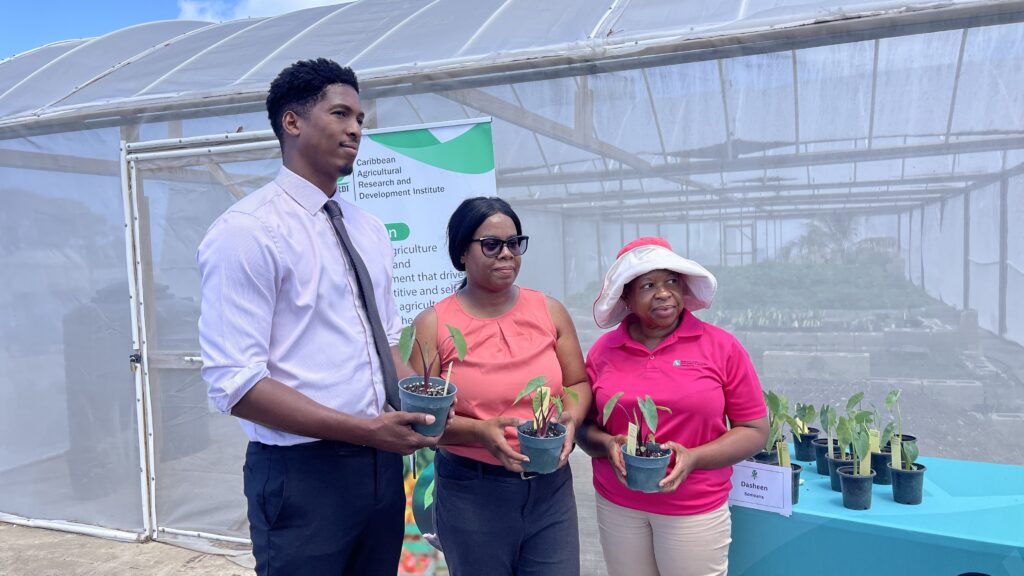
A regional agricultural initiative aimed at cutting Barbados’ food import bill and strengthening domestic food production has delivered two high-yield dasheen cultivars to farmers, with officials signalling their potential to significantly improve root crop output and climate resilience on the island.
The new cultivars were presented to the Ministry of Agriculture in a ceremony held on Wednesday at the ministry’s Graeme Hall, Christ Church headquarters.
The Caribbean Agricultural Research and Development Institute (CARDI) distributed planting material for the IND512 red-petiole dasheen and the Samoana green-petiole dasheen, which officials say could play a key role in boosting domestic root-crop production and improving food resilience.
The project emerged from discussions with the ministry on increasing the production of roots and tubers, said CARDI country representative Christina Pooler. CARDI partnered with its St Vincent and the Grenadines office and the tissue culture laboratory there to bring the planting material into Barbados.
“We have the IND 512, which is a red petiole dasheen variety, and we also have the Samoana, which is a green petiole, which both have been shown to have increased yields for dasheens in the Caribbean,” she said.
“We’ve done trials in a few of the islands and we’ve seen increased yields, adaptation to our climate within the Caribbean, and an uptake of farmers using these new varieties into their cropping systems.”
The Samoana variety has produced yields of “about five to 10 pounds per plant” while the IND512 has yielded “about four to eight pounds”, with both varieties reaching harvest between seven and nine months, said Pooler.
The first phase will focus on multiplying and assessing the planting material under Barbadian conditions before wider farmer distribution begins: “We know we have different soil profiles, different elevations where people plant at, and so on.”
While dasheen is not yet one of Barbados’ major root crop industries, it has strong potential both nutritionally and commercially, the CARDI official said,
“Dasheen can be used. The leaves can be used. The tubers can be used,” she said. “You can prepare the dasheen in similar ways that you use with sweet potatoes. You can create the flour for thickening soups and gravies. You can use it to produce chips and use it as a gluten-free option as well.”
She also linked the initiative to Barbados’ wider fight against non-communicable diseases and regional food import dependence.
“Especially with the different NCDs that Bajans are battling with currently, it’s part of the national priorities in terms of food security, so increasing food production.”
The project supports the region’s target of reducing the food import bill by 25 per cent by 2030 and forms part of broader work involving sweet potatoes and yams later this year.
Chief Agricultural Officer Paul Lucas, who accepted the donation on behalf of the ministry, described the timing of the initiative as critical.
“I would just like to say thank you very much for the donation. And it’s quite timely because of the current issues that we’re dealing with at the moment,” he said.
“And in terms of the partnerships… It is very important to have these partnerships to ensure that we build the capacity here in Barbados and to ensure that the work that’s being done is able to benefit the stakeholders here on island.”
Officials will closely monitor the performance of the cultivars once planted, Lucas pledged.
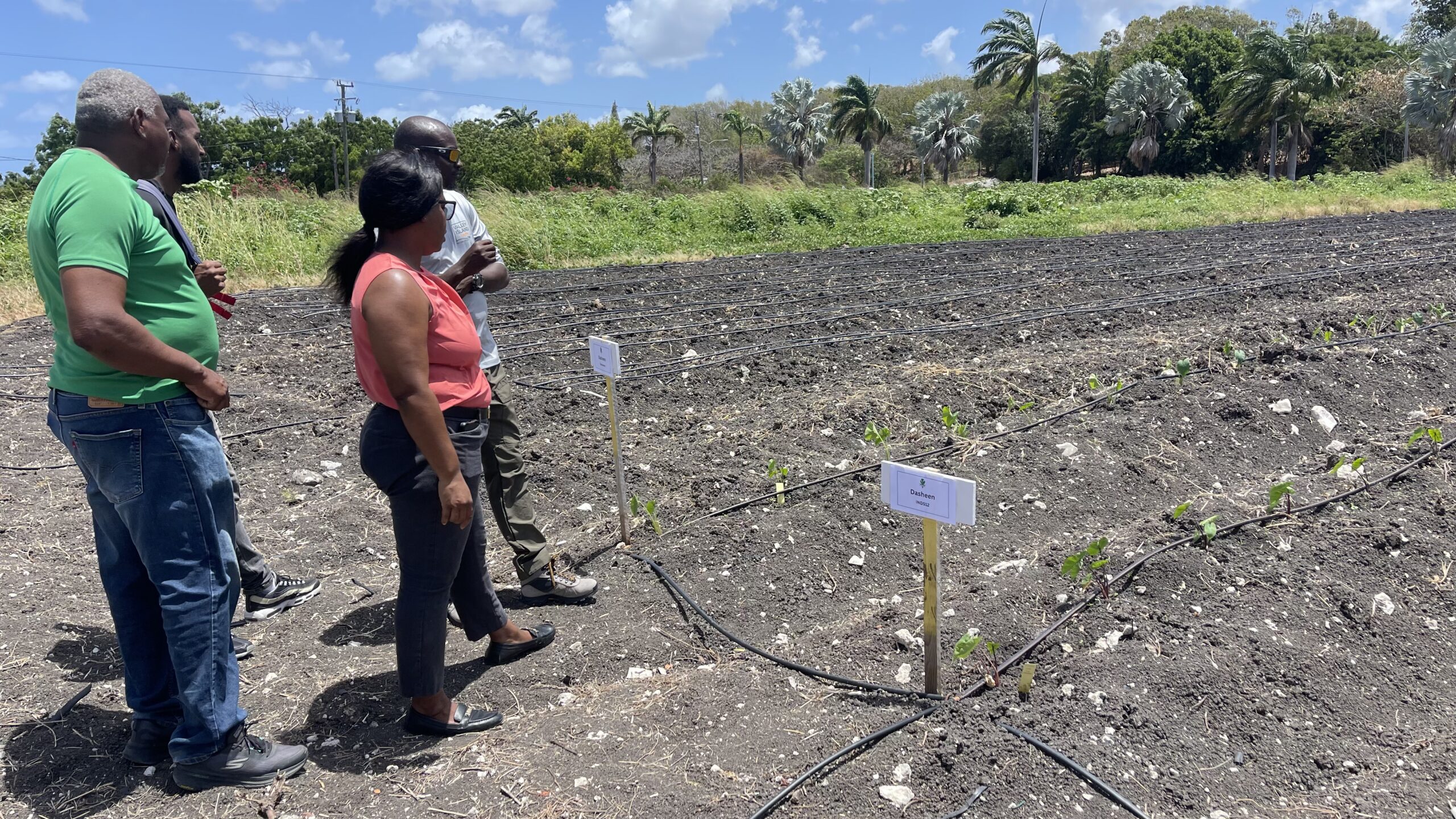
CARDI officials looking at the dasheen beds. (Photo Credit: Lauryn Escamilla/Barbados TODAY)
“We’re going to take good records because we need to understand how best these are able to perform here in Barbados.”
The Barbados Agricultural Development and Marketing Corporation’s (BADMC) deputy chief executive officer, Dr Claire Durant, said the state-owned farming enterprise viewed the initiative as an opportunity to diversify domestic food production and improve diets.
“Dasheen is not a very popular item in Barbados,” she said. “But as we move forward and look to develop food security and improve the offerings for Barbadians and improve their diets, this is a timely and important donation.”
The planting material would contribute to BADMC’s crop escalation programme, which aims to increase staple crop production and improve the quality of planting material available to farmers, Durant added.
CARDI officials also announced plans to provide strategic training for farmers and extension officers to help maximise yields and ensure the new cultivars reach their full potential.
(LE)
The post Dasheen cultivars introduced to boost food production appeared first on Barbados Today.