
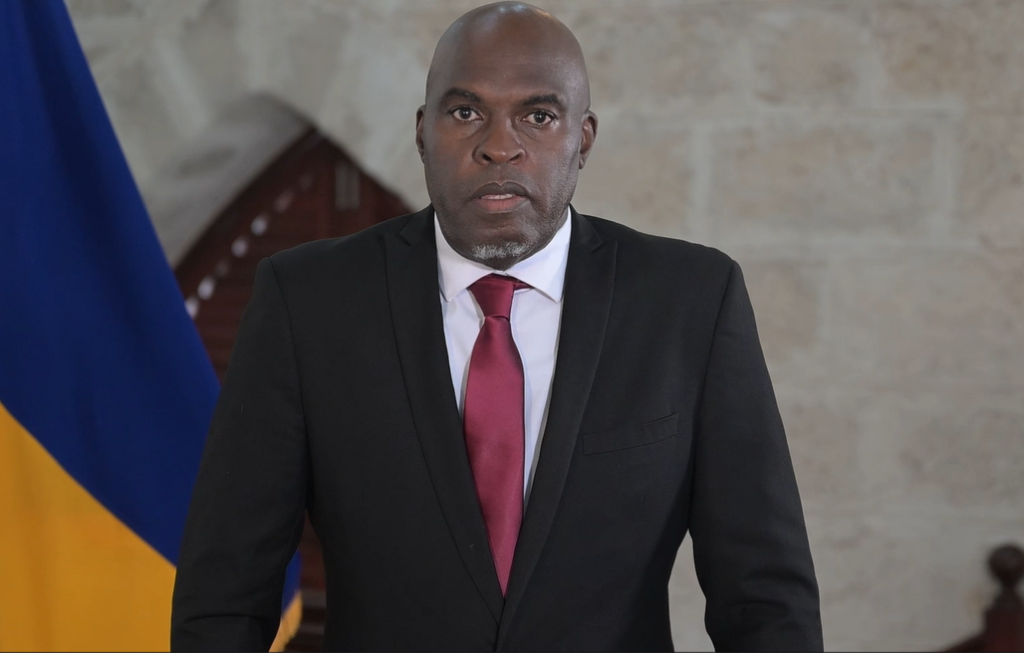
In the wake of a spate of deadly shootings, the top criminal defence attorney now leading the Mottley administration’s anti-crime thrust has revealed an aggressive and modern strategy to stem rising gun violence and overhaul the justice and law enforcement systems.
Michael Lashley SC, the Minister of Legal Affairs and Criminal Justice, made his first national statement on his ministerial role — a day after shootings in St Michael on Monday left two men dead and at least two others injured — pushing the homicide tally to ten so far this year.
Lashley’s ministry would work closely with law enforcement and other agencies to ensure the criminal justice system is equipped to respond effectively to evolving threats, he said.
“My job is to work with the police, with the courts, with the prosecutors, with the prison service, and with every part of the criminal justice system to make sure they have what they need to do their job and indeed to do it well.
“That means funding where funding is needed. That means equipment where equipment is needed. That means policy reform. That means research. That means the change or introduction of new laws where new laws are required.”
He said modernisation of the justice system would also form a key component of the strategy.
“That means modernising our systems so that our police service and the justice system are fit for the third decade of the 21st century, not resting on systems, our practices and rules that were settled 50, 60, 70, or even 100 years ago.”
The minister stressed that operational decisions remain the responsibility of the police, but the government would ensure that officers receive the support required to carry out their duties.
“The minister does not run police operations from an office,” he said. “The police must be allowed to do their work and to do it aggressively.
“My duty and the duty of this government is to make sure they have every lawful tool, every piece of equipment, every policy support, every legislative support and every institutional support they need to execute their duties.”
Lashley signalled an all-of-government approach to address both the causes and consequences of crime: “I will be working closely with my Prime Minister and my ministerial colleagues on building out an aggressive and modern crime prevention policy.
“Because if you are serious about fighting crime, then you must be serious about understanding crime.”
Part of that strategy, he said, would focus on early intervention among young people between the ages of 16 and 25 — a stage he described as critical for prevention efforts.
“Crime is not limited to one age group, but we would be making a mistake if we did not focus on the part of prevention or prevention strategy for our young people, especially those between 16 and 25,” Lashley said.
“That is a crucial stage of life and if we are serious about prevention then we have to intervene early, reach them directly, give them support, direction or alternatives before negative influences take hold of them.”
The minister also pointed to emerging social factors contributing to criminal behaviour, including mental health challenges, substance abuse and the growing use of synthetic drugs.
“In too many recent cases mental health issues have been a factor. We are seeing irrational behaviour. We are seeing dangerous obsessions.”
He added that authorities remain concerned about alcohol abuse, domestic violence and criminal activity linked to robbery, burglary and drug trafficking.
“There’s the most dangerous element of all, those who are involved in illegal activity whether robbery, burglary or the trafficking of drugs and who use guns as tools of trade.”
The government’s response, he said, must reflect the complexity of the problem.
“Our response has to match reality. It has to be layered. It has to be coordinated. It has to be modern and it has to be firm.”
Among the “priority” measures under consideration is the creation of a dedicated gun court to accelerate the handling of firearms-related offences.
“The gun court is a priority, not something for a distant future, not something in contemplation, but it is a priority. The creation of a gun court must send a very clear message where guns are concerned. This country is going to respond with speed, seriousness and resolve.”
He also warned that individuals who shield violent offenders could face stronger penalties.
“You cannot be harbouring dangerous persons, hiding them, shielding them and protecting them while the police are trying to find them. That cannot continue.”
Lashley acknowledged that reducing crime will require sustained effort and cooperation across society.
“No serious person will pretend that this will all be solved overnight. It will not,” he said.
“But equally we do not have the luxury of taking our foot off the gas.
“Government has a role. The police have a role. The courts have a role. Communities have a role. Families have a role. Citizens have a role.”
The administration intends to move quickly to strengthen the country’s crime-response systems, Lashley said.
“My commitment is that I will hit the ground running.
“The country is looking not for excuses but for action. The action is exactly what this government intends to deliver.”
What to know: Lashley’s anti-crime plan
A new, island-wide crime prevention plan will be the centrepiece of the government’s response, combining enforcement, legislative reform and community action.
– Justice system overhaul: Modernising outdated court and policing systems is a top priority to ensure they are “fit for the third decade of the 21st century”.
– Gun court: A specialised court for firearms offences will be fast-tracked to deliver speedier trials and tougher deterrence.
– Support for law enforcement: Police will receive additional funding, equipment and legal backing, though operational control will remain with the force.
– Youth intervention: Early prevention programmes will target 16- to 25-year-olds, offering alternatives, mentorship and social support before criminal influences take hold.
– Social factors: Authorities are responding to rising cases linked to mental health struggles, substance abuse and synthetic drugs.
– Tougher penalties: New laws will target those who harbour offenders or aid crimes
The post Dedicated ‘gun court’ among new measures to speed justice appeared first on Barbados Today.