
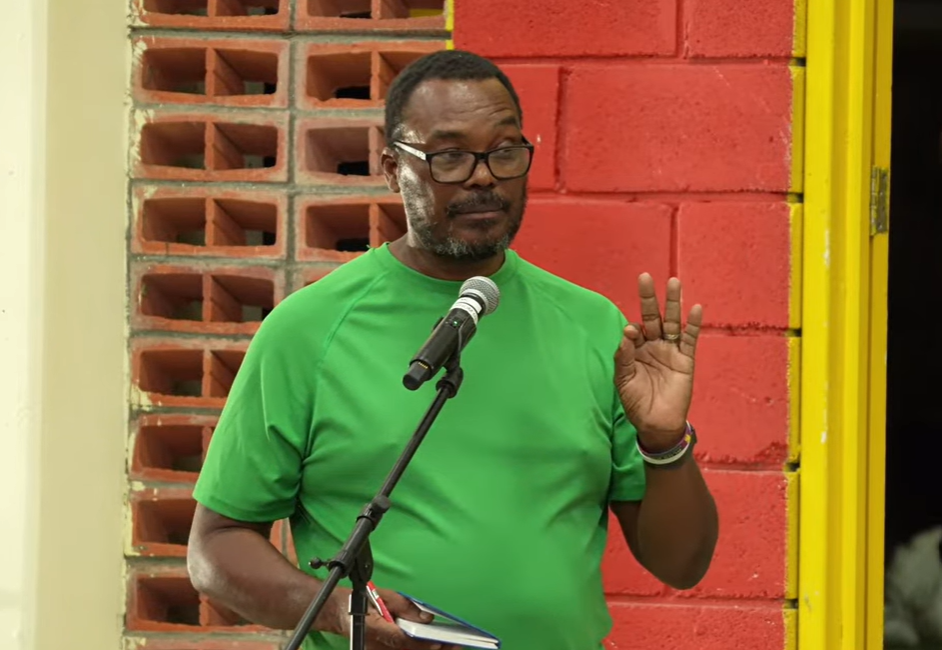
A former police officer has called for greater use of supervised rehabilitation for young people accused of minor offences, arguing that convictions can create long-term barriers to work, travel and future opportunity.
Jonathan Best, who served with the force for 36 years, spoke at the St Andrew Ideas Forum on Thursday night, where he proposed giving young offenders opportunities to avoid conviction through rehabilitation and supervision.
Best gave the scenario of a young person who may be involved in an altercation with another person. He proposed returning the person home under supervision and with rules to follow if they wanted to avoid prison time.
He said: “Send that youngster home with proper guardianship and with certain stipulations, and you could adjourn the case for about three months. During that three months, he has to go either back to school or some learning institution or go and find a job, and the magistrate can have a list of available jobs and ask the court officers and say, look, go and take up one of these.
“After the three months you return to court, and you start to do good, adjourn for three more months and then by one year and you are gainfully employed or in a learning institution are doing well and you do not reoffend then you can either adjourn it now for one more year or you could dismiss the case and that guy will not have or lady will not have a conviction.”
Best argued that convictions can later prevent young people from getting jobs, obtaining visas and moving forward in life.
“Something later know you go somewhere to work for a job and you say bring your police certificate or character, and you got two-three-four of those old convictions, and you cannot get the job and you don’t know why or you slip through the crap, as I see a few days ago, you get the job but then when I go to check and I see these convictions you got. They lay you off; you don’t get it back.”
He believed that, in the case of petty offences, people should be given chances.
“We hear about second chances, give them third chances. It’s strange hearing it coming from me because of my past job, but third chances, fourth chances if need be. But do not give these young people – I know they’re committing the crime – but the petty crime. Give them some chances to get their act back together because it’s coming back to bite them. I know they’re going deeper and deeper and going for a 16-year-old with a gun?”
But Attorney General Wilfred Abrahams responded by stating that people were no longer being convicted for simple crimes.
He gave an assurance that the government’s philosophy was not to stain people’s records or cripple them for life over mistakes.
“This government, in particular in relation to small minor crimes, is …not seeking to stain anybody’s record and cripple them for life over something that is a mistake, right? So our philosophy has been to provide every possible avenue: you would see all of the social programming, you will see the Youth Advanced Corp, you see all of those things diverting persons from that stream, so the philosophy is not to punish people, not to give them convictions.”
But he made clear that diversion from criminal prosecution did not apply to serious offences.
“We don’t believe in convicting people for things that can be resolved otherwise, in instances where they can, have diversion to better themselves, to go into some sort of program and come out better on the other end. If you’re paying attention to the court pages, you’re not seeing youngsters getting our first-timers, being given a conviction for minor offences.
“If you have a firearm, regardless of how old you are, you’re going to take a charge on that and going to be dealt with on that. If you shoot somebody, you’re going to be dealt with on that.”
Abrahams said the government was trying to divert people from the criminal justice system into a rehabilitative, corrective and nurturing environment.
“It is not our policy to prosecute or convict people for simple offences, especially where the person is capable of learning from that and coming out better at the end of some social programming, so I hope that puts your mind at rest. So there are other facilities as well being built to accommodate our young people, and it’s diversion.”
He said the government was trying to divert people out of the criminal justice system and into more corrective, nurturing environments.
“We accept everybody’s not equal, so the support that you have, you had at home as a child, and I had at home as a child, not everybody has that same support.”
With the programme now in place, the intention was to address at-risk young people in the school system and give them the assistance they need before they commit a crime or come into conflict with the law, Abrahams said.
(LG)
The post Ex-cop urges more chances for young offenders appeared first on Barbados Today.