The 2026 sugar crop is set to begin on Tuesday with Portvale Sugar Factory accepting canes from daybreak, but veteran farmers warned that the centuries-old sugar industry now stands at a critical crossroads amid stalled restructuring efforts and dwindling production prospects.
With decades invested in the industry, long-standing producers declared they did not want to see sugar cane disappear from the landscape, arguing that no other crop could replace it across the island’s vast acreages.
Veteran farmer and manager of Edgecumbe Plantation, Richard Mayers, who has spent nearly five decades in the industry, expressed deep concern about the industry’s long-term survival.
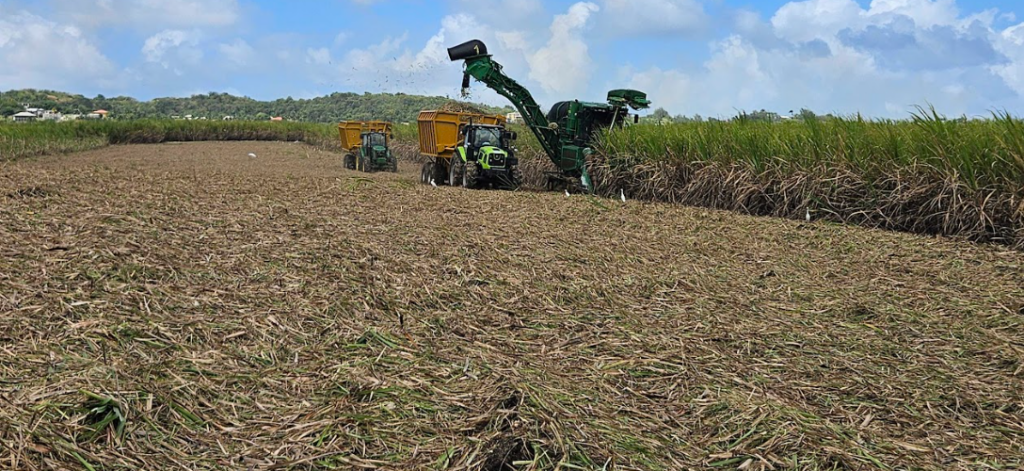
“This crop season is my 46th crop season in the sugar industry,” he told Barbados TODAY at Campaign Castle, St George, on Monday where harvesting has already begun.
“And if I live to see July 16 this year, it will be 47 years for me in the industry. That is a long, long journey in the industry.”
Mayers warned that the industry faces serious structural challenges and uncertainty about its future.
In January 2024, the government announced a cooperative-driven ownership structure, with Co-op Energy holding a 55 per cent majority stake, former and rehired workers owning 20 per cent, and the government retaining 25 per cent to be offered to the public.
Two companies were created to run operations: Agricultural Business Company Ltd at Bulkeley, St George, managing farms; and Barbados Energy and Sugar Company Inc at the Portvale Sugar Factory in St James, overseeing milling, sugar production, and by-products. Both entities assumed operations from the state-owned Barbados Agricultural Management Company (BAMC) on January 15, 2024.
The transition later stalled amid uncertainty over the transfer of BAMC assets and management of the industry. The situation worsened last August when the Memorandum of Understanding between Co-op Energy and BAMC was terminated after the government said the company failed to raise $16.5m in equity financing.
Co-op Energy, disputing the claim, said members’ funds would not be released without audited financial records and clear documentation of assets. The collapse halted what had been promoted as a historic shift towards worker ownership.
Farmers represented by Barbados Sugar Industries Limited (BSIL), the last grouping of the original planter class, have since expressed hope that another investor will emerge to stabilise the sector, although chairman Mark Sealy warned BSIL farmers cannot shoulder the financial burden of recapitalising the Portvale factory and state-managed sugarlands.
For Mayers, who has spent nearly half a century working in the fields, the future of the industry now hangs in the balance.
“Over the last 47 years I saw this industry fall and I saw it get back up. But this year it is at a crossroads and I don’t know what to say, to be honest,” Mayers said. “I am very concerned for the sugar industry at this point. There are a lot of decisions that have to be made to take this industry forward.”
He stressed that the responsibility for saving the industry should not rest on a handful of plantations.
“We at Edgecumbe play our part but we cannot do everything. We need everybody in the industry to step up and save it. One plantation cannot save it.”
For Mayers and other veteran producers, the disappearance of sugar cane would leave large areas of farmland idle.
“There’s nothing to replace this. As you see, as a plantation go out of sugar cane, it runs away in bush. There’s nothing to replace sugar cane and you need sugar cane to rotate with other non-sugar crops.
“I would like to see it (the industry) survive but it is not my call… there are a lot of decisions that have to be made to take this industry forward.”
Yet the uncertain production outlook comes as the industry continues to grapple with the fallout from a stalled restructuring process.
“I would love to do 50 years,” he said. “But it depends on if there’s a sugar industry within the next three years.”
Mayers said he began harvesting a day ahead of the official start to ensure that equipment was operating efficiently before the busy crop period.
“My goal is every year the factory announces that they are taking canes a Tuesday or a day in the week. I like to start the afternoon before so I will know if my harvester has any small issues that I need to get sorted out.
“We did a big maintenance programme last year, but there are some small issues that you will miss and it is only when you start to harvest cane that they will pop up.”
By late Monday, harvesting on the St Philip farm was progressing steadily as workers prepared haulage trailers for delivery of canes to the mill the next day.
Mayers said: “Things are going good. What we’re doing is filling up the haulage trailers for tomorrow morning to get push off.”
Early projections suggest that overall cane production could fall well below last year’s levels, largely due to drought conditions that affected growth during the latter half of 2025.
“I would like to do 9 500 tonnes again. I don’t know if I have it,” Mayers said. “We went through a drought last year July, August, September, and a lot of the ratoon canes did not put on the growth that you wanted to see.”
Industry-wide production could also decline sharply.
“I think this crop will be 20 000 tonnes short on last year,” he predicted. “And from my years’ experience in the industry, Portvale factory needs at least 100 000 tonnes of quality sugar cane every year to be viable.”
Earlier this year, BSIL Chairman Mark Sealy indicated that farmers within that grouping expected to reap about 66 000 tonnes of cane this season, although producers now warn that the prolonged drought may further reduce that figure.
Tuesday’s start of the crop would be roughly in line with earlier projections by newly appointed Minister of Agriculture Dr Shantal Munro-Knight, who announced last month that the season would begin in early March.
sheriabrathwaite@barbadostoday.bb
The post Farmers brace for uncertain sugar crop appeared first on Barbados Today.