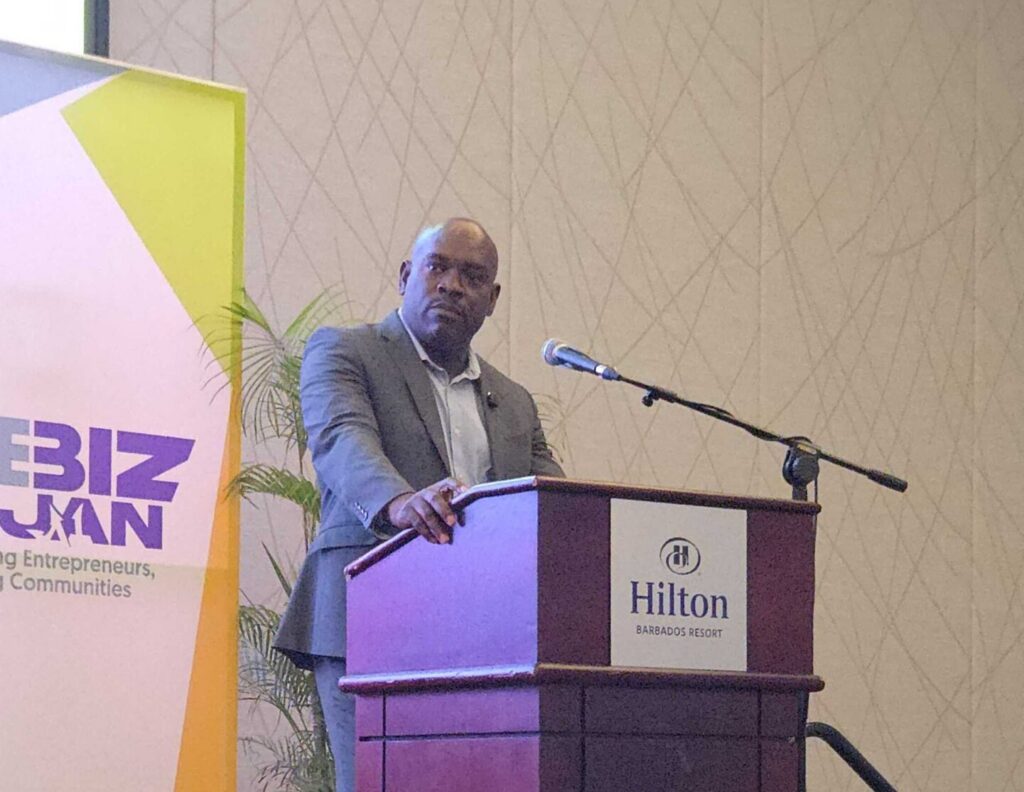
A stronger push on compliance, faster government services and better access to credit are central to plans to help small Barbadian businesses grow and compete internationally, Minister of Finance Ryan Straughn said on Friday.
As the WeBizBajan community financial literacy campaign launched, Straughn delivered a speech calling for greater collaboration between regulators, the private sector, and community-level entrepreneurs to drive sustainable economic growth.
The finance minister said the modern definition of a micro-business has evolved due to rapid technological advancements, enabling even the smallest operations to have a global footprint.
“Micro is just a definition in terms of utilising the global supply chain to its fullest extent,” Straughn said. “So therefore, if we get the IP (Intellectual Property) right, you get the financing right, a so-called micro-business can leverage the entire global supply chain and become a large company because we’re using technology to help not just grow your business environment but build your business and your brand globally.”
A significant portion of the finance minister’s address focused on regulatory compliance, which he said is often misunderstood by small business owners as an unnecessary administrative burden. He defended the oversight requirements of agencies like the Barbados Revenue Authority (BRA), the National Insurance and Social Security Service (NISSS), and the Corporate Affairs and Intellectual Property Office (CAIPO), explaining that global markets demand strict regulatory frameworks.
“We’ve done a lot of work over the last eight years trying to get Barbados off of all the possible lists that they are on, and it is important that small businesses understand why compliance is important,” Straughn said. “We’re not humbugging anybody just because we want to humbug you. We want businesses to grow in an ecosystem that is supported.”
Straughn said some Barbadian companies have faced roadblocks when attempting international acquisitions because the island could not readily verify the strength of its regulatory framework to external parties. He also pointed to the risks that low compliance poses to correspondent banking relationships, noting that Barbados is too small an economy to absorb the negative risk perceptions associated with financial opacity.
“The reason that we have to be open and transparent is because you’re too small. Too small for any risk perception associated with correspondent banking,” he warned.
To match the compliance push, Straughn said the government is pursuing administrative reforms and digitisation to improve public service delivery. He reported that the administration had cleared 99.9 per cent of the state’s long-standing vendor arrears over the past eight years, bringing government payment timelines to under 30 days to protect private-sector cash flow. The next phase of reform, he said, involves creating a unified digital portal.
“Our mechanism for digitisation has to be further enhanced as government,” the finance minister said. “Our systems have to talk with one another so that there’s a single entry point to government rather than having different government organisations going at you for the same information. We’re working on solving that because that is critical to your time as businesses.”
Addressing weaknesses within the domestic private sector, Straughn expressed concern about the historical trajectory of many family-owned enterprises in Barbados. He said a lack of education on governance, management structures, and succession planning has led to too many long-standing entities collapsing prematurely rather than continuing across generations.
Turning to the Office of Insolvency, headed by supervisor Ester Springer, Straughn said a new, consolidated bankruptcy and insolvency regime is being drafted. He urged entrepreneurs to treat market exit as a deliberate strategic decision rather than a chaotic failure.
“Businesses must from inception be thinking about what is the exit strategy,” Straughn asserted. “And let me say this: the exit strategy cannot be leaving the taxpayers or the national insurance holding the bag. If that is your exit strategy as a business, then obviously that is not the kind of business that we want to support in Barbados.”
The minister also identified upcoming areas for economic expansion, including establishing an international food centre to help culinary entrepreneurs scale production for international trade fairs and rolling out comprehensive credit reporting frameworks to improve access to bank financing.
The finance minister said public education on credit management, financial transparency, and community-level networking would be essential to achieving the country’s targeted four to five per cent economic growth rate.
“Small businesses having access to credit will be the engine of growth in this economy,” Straughn said, reinforcing that a reliable template for local business success relies entirely on “why not just compliance, but the ability to compete is integral to the success.”
(RR)
The post Finance minister to small biz: embrace compliance, digitisation appeared first on Barbados Today.