
Businesses in St Lawrence Gap and the Barbados Alliance to End Homelessness are pressing for urgent policy action to address homelessness, saying the problem is affecting public spaces, troubling visitors and placing a growing burden on operations.
The concerns were raised during a meeting at Hotel Le Roy on Wednesday, chaired by the alliance and attended by representatives of the Psychiatric Hospital, The Barbados Police Service (BPS), the National Council on Substance Abuse (NCSA), the National Conservation Commission (NCC) and the Ministry of Tourism.
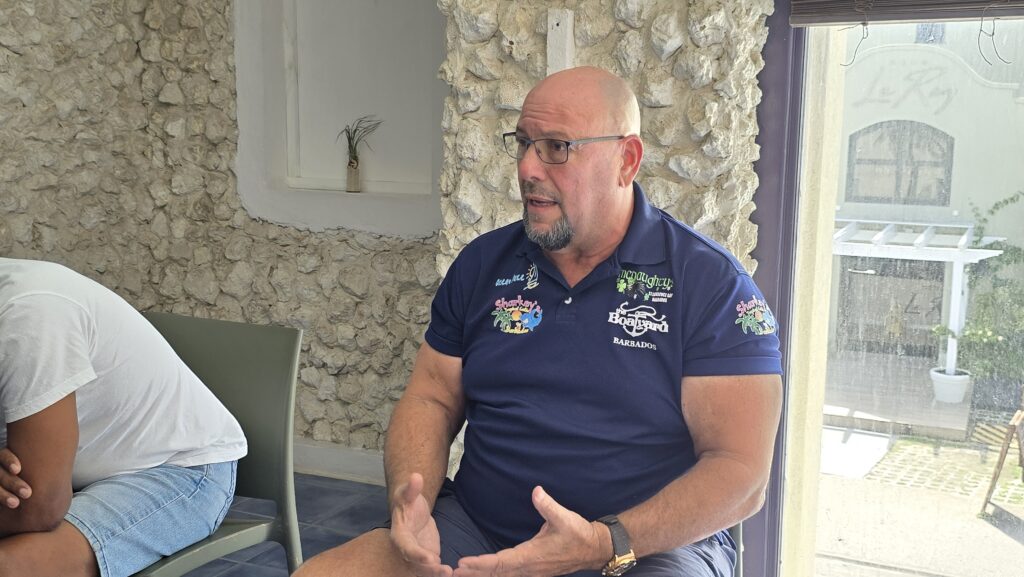
Business owner Sean DeFreitas argued that more needed to be done, particularly in a country that depends heavily on tourism. He contended that substance-use problems among homeless people had worsened significantly over the past five years.
“They do not have mental health issues; they have drug issues. There’re addiction issues… and I can openly say that we see it on the street every day,” he said.
DeFreitas also questioned whether existing laws, particularly those relating to public cannabis use, were being enforced consistently.
“I’ve seen people standing in front of police officers smoking weed, and then when a tourist is told it’s not legal, he says, ‘Well, why not? They’re smoking right there in front of police officers’,” he said.
While he did not believe people should be jailed simply for smoking cannabis, he said authorities should issue warnings and impose penalties for those who continued to use it openly in public.
Another business representative said the situation was affecting residents’ and visitors’ ability to use public spaces.
“We’re seeing an increase of people on bus [stop] benches, pulling up the garbage and leaving. Locals and kids can’t use the bus stops in the morning,” the representative said.
DeFreitas said businesses were also being forced to spend heavily on security.
“My business spent $30 000 a month. That’s just me. I don’t know how much the rest spend … to have people there at all times to protect [their] businesses. I can’t walk the rest of the street without a man looking to peddle drugs to somebody.”
He said business owners were prepared to assist in finding solutions but wanted to see tangible results.
“What can we do to help make progress? We are disgruntled because we are not seeing results. Is there something we can do with our voice or financially?” he asked.
The concerns were echoed by Kemar Saffrey, president of the Barbados Alliance to End Homelessness, who said the problem was affecting both businesses and visitors and required a coordinated response involving multiple agencies.

Kemar Saffrey, president of the Barbados Alliance to End Homelessness (Photo by: Lourianne Graham)
“I received several videos where homeless persons in the area are cursing business owners [and] tourists. I’m always in the Gap and see them using substances on the side of the road, and they are affecting the entrances to businesses in the area.”
Saffrey said the alliance already provided rehabilitation, shelter and reintegration programmes, but some people living on the streets required more specialised and sustained intervention.
“We need policy, but we don’t need policy 10 years from now. We need policy now,” he said, calling for legislation to support appropriate care for people who were unable to look after themselves or posed a danger to themselves or others.
“The organisation is here to advocate for homeless persons when they are mistreated on the streets … to protect them at the end of the day. The homeless cannot be made to run rampant and harass people and their businesses, especially those with mental health illness or those who need to be seriously taken off the streets.”
Saffrey argued that many people were being caught in a cycle of receiving assistance, returning to the same environments and eventually ending up back on the streets, underscoring the need for a treatment facility that could provide longer-term support beyond services offered by the Psychiatric Hospital.
Police representatives reminded business owners that officers could not simply remove people from public spaces because they were homeless or considered a nuisance. Any intervention, they explained, must be based on legal grounds, while admission to the Psychiatric Hospital remains subject to medical assessment.
Saffrey announced that the alliance plans to launch a 24-hour roaming response team next year to engage homeless people in communities across the island. The team would provide outreach and practical assistance, including helping people obtain medication, and would work alongside the Psychiatric Hospital and community mental health nurses.
He added that the alliance also intends to develop an action plan for the St Lawrence Gap and Dover areas in collaboration with relevant agencies.
Wednesday’s meeting follows a previous meeting chaired by the alliance with businesses in Oistins.
(LG)
The post Gap businesses sound homelessness alarm appeared first on Barbados Today.