
Barbadians are to get a mix of targeted cash support, tax cuts and trade cushions as the Mia Mottley administration braced the country for a fresh wave of global price shocks while laying out an ambitious plan to re‑industrialise the economy and seed a $5 000 nest egg for every child.
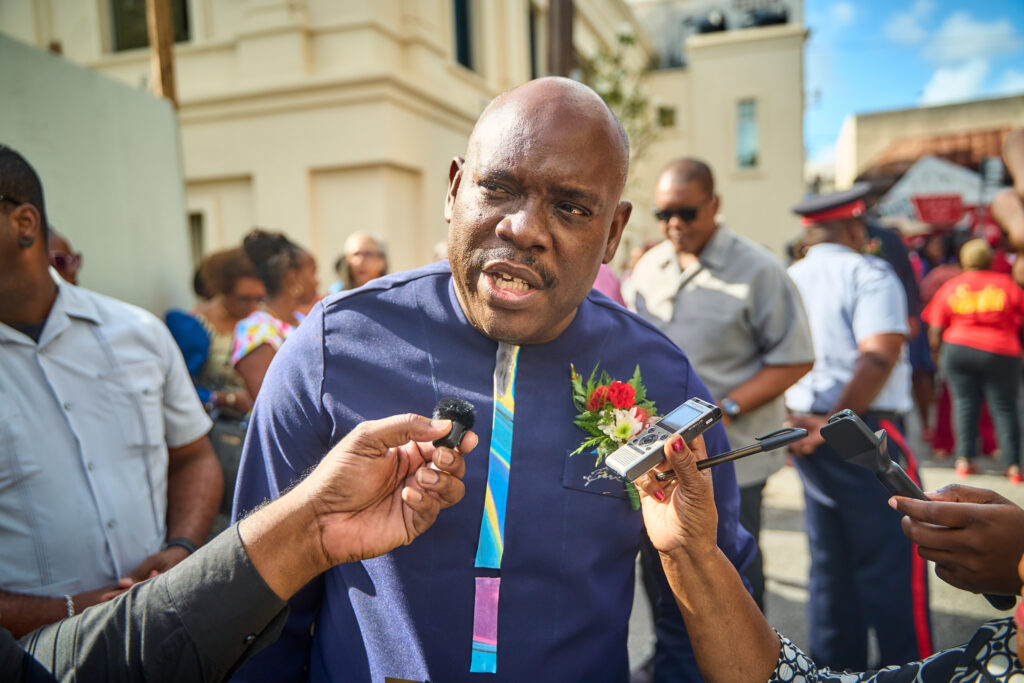
Delivering the 2026–27 national budget in the House of Assembly, Minister of Finance Ryan Straughn warned that emergency bunker surcharges by major shipping lines, triggered by conflict in the Middle East, were already “gathered…to assist in continuing further price escalation”, but insisted that “while the government will do its best to shield the country from the full impact of these shocks, Bajans should also have an appreciation for the full picture.”
To blunt the immediate blow from freight hikes that will ripple through supermarket shelves, Straughn announced that from next month to March 31 2027, the Customs and Excise Department will cap the value of containers used to calculate customs duties and VAT at $3 000 for a 20‑foot container and $6 000 for a 40‑foot container for CIF shipments. He said tariff headings for both FOB (free on board) and CIF (Cost, Insurance, Freight) shipments would be issued via the Customs portal, ASYCUDA World, by March 23.
At the same time, the minister set out a package of tax credits and rate cuts aimed squarely at lower‑ and middle‑income earners hit hardest by inflation and rising fuel and electricity costs.
From income year 2025, the reverse tax credit will climb from $1 300 to $1 700 for individuals earning up to $25 000 a year, while eligibility will be widened so that those on $25 000 to $35 000 receive a $750 credit, a measure he said would benefit 17 221 persons at a cost of $12.9 million. The compensatory income credit income limit will, in turn, rise from $35 000 to $50 000, benefiting 18 415 taxpayers at a cost of $31.7m.
Straughn argued that the government’s strategy of using tax credits rather than higher allowances “gives the government more flexibility should there be…a significant downturn in the economy”, noting that credits could be adjusted in a crisis without permanently embedding relief into the tax base.
Looking ahead to income year 2026, the Budget trims personal income tax rates: from 12.5 per cent to 11.5 per cent for those earning between $25 000 and $75 000, and from 28.5 per cent to 27.5 per cent for incomes above $75 000, at a combined estimated cost of $26.1 million. “Fiscal caution today is what protects our ability to deliver more for Barbadians tomorrow,” Straughn said, stressing that deeper cuts were deferred because of the “current global environment marked by geopolitical conflict, supply chain disruption and raising inflation”.
Cost‑of‑living credits for pensioners, welfare, over‑65s
With pensioners singled out as particularly exposed to years of low growth and anaemic investment returns, the minister unveiled a one‑year cost‑of‑living cash credit of $100 per month from April 1 for those with income below $50 000, to be paid through the National Insurance and Social Security Service, which will verify income with the Barbados Revenue Authority. At the same time, the taxable allowance for pensioners will rise sharply from $50 000 to $75 000, at an annual cost to the Treasury of $11.7 million.
The $100 monthly cost‑of‑living cash credit will also extend, for one year from next month, to persons over 65 who receive no pension income at all, domestic or abroad, once they present identification to the National Insurance Scheme, and to those on welfare, whose base rates have already been increased by 30 per cent from March 1. Recipients of the Special Needs Grant, children and adults, will likewise receive the $100 monthly payment for 12 months.
Straughn cast these moves as part of a broader effort to “ensure that those who earn the least, who will always face the full breadth of any shocks…find ways to ease the pressure.”
Security, crime, home protection
Against a backdrop of rising concern about gun crime, the Budget promises to establish two dedicated gun courts – one to handle offences committed within the last year and a second to clear the backlog of older cases – in a bid to speed up firearms trials and “reduce the backlog in the justice system”.
The Barbados Police Service will see its complement increased first to 1 530 and then to 1 750 officers, alongside a three‑year investment programme to upgrade police accommodation, starting with a new station at the Six Roads Civic Centre.
For households, Straughn proposed that, from next month, all customs duties and VAT be removed from the importation and installation of CCTV security systems and burglar alarm systems at residential properties. He also sought to hard‑wire dash cams into routine motoring, noting that insurers now manage most minor collisions without police attendance and saying the government would “encourage insurance companies to give a benefit where the dash cams are installed”.
From April 1, for one year, dashcams and GPS devices for installation in vehicles will be duty‑ and VAT‑free on importation, before they fall under the new courier de minimis regime from April 1 2027.
Online shopping, farm support
Recognising the surge in online shopping since the pandemic, the minister announced that from next month the duty‑ and VAT‑free de minimis threshold for courier and postal imports for personal use will be raised from $60 to $150 FOB. Goods worth between $150.01 and $199.99 will be duty‑free but subject to VAT, while items over $200 will attract both duty and VAT. Alcohol, cannabis and vaping products, cigars, cigarettes and tobacco, firearms and ammunition, and illicit drugs are explicitly excluded, and a $500 fine plus assessed duty will apply to false declarations or under‑invoicing.
In agriculture, Straughn pitched a cluster of incentives aimed at boosting food security and resilience:
- From April 1, a 50 per cent rebate up to $5 000 per year on approved apiculture (beekeeping) inputs, including hives, frames, foundation, smokers and tools.
- An annual rebate up to $5 000 for projects using organic materials for fertiliser and plant and animal inputs, to cut reliance on imported chemicals.
- A 100 per cent rebate up to $15 000 for heat‑reducing paint on small poultry farms for two years from next month, falling to 50 per cent thereafter, available every three years.
- An increase in the farm security rebate threshold from $10 000 to $15 000 for approved systems to combat agricultural theft, commonly known as praedial larceny.
He linked these measures to climate‑smart initiatives, including the imminent completion of a tissue culture laboratory and work on grass‑based feed pellets, as well as plans for the government to contract and brand local honey for commercial sale.
Small business finance, tourism, travel concessions
For micro and small businesses, the Trust Loan Fund loan limit will double from $10 000 to $20 000 from next month, and the VAT registration threshold will rise from $200 000 to $350 000 turnover from October 1 2026, easing compliance burdens. A new collateral registry will be created to help firms without fixed assets access credit, and a $3 million factoring facility will be set up through the Central Bank, with the Small Business Association helping to promote and oversee its use.
In tourism, properties granted concessions under the Tourism Development Act on or after 1 January 2005 will receive an automatic three‑year extension to those concessions from next month, except for properties whose concessions began on or after April 1 2020.
From 1 July 2026, car‑rental companies that meet criteria including VAT and NIS compliance, tax clearance, proper vehicle licensing and inspection, and at least 60 per cent of revenue from foreign sources deposited in the banking system will be treated as eligible tourism service providers. Approved firms will qualify for duty, excise and VAT exemptions on hybrid and electric vehicles and charging infrastructure imported every five years, and their VAT rate will be cut from 17.5 per cent to 10 per cent, aligning with the rest of the industry. Stand‑alone restaurants will also gain duty‑free concessions on spirits under the Tourism Development Act.
To bolster the maritime and cruise sector after Hurricane Beryl, the Bridgetown Port will install concrete‑filled protective pylons, marine‑grade navigational lighting and strengthened moorings, as well as improved car‑park and environs lighting, to protect infrastructure, extend night operations and enhance visitor safety.
Regional tourism is to be further incentivised by cutting the Air Travel and Tourism Development Fee for CARICOM passengers from US$35 to US$20 between July 1 and June 30 2027, at an estimated cost to taxpayers of $2.8 million.
Bridgetown regeneration, traffic reform
Setting out a vision to recast Bridgetown as “the heritage capital of the Caribbean” by 2028, when the city marks 400 years, Straughn detailed a programme of urban regeneration in inner‑city low‑ to medium‑income neighbourhoods such as Chapman Lane, Greenfield, Nelson and Wellington Street, and communities bounded by President Kennedy Drive, Westbury Road, Baxter’s Road and Mason Hall Street, as well as corridors from Reed Street to the Delamere Clinic and Jemmotts Lane to Bay land.
Phase one will focus on Chapman Lane and environs, through Jemmotts Lane, from Delamere Clinic to Bayland. He highlighted new financing secured via the Saudi Fund for Development, the completed Golden Square Park and upgrades to Fairchild Street Market and Temple Yard, highlighting that the African Export–Import Bank will establish its headquarters, trade centre and hotel at James Street, contributing $7 million to an Urban Development Fund for adjacent communities.
A public–private partnership agency will be formed with the Barbados Chamber of Commerce and Industry and others to oversee the effort.
On traffic congestion, Straughn offered a blunt history of stalled highway expansion and flyover plans, arguing that “poor decision making and lack of foresight” had left Barbados “choking…everywhere we turn”. Cabinet has now agreed to re‑engage the original company that designed the ABC Highway overpasses, and the Ministry of Transport and Works will begin a series of national consultations from next month, ahead of planning for overpasses and highway widening, including Highway 2A.
Accessibility, housing, special needs
In the coming financial year, a pilot accessible Bridgetown corridor will be built, creating a fully accessible pedestrian route from the Elsie Payne Roundabout through Prescod Boulevard, Lower Broad Street, Broad Street and Bridge Street, with extensions into adjoining streets. Sidewalks will be rehabilitated, kerb ramps, tactile paving and accessible crossings installed, and barriers removed, at an estimated cost of $600 000.
On housing, Straughn said the government would work with lenders on alternative credit assessment, flexible debt‑to‑income ratios, down‑payment assistance, subsidised interest rates, extended loan terms and home‑ownership counselling to unlock mortgages for low‑income earners.
For families with children with disabilities, a new Special Needs Trust framework will take effect from next month, allowing parents and guardians to create trusts whose income and distributions used for the care of disabled beneficiaries will be exempt from personal income tax, and clarifying the tax position of trustees.
The Budget also funds an Adaptive Aquatics programme, run through the National Sports Council and All Access Water Sports, to teach children and adults with disabilities to swim and kayak, including a summer camp and year‑round water‑safety training backed by around $450 000, and supports two new Olympic‑size pools in St Philip and Holetown.
Investing in youth, skills, crime prevention
Responding to the President Jeffrey Bostic’s “Chapman challenge” for national mentorship, the government will allocate $500 000 to run a supporting secretariat, and will activate a $5 million fund for churches and faith‑based organisations to build community programmes for young people, under the minister of ecclesiastical affairs.
A Secondary Schools Students International Exposure Initiative will allow students from age 15 to access funding from a new Global Young Bajan Fund, initially seeded with $2 million, for up to one month abroad to study other economies and cultures. Parallel to this, the SOMOS programme, backed by CAF – Development Bank of Latin America and the Caribbean and the governments of Argentina, Colombia, Cuba, Panama and Venezuela, will promote Spanish and intercultural exchange, including a study visit to Panama in April for 15 students from St Leonard’s Boys’ School and teachers.
On skills for the digital economy, Straughn tabled findings from a labour assessment showing nearly half of workers lacking necessary digital skills and 80 per cent of firms saying non‑ICT staff need upskilling, with strong demand for data management, digital security and generative artificial intelligence capabilities. Government will repurpose the $3.1 million retraining account of the National Insurance and Social Security Service, expand approved training providers to include the National Transformation Initiative, Barbados Workers’ Union Labour College, National Public Workers’ Academy and Barbados Community College, and extend the 100 per cent tax credit for business digitisation and process re‑engineering for two more years from income year 2026. The retraining account will fund around 70–75 per cent of training costs, with employers covering the remainder.
A National Competitiveness and Productivity Commission, co‑chaired by Tricia Trotman and Toni Moore, will be created to assess the economy’s competitiveness under the Barbados 3.0 framework and recommend reforms to unlock investment, jobs and foreign‑exchange earnings or savings.
Beneficial ownership and financial transparency
To strengthen corporate transparency and the fight against money‑laundering, tax evasion and terrorist financing, the Cabinet has approved a policy to establish a beneficial ownership register, identifying the natural persons who ultimately control companies and other structures.
The framework will be implemented in phases: first, legal drafting of sanctions and information‑sharing powers; second, digital implementation with secure IT architecture; and third, operationalisation of a Barbados beneficial ownership framework by May 2027.
In the credit union sector, work on a deposit insurance scheme is at an advanced stage, with Straughn expressing hope to debate the legislation before the end of May, and the government committing $1.2 million as initial capital.
Green industrialisation and creative economy
Casting the global economy as “rapidly, fundamentally and irreversibly” changing under the weight of artificial intelligence, renewable energy and advanced manufacturing, Straughn announced the Green Industrialisation Gateway Advantage (Giga), led by Export Barbados.
The strategy will organise Barbados into four industrial corridors and six specialised industrial zones, targeting sectors including advanced manufacturing and agro‑processing, AI infrastructure, life sciences and global digital services. The aim is to create thousands of high‑value jobs, lift industrial output from under 6 per cent to 24–25 per cent of GDP and expand exports from about US$700 million to US$4–6 billion annually within ten years.
Alongside this, the government will use the Economic Growth and Diversification Fund, allocated $75 million for 2026–27, to catalyse new industries, with an early emphasis on building a film industry. Under a forthcoming regime, productions filming in Barbados will be eligible for tiered cash rebates up to 25 per cent of qualifying local spend, rising to as much as 40 per cent for projects employing Barbadians, partnering with local producers and showcasing Barbados’s heritage and culture.
Straughn said Invest Barbados was already processing requests for two major international productions, and announced plans for a Barbados Film Festival in partnership with an international organisation, with the first edition slated for November 2026 and focusing on films from the African and Caribbean diaspora.
The Barbados Republic Child Wealth Fund
In one of the Budget’s most far‑reaching social measures, Straughn outlined the creation of the Barbados Republic Child Wealth Fund – a universal “birthright” endowment intended to break what he described as cycles where “too many families start from zero, generation after generation”.
The fund will provide a one‑time $5 000 investment for every child born in Barbados on or after 30 November 2021, to be held in trust and invested in real assets, bonds, equities and diversified funds, with individual beneficiary accounting. The money will be available later for education or housing investments in Barbados.
For 2026–27, the administration has set aside an estimated $52.1 million to cover those born between November 30 2021 and the end of the financial year, and projects an ongoing annual cost of $10–12 million based on current birth rates. Once legislated later this year – before the fifth anniversary of the Republic and the 60th anniversary of Independence – payments into the fund will be statutory, with an independent entity or company appointed to administer and manage investments.
“The Barbados Labour Party believes that we must reduce inequality without dividing the country,” Straughn said, presenting the child fund as a universal standard in a republic “where every Bajan child deserves a chance to thrive”.
The post Govt moves to cap freight pain, cuts taxes, pledge cash relief as global shocks bite appeared first on Barbados Today.