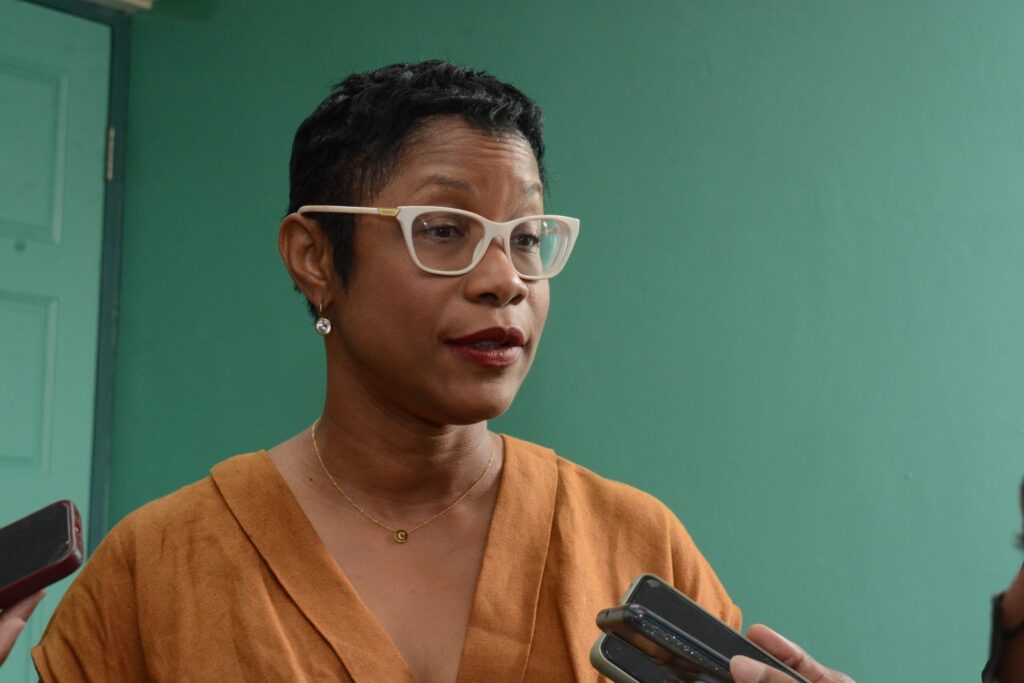
The Mangrove Landfill in St Thomas is set for a major transformation into a green energy facility that will convert waste into electricity, Senator Lisa Cummins, the leader of government business in the Senate, announced on Monday.
More than a decade after a waste-to-energy plant, mooted by the Freundel Stuart administration, failed to gain public support amid a howl of protests, Sen Cummins, as Minister of Health, was before the upper chamber outlining plans for a waste-to-energy partnership involving the Sanitation Service Authority (SSA) which again falls under the Ministry of Health and Wellness.
She told the Senate: “There is an allocation in the estimates for the sanitation services authority for waste management overall, and interestingly, over the course of this financial year, there is meant to be a partnership with the Sanitation Services Authority and the Mangrove Landfill … to be able to transition that facility into a green energy plant that allows for us to use energy, to convert the waste, the waste that has a higher calorific value, to be able to create energy.”
The former energy minister also highlighted the steady increases in national energy allocations, pointing to the government’s ongoing investment in the industry.
“In 202–2023, the ministry that I had the privilege of leading then was the Ministry of Energy and Business. The allocation of the estimates of expenditure at the time was $16m. By 2023–2024, the allocation in the estimates of expenditure was $74m; 2024 to 2025, the allocation was $82m; 2025 to 2026 the allocation was $86 million. This year… the allocation is $87 million, and so there has been an incremental increase in the allocation to energy.”
Sen Cummins said the proposed plant would also help reduce the cost to run the landfill and the government’s dependence on external waste management facilities.
She said: “IT reduces the cost of the management of that particular facility, but it also allows for the government to manage the annual transfer to the SBRC (Sustainable Barbados Recycling Centre) for the management of certain types of waste that is accounted for in these estimates of expenditure.”
The SBRC, located next to the Mangrove Pond landfill, receives and processes the island’s solid waste. Its main objective was to divert waste from the landfill and extend its operational life.
In 2019, then-Minister of the Environment and National Beautification Trevor Prescod disclosed that the government had renegotiated its contract with SBRC, reducing payments from $2m to less than $1m per month. Despite this, the government remained indebted to the recycling company, owned by industrialist Ralph “Bizzy” Williams, by more than $20m.
In 2020, Prime Minister Mia Mottley announced plans for a partnership with SBRC to tackle the country’s garbage problem.
She said then: “We are already in partnership with the private waste haulers to help us with bulky waste. We have already recognised that even in the reduction of the amounts that we pay the SBRC – and we have reduced their amount from $24m a year to $14m a year – that we will work with them towards a joint venture with respect to renewable energy, to help create another stream of income for the Sanitation Service Authority, so that your taxes don’t have to carry the SSA’s work alone.”
In 2014, Guernsey-based Cahill Energy Limited announced a $240m plasma gasification waste-to-energy plant at nearby Vaucluse, St Thomas, to process about 650 tonnes of waste a day and generate up to a quarter of the island’s electricity needs, promising hundreds of jobs and long-term savings while easing pressure on the landfill and cutting the fuel import bill.
But from the outset, activists, environmental groups and commentators questioned the secrecy surrounding the agreement, the absence of open tendering and full disclosure of the contract, and whether Barbados should commit to an unproven, large-scale technology in a small island setting with limited regulatory capacity.
Concerns about emissions, ash handling and the siting of the plant near existing waste facilities fed community unease, while doubts grew about Cahill’s ability to raise the required financing and deliver on its ambitious timelines, especially given its lack of a track record and wider global challenges with plasma gasification projects.
With no construction materialising and public protests intensifying, by 2018, the incoming Mia Mottley administration eventually confirmed the project would not go ahead, leaving Cahill’s Barbados venture in ruins.
In 2019, Cahill sold its Barbados entity, Cahill Energy Barbados, to Quantum Utility Generation.
The post Govt revisits Mangrove landfill as waste-to-energy plant appeared first on Barbados Today.