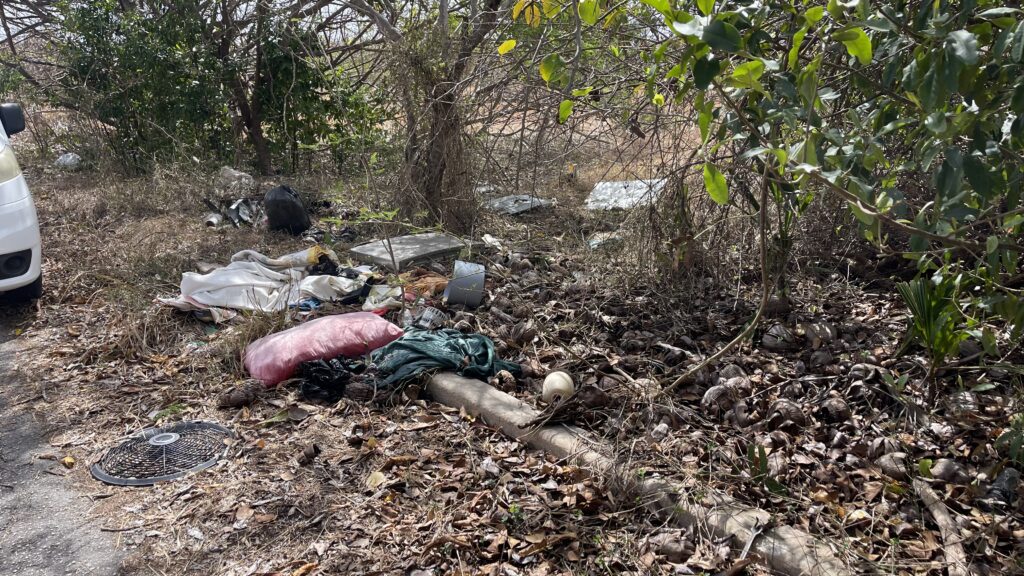
Illegal dumping remains a major problem despite years of anti-dumping campaigns and tougher legislation, as environmental advocates blame weak enforcement and gaps in waste management.
The concerns come as the Caribbean Youth Environment Network (CYEN) revealed that it collected more than 1,800 kilogrammes of waste from each of 18 beaches during its 2023 Barbados International Coastal Cleanup.
On Monday, CYEN Finance Officer Ramon Straughn described the situation as “a bit of a mixed result”.
“When you look at the amount of volunteers that CYEN has assisting with these clean-ups year in year out, you understand that persons, at least the young persons, understand the risk,” he said. “But when you look at the sheer numbers of waste that we see and collect, then it tells a different story.”
He pointed to findings from the Barbados International Coastal Cleanup (BICC) 2023 report.
“For example, the Barbados International Coastal Cleanup 2023 report, we collected over 1 800 kg of waste from 18 beaches,” he said.
According to information published on CYEN’s website, more than 400 participants, some as young as five years old, removed 1 828.03 kilogrammes+ of marine debris from 18 beaches between September 16 and October 22, 2023. Among the unusual items recovered were a car bumper, gas bottle, toilet seat, tongue depressor, car jack and hair extensions.
The top items collected included plastic and foam pieces, plastic bottle caps, plastic beverage bottles, food wrappers and construction material.
Ashley Lashley, founder of the Ashley Lashley Foundation, said that while anti-dumping messages are reaching some Barbadians, behaviour has not changed enough.
“I think the message is getting across to some people, but we are still seeing far too many examples of irresponsible waste disposal,” she said.
“Through clean-ups and community engagement activities, we continue to encounter illegally dumped household garbage, old furniture, mattresses, construction debris, tyres, appliances and large volumes of single-use plastics in gullies, coastal areas and vacant lots. These are not items that accidentally end up in the environment; they are deliberately dumped.”
She added: “What concerns me most is that many of these issues persist despite years of public awareness campaigns. While there has been progress in some areas, the continued presence of these types of waste suggests that awareness alone is not enough to change behaviour. We need a stronger culture of environmental responsibility.”
Although reusable shopping bags and paper straws have become more common, the environmental advocates suggested that significant amounts of plastic and other waste continue to be found during clean-ups.
One factor that may be contributing to the problem is frustration over waste collection, Straughn said.
“One of the things that was mentioned was that in residential areas garbage was piling up. The Sanitation Service Authority would often not be around to collect the garbage sometimes for weeks and the garbage piles up.
“So you have to wonder if there is a lack of faith there. Persons might be saying to themselves, if my garbage at my home is not being collected, when I have something to dump, does it make sense for me to then call the Sanitation Service Authority?”
He also questioned whether existing laws are being adequately enforced: “We’re seeing illegal dumping, but I’m not seeing evidence of any enforcement being done in that regard.”
Lashley agreed that stronger action is needed.
“We need a combination of stronger enforcement, greater public education and more accessible disposal options.
“If people have old appliances, tyres, furniture or construction waste, there should be clear and convenient pathways for proper disposal. At the same time, there must be consequences for illegal dumping.”
Communities also have a role to play: “When residents, businesses and community groups work together to monitor and care for their surroundings, we often see cleaner and more sustainable communities. Ultimately, tackling illegal dumping requires both individual responsibility and systems that make doing the right thing easier than doing the wrong thing.”
The government has repeatedly pledged to crack down on illegal dumping. In 2020, then Minister of the Environment and National Beautification Adrian Forde announced a “zero tolerance” approach, warning that offenders would face the courts. In 2025, Parliament passed the Storm Water Management Act, allowing for fines of up to $20 000 for illegal dumping that obstructs waterways or contributes to pollution.
Even so, environmental groups maintain that without visible enforcement, reliable waste disposal systems and continued public engagement, Barbados may continue fighting an uphill battle against illegal dumping.
(LE)
The post Illegal dumping persists despite awareness campaigns, environmentalists say appeared first on Barbados Today.